Mandibular Condyle
A key anatomical reference when assessing the TMJ region and mandibular movement.
SERVING HEALTHCARE PROFESSIONALS AND COMPANIES
My Cart:
0item(s)0

Login Form
Registration
Profile Informations
Login Datas
or login
Explore the anatomical landmarks, treatment-area considerations, and safety principles practitioners should evaluate when planning botulinum toxin treatment for TMJ-related symptoms.

There is no single Botox injection point that represents the TMJ for every patient
“TMJ Botox” is often used as shorthand for botulinum toxin treatment of selected temporomandibular-disorder presentations. Site selection should follow the diagnosed source of symptoms and the structures involved—not the search term alone.
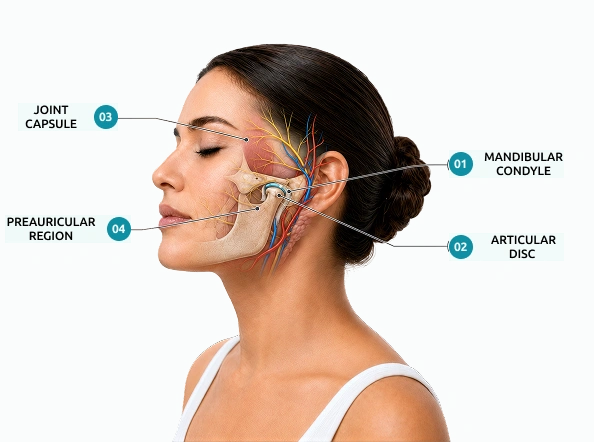
Pain near the joint does not automatically identify the structure responsible for symptoms. The temporomandibular joint is a small but mechanically complex region connecting the mandible to the temporal bone. Practitioners should understand joint surfaces, articular structures, mandibular movement, and surrounding anatomy before considering any treatment target.
A key anatomical reference when assessing the TMJ region and mandibular movement.
Important when differentiating intra-articular disorders from muscular sources of pain.
Pain around the joint line should not automatically be treated as a muscular hyperactivity problem.
Use as an anatomical orientation area rather than a universal Botox injection point.
Mandibular range of motion provides useful functional context during TMD assessment
Commonly cited adult reference range for maximum mouth opening.
Measure mandibular excursion toward the patient's right side.
Compare with the opposite side and note meaningful asymmetry.
Measure anterior translation of the mandible from the reference position.
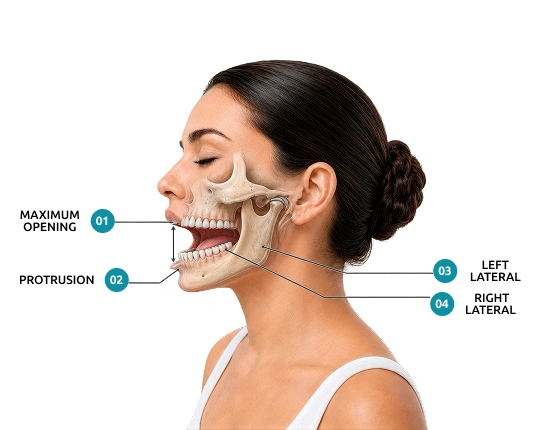
For TMJ, injection planning should be based on the identified therapeutic target rather than a universal point over the joint.
Published protocols vary substantially, and the evidence is more developed for selected muscular presentations than for disorders arising primarily from the joint itself. That makes patient-specific assessment central to responsible planning.
Differentiate predominantly joint-related, muscle-related, mixed, and unclear presentations.
Only after assessment should the practitioner determine whether botulinum toxin is relevant to the identified clinical problem.
Jaw pain, clicking, limited opening, facial pain and clenching can arise through different mechanisms.
Mandibular range of motion provides useful functional context during TMD assessment
Orient to the preauricular region and relevant skeletal landmarks.
Assess opening, closing, lateral excursion and protrusion.
Determine whether movement reproduces familiar pain or dysfunction.
Combine history, movement findings and other clinical information.
Orient to the preauricular region and relevant skeletal landmarks.
Assess opening, closing and functional movement.
Consider joint sounds, tenderness and mechanical symptoms.
Determine whether muscular hyperactivity appears clinically relevant.
Review response to prior conservative or interventional care.
Review contraindications, product information and applicable professional requirements.
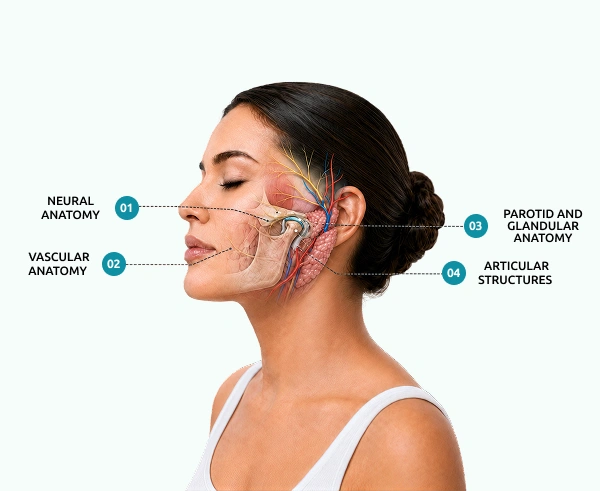
Working around the TMJ requires understanding more than the joint itself.
Understand regional sensory and motor structures.
Account for vascular structures within the preauricular and deep facial region.
Understand spatial relationships around the posterior mandibular region.
Do not automatically treat intra-articular pain as muscular hyperactivity.
TMJ / TMD-focused planning
Begins with the clinical source of pain or dysfunction and asks whether botulinum toxin is relevant to the identified therapeutic target.
Masseter Botox
Targets the masseter for functional and/or aesthetic objectives.
Original manufacturer product, bought inside the EU where the price is lower, and shipped to your clinic cold chain intact. No compromise on what goes in the syringe, only on what you pay for it.
Prescription products. Supplied to verified medical professionals only. Account approval takes about one working day.
Manufacturer originals with batch numbers and full documentation.
Live inventory on the brands you use. No back-orders.
Validated packaging and temperature logs, warehouse to door.