Login Form
Registration
Profile Informations
Login Datas
or login
How Many Units of Botox for Forehead Wrinkles?
A clinical guide to forehead dosing, frontalis muscle anatomy, patient assessment and safe, predictable aesthetic results.
- Also known as Forehead lines, horizontal forehead lines
- Muscles involved Frontalis
- FDA status FDA-approved
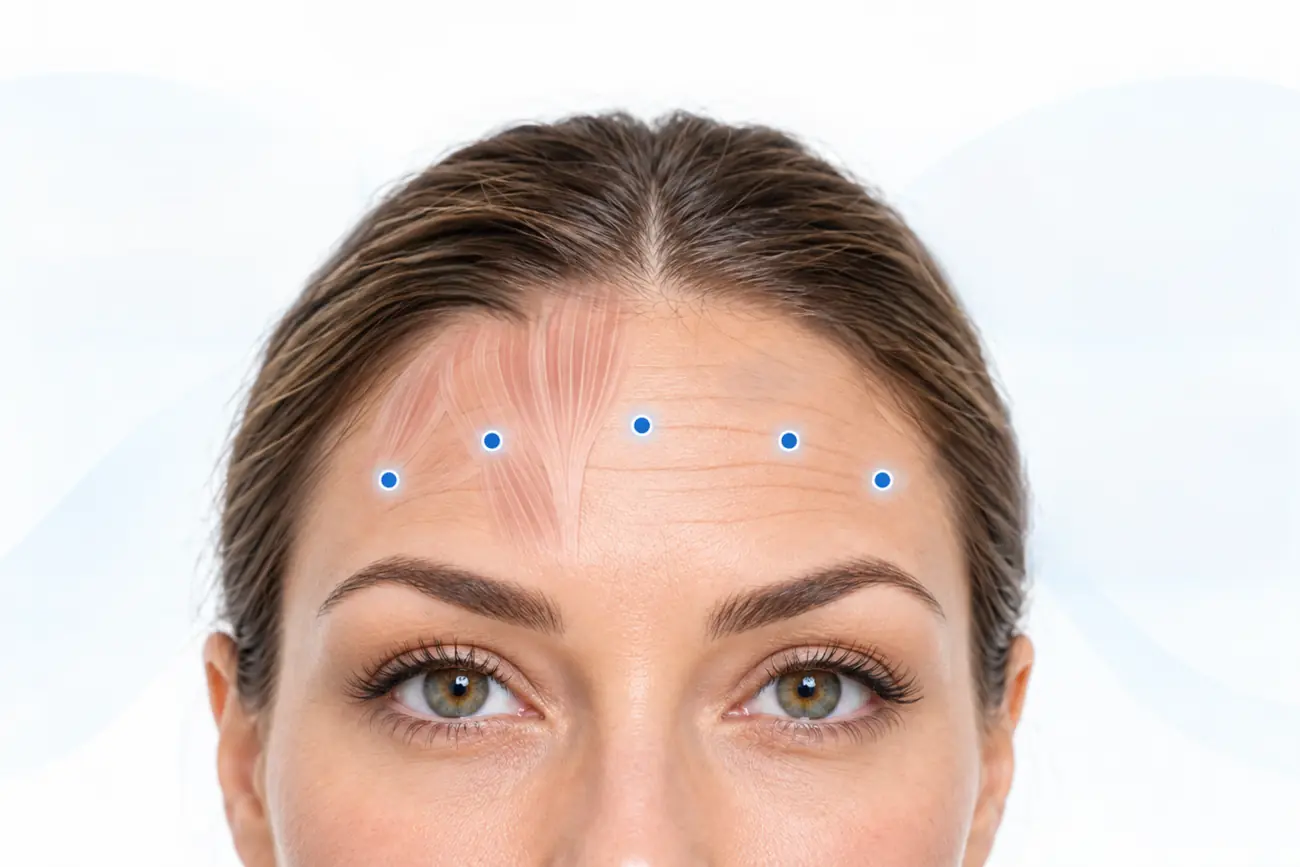
Forehead Botox treatment requires a thorough understanding of frontalis anatomy, facial dynamics and product-specific dosing. For aesthetic practitioners, effective wrinkle reduction and preservation of natural expression depend on careful assessment and precise treatment planning. This guide examines forehead Botox units, clinical considerations and expected outcomes.
How Many Units of Botox Are Recommended for the Forehead?
The FDA-recommended dose of BOTOX Cosmetic (onabotulinumtoxinA) for moderate to severe horizontal forehead lines is 20 units, administered across five injection sites in the frontalis muscle.
Under the approved protocol, each injection site receives four units. The forehead component is administered in conjunction with 20 units in the glabellar complex, resulting in a combined treatment dose of 40 units. Concurrent treatment is recommended to minimize the potential for brow ptosis.
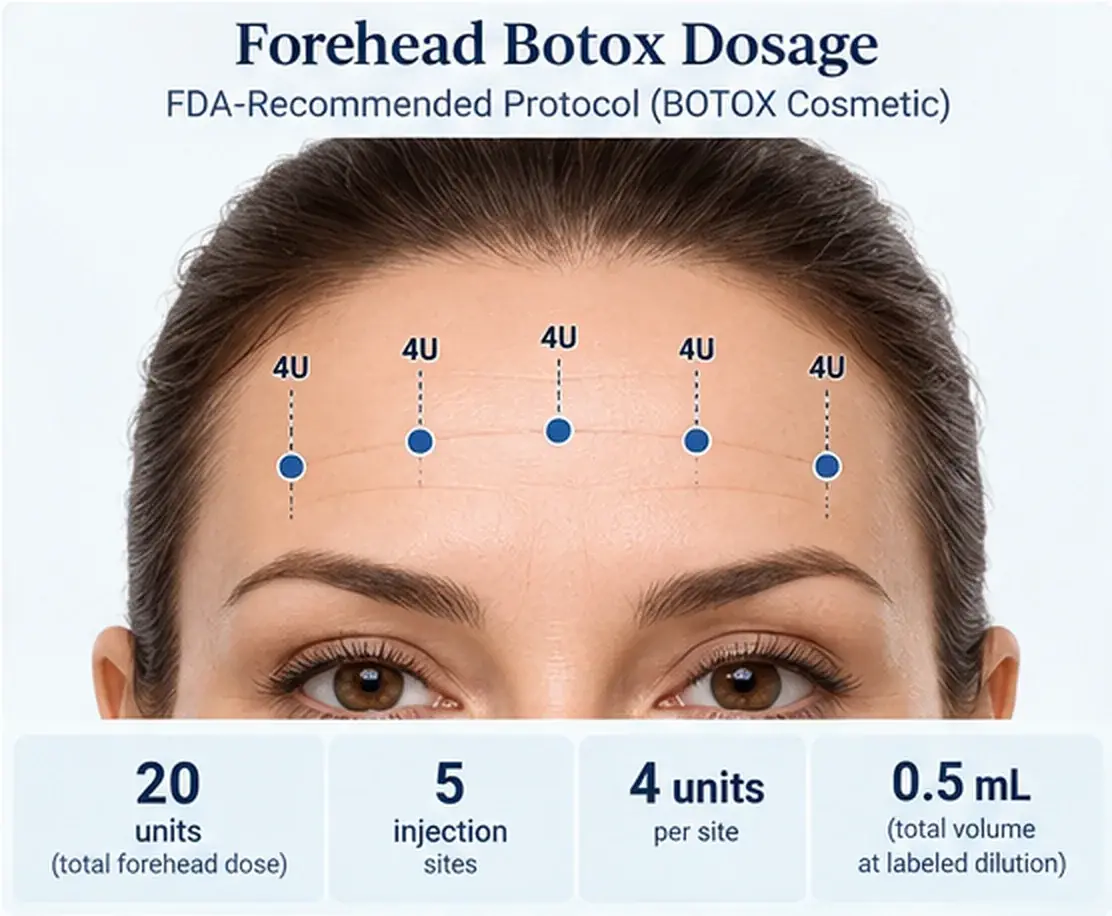
Forehead Botox Dosage at a Glance
| Treatment consideration | BOTOX Cosmetic recommendation |
|---|---|
| Target muscle | Frontalis |
| Recommended forehead dose | 20 units |
| Number of forehead injection sites | 5 |
| Dose per site | 4 units |
| Total injection volume in forehead | 0.5 mL at labeled dilution |
| Primary indication | Moderate to severe horizontal forehead lines |
| Typical duration of results | Approximately 3–4 months |
| Recommended reassessment | Around 14 days |
Professional aesthetic supplies
Explore professional botulinum toxin products
Compare formulations, specifications and product availability for your practice.
Forehead Wrinkle Severity and Treatment Planning
The severity of horizontal forehead wrinkles is an important consideration during consultation, but it should not be used as the sole determinant of dosage.
Practitioners must distinguish between dynamic rhytids, which develop during frontalis contraction, and static rhytids, which remain visible when the forehead is relaxed.
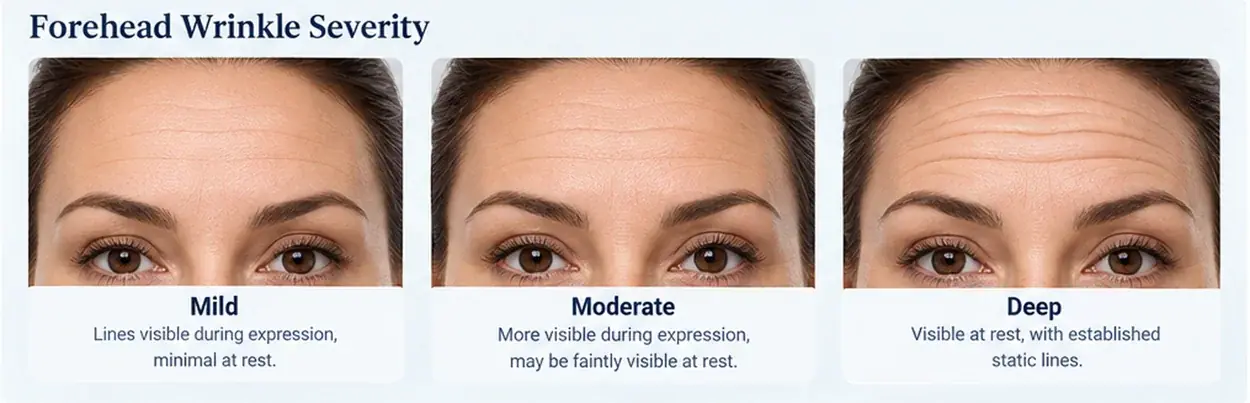
Mild Forehead Wrinkles
Mild forehead rhytids typically become visible during eyebrow elevation and may disappear almost completely at rest. For patients presenting with early dynamic lines, treatment planning should prioritize the degree and distribution of frontalis activity, baseline brow position, and desired preservation of movement.
Although individualized lower-dose approaches may be used off-label in selected patients, no standardized reduced-dose regimen has been established for mild forehead wrinkles. Practitioners should consider that lower dosing does not necessarily eliminate the risk of brow heaviness or guarantee a more natural result.
Moderate Forehead Wrinkles
Moderate forehead wrinkles are generally more pronounced during active frontalis contraction and may remain faintly visible at rest. Before treatment, practitioners should evaluate frontalis strength, contraction symmetry, forehead dimensions, and the contribution of muscle activity to visible wrinkle formation. Patients with moderate dynamic lines may respond well to neuromodulation, although the degree of improvement varies according to baseline anatomy and skin quality.
Deep Forehead Wrinkles
Deep forehead rhytids may remain visible even in the absence of active frontalis contraction. These static wrinkles result from repeated muscle activity combined with structural changes in the skin, including reduced elasticity and dermal remodeling. Botulinum toxin can reduce the muscular contribution to wrinkle formation, but complete correction of established static lines should not be expected. Practitioners should distinguish between insufficient neuromodulation and persistent structural wrinkles before considering any treatment adjustments.
What Factors Determine Forehead Botox Dosage?
Anatomical variation and individual muscle dynamics can significantly influence the clinical response to botulinum toxin. Patient-specific assessment should evaluate the muscle, brow support and wrinkle characteristics—not simply forehead size or the depth of a single crease.
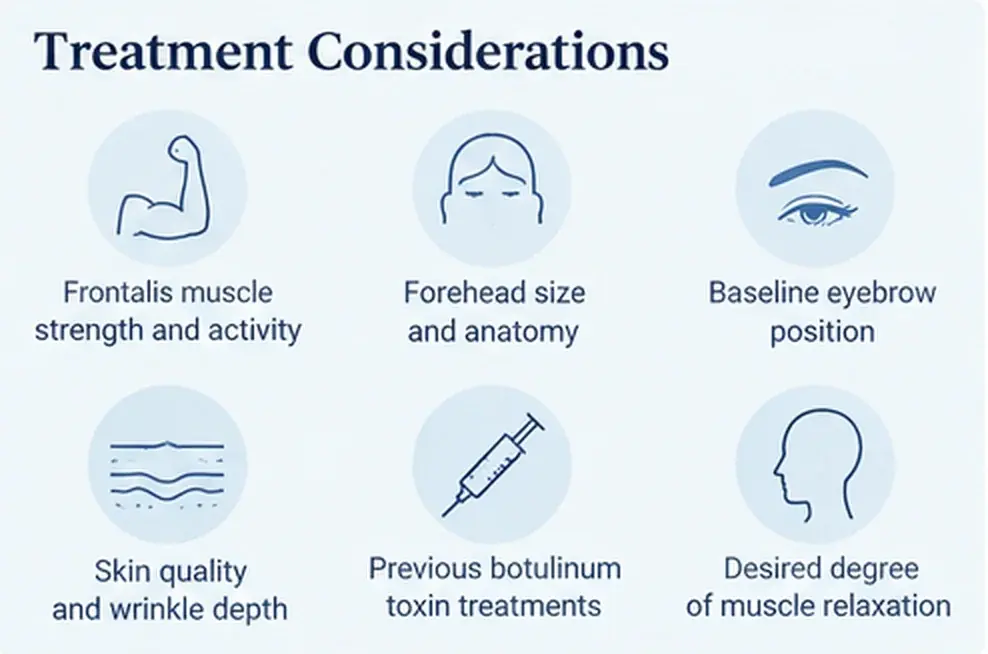
1. Frontalis Muscle Strength and Activity
The frontalis is the primary elevator of the eyebrows and is responsible for forming horizontal forehead wrinkles during contraction.
Patients with strong frontalis activity may exhibit more prominent dynamic rhytids. However, increased muscle strength does not automatically justify higher dosing. Practitioners should assess the distribution, intensity, and symmetry of frontalis contraction at rest and during maximal eyebrow elevation.
2. Forehead Size and Anatomy
Forehead height and width influence the distribution of the frontalis muscle and the location of active contraction zones.
A broad forehead does not automatically require a greater number of Botox units, nor does a smaller forehead necessarily require fewer. Treatment planning should consider the relationship between forehead dimensions, frontalis activity, and surrounding muscular structures.
3. Baseline Eyebrow Position and Compensatory Activity
The frontalis plays an important role in maintaining eyebrow elevation.
Some patients demonstrate persistent frontalis activation at rest as a compensatory mechanism for low brow position or upper facial tissue changes. Weakening the frontalis in these individuals can alter brow position and create an undesirable heavy-brow appearance.
Practitioners should assess resting brow position, eyebrow symmetry, and compensatory muscle activity before determining treatment suitability.
4. Skin Quality and Wrinkle Depth
Skin elasticity, dermal thickness, and the presence of static rhytids influence the visible response to botulinum toxin.
Patients with predominantly dynamic wrinkles may experience more pronounced smoothing than those with deep static creases. Higher doses should not be used simply to compensate for structural skin changes that cannot be fully addressed through muscle relaxation.
5. Previous Botulinum Toxin Treatments
A documented treatment history can provide useful information about individual responsiveness to botulinum toxin. Relevant considerations include the product previously administered, total dose, duration of effect, treatment interval, and any adverse outcomes. Previous treatment records should inform clinical decision-making without replacing a current anatomical assessment.
6. Desired Degree of Muscle Relaxation
Aesthetic treatment objectives differ between patients. Some patients prefer substantial reduction in forehead movement, while others prioritize retaining more dynamic facial expression. Practitioners should establish realistic expectations and explain that reducing dose or altering treatment distribution may affect both wrinkle improvement and the risk of undesirable muscle imbalance.
Is 10, 20, 30 or 40 Units Appropriate for the Forehead?
The numbers below describe units placed directly in the frontalis, not the overall dose that may be used in a multi-area treatment. The FDA-labeled forehead amount is 20 units of BOTOX Cosmetic.
10 units
Below the labeled dose
May be considered only as an individualized, off-label approach. It is not an established universal treatment for mild lines.
20 units
FDA-labeled forehead dose
Five frontalis sites at four units each, as part of the approved treatment protocol.
30 units
Above the labeled dose
More units do not automatically produce better outcomes; greater muscle weakness is a concern.
40 units
Not a forehead-only standard
The labeled combined 40-unit protocol does not mean 40 units should be placed into the frontalis.
For BOTOX Cosmetic, 40 units refers to the combined forehead-plus-glabellar protocol (20 + 20), not a 40-unit frontalis dose. Product labeling and patient-specific safety assessment govern treatment.
Practitioner reading: understand differences between botulinum toxin brands →
Where Is Botox Injected in the Forehead?
Botulinum toxin treatment for horizontal forehead lines targets the frontalis muscle, a broad superficial muscle responsible for elevating the eyebrows and producing transverse forehead rhytids.
The FDA-approved BOTOX Cosmetic protocol specifies five frontalis injection sites, with four units administered per site. The labeled injection pattern is based on the distribution of frontalis activity and the relationship between forehead dimensions and eyebrow position.
Frontalis Muscle Anatomy
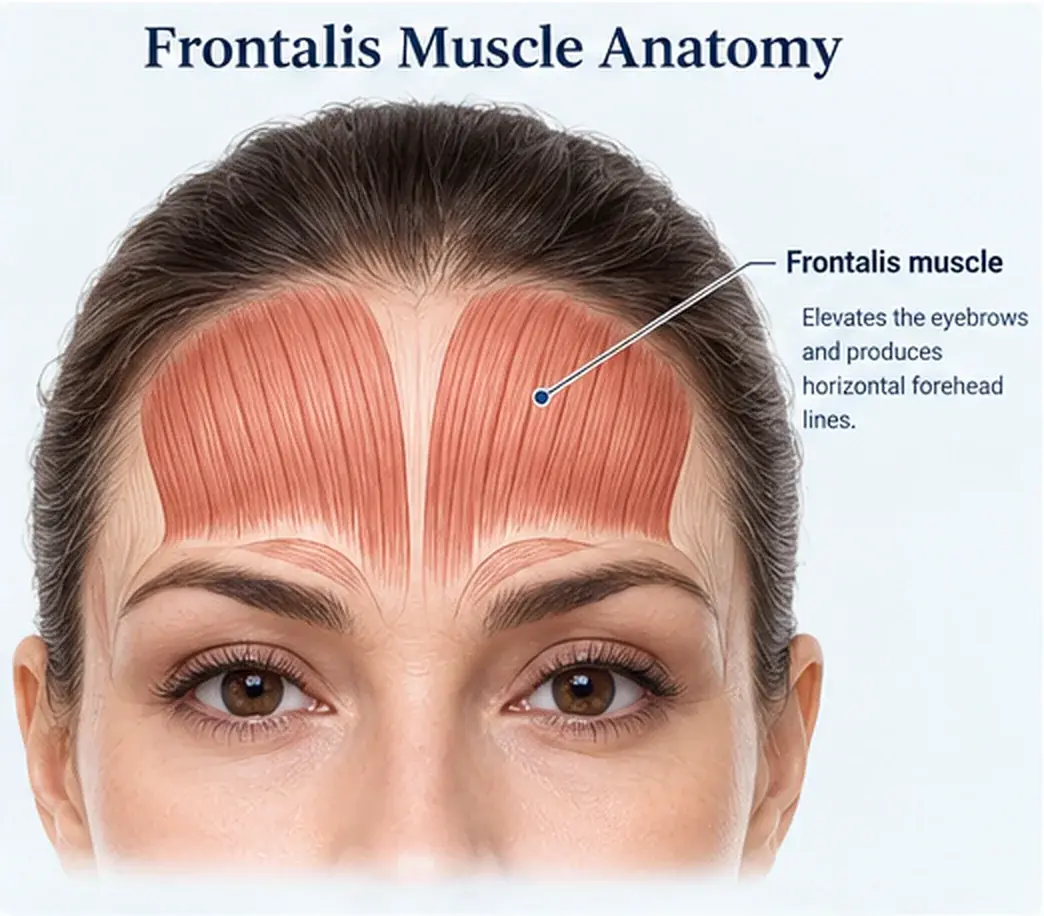
The frontalis is part of the occipitofrontalis muscle complex and contributes to eyebrow elevation and forehead expression. Unlike many facial muscles, the frontalis does not act primarily across a conventional joint. Instead, its contraction moves the soft tissues of the forehead and eyebrows. Its activity varies between individuals and may be asymmetrical.
Understanding the patient's contraction pattern is important for anticipating the effects of neuromodulation and maintaining appropriate facial balance.
Forehead Injection Site Considerations
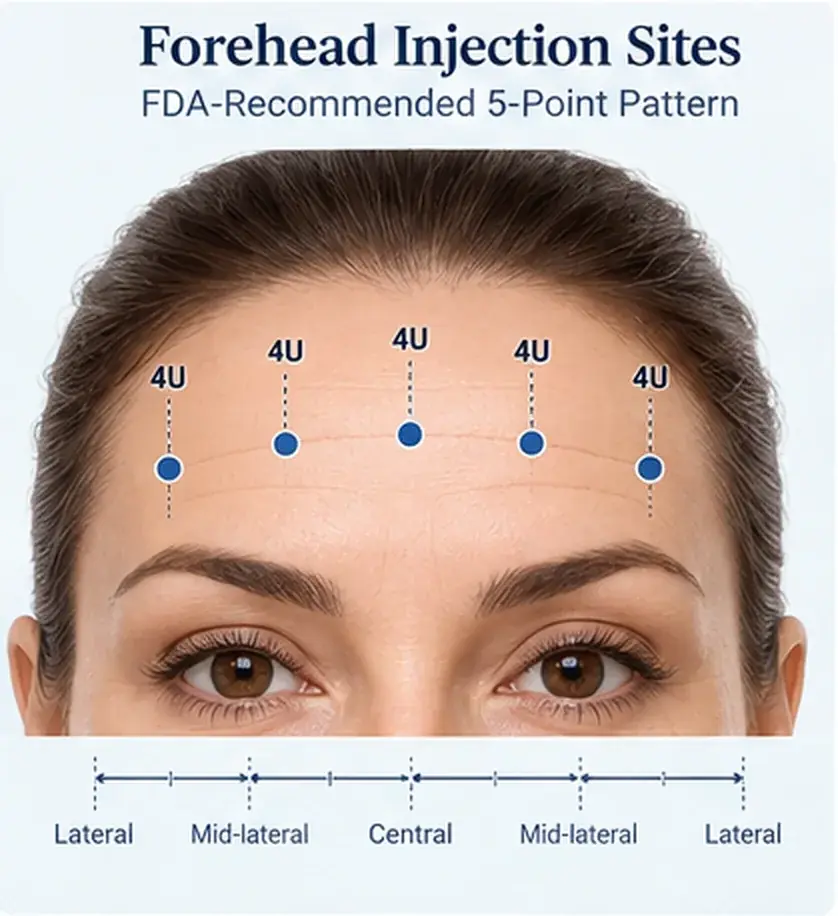
When planning treatment, practitioners should evaluate:
- Frontalis contraction patterns: Identify the regions demonstrating active muscle movement during eyebrow elevation.
- Forehead dimensions: Assess the relationship between forehead height, muscle activity, and anatomical landmarks.
- Eyebrow position: Consider baseline brow elevation and the possibility of compensatory frontalis activity.
- Facial symmetry: Document pre-existing asymmetry that may influence treatment response.
- Previous treatment effects: Review any history of brow heaviness, excessive relaxation, or asymmetrical movement.
Precise injection placement is essential because inappropriate treatment distribution can result in excessive weakening of the frontalis or undesirable changes in eyebrow position.
When Do Results Appear—and How Long Do They Last?
Botulinum toxin produces progressive muscle relaxation rather than immediate smoothing. Early effects may be visible after several days, with a fuller assessment often undertaken at approximately 14 days.
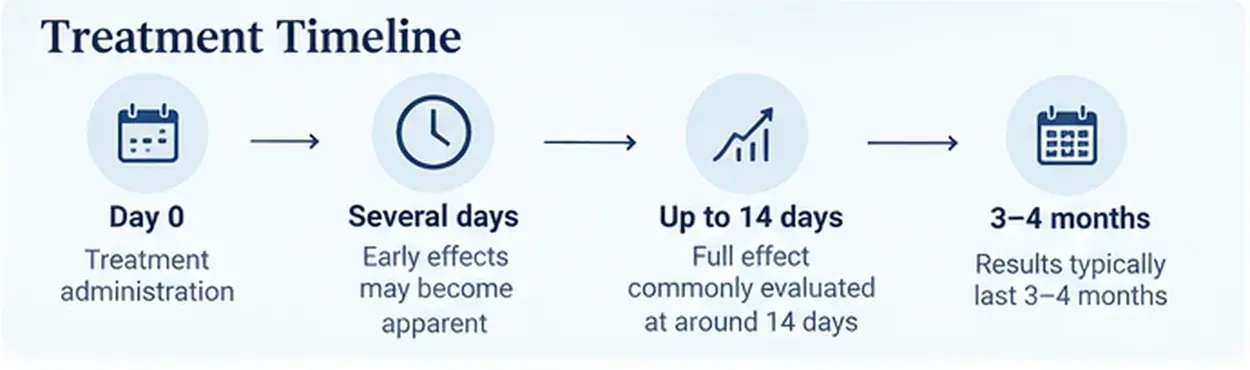
Forehead improvements commonly last about three to four months, though duration varies with the product and individual response.
What Happens If Too Much Botox Is Injected Into the Forehead?
Excessive weakening of the frontalis muscle can compromise eyebrow elevation and alter normal forehead movement.
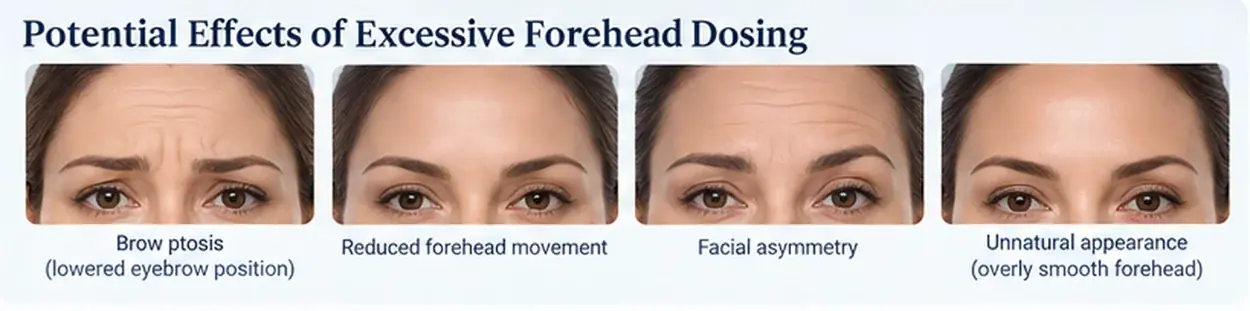
Potential complications include:
- Brow ptosis: Reduced frontalis activity may lower eyebrow position and produce a heavy-brow appearance.
- Excessive muscle relaxation: Overcorrection can substantially restrict normal forehead movement.
- Facial asymmetry: Uneven muscular weakening may lead to differences in eyebrow elevation or forehead expression.
- Unnatural aesthetic results: Excessive neuromodulation may produce an overly static or disproportionate forehead appearance.
- Injection-related adverse effects: Temporary headache, bruising, swelling, or localized discomfort may occur.
The likelihood of complications depends on multiple factors, including patient anatomy, dose, injection distribution, and technique. Patients with pre-existing compensatory frontalis activity or low baseline eyebrow position may require particular caution.
Are Forehead Botox Units the Same Across Different Brands?
No. Botulinum toxin units are specific to the product's potency assay and cannot be directly exchanged among BOTOX Cosmetic, Dysport, Xeomin or other formulations. Practitioners should evaluate dosing, approved indications and handling requirements from each product's prescribing information.
Practitioner guide
Not all botulinum toxin units are equivalent.
Review formulation differences and product-specific dosing considerations before selecting a neuromodulator for your clinic.
Choosing the Right Botulinum Toxin for Forehead Treatments
Effective forehead rejuvenation requires appropriate product selection, detailed anatomical knowledge, and a patient-specific treatment strategy. Practitioners should assess the formulation's approved indications, dosing recommendations, onset characteristics, duration of effect, storage requirements, and preparation instructions.
All products should be selected and administered in accordance with applicable regulations and professional prescribing requirements.
Explore Botox Units by Treatment Area
Hover over an area to see its typical units, then click to open the full guide.
Tap an area on the face or in the list to see its typical units, then tap “View guide”.

-
Forehead 20 units
Choosing a Botulinum Toxin Product for Your Practice
Product selection should account for approved indications, clinician familiarity, labeling, availability, storage and preparation requirements. Treatment choice must remain grounded in professional authorization and product-specific evidence.
Activa Derma · For healthcare professionals
Professional botulinum toxin products, in one place
Explore available brands, product specifications and aesthetic supplies for your practice.
Frequently Asked Questions About Forehead Botox Units
The FDA-recommended dose of BOTOX Cosmetic for horizontal forehead lines is 20 units, distributed across five frontalis injection sites. The labeled protocol includes concurrent glabellar treatment to minimize brow ptosis.
There is no standardized higher dose specifically for deep static forehead wrinkles. The FDA-labeled frontalis dose is 20 units. Deep static rhytids may remain visible after successful neuromodulation and should not automatically prompt increased dosing.
First-time patients require comprehensive anatomical and clinical assessment. The labeled BOTOX Cosmetic frontalis dose is 20 units within the approved combined treatment protocol, but individual suitability and treatment risks must be evaluated.
The FDA-approved BOTOX Cosmetic protocol specifies five injection sites within the frontalis muscle, with four units administered at each site.
Forehead dimensions can influence treatment planning, but size alone does not determine dosage. Frontalis muscle strength, contraction patterns, eyebrow position, and individual anatomical variation must also be evaluated.
Forehead Botox effects commonly last approximately three to four months, although individual responses vary. Treatment duration can be influenced by muscle activity, biological response, and formulation-specific characteristics.