
Chin filler can add projection, improve balance, or smooth mild asymmetry without surgery, but every product behaves differently.
Knowing how each filler supports the chin, how long it lasts, and when it can be reversed helps providers choose wisely.
Chin Filler at a Glance
|
Question |
Quick Answer |
|
What does chin filler do? |
It can add chin projection, length, width, definition, or mild asymmetry correction. |
|
Is chin filler surgical? |
No. It uses dermal filler injections instead of incisions, an implant, or bone surgery. |
|
When are results visible? |
Added volume appears immediately, but the clearest result develops after initial swelling subsides. |
|
How long does chin filler last? |
Many HA results remain visible around 12 to 18 months, depending on the exact product. |
|
Can it be dissolved? |
HA filler may be reduced with hyaluronidase; CaHA and PLLA lack a direct dissolving enzyme. |
|
Is downtime required? |
Most patients resume routine activity immediately, although bruising, tenderness, and swelling can last several days. |
|
Who should administer it? |
An appropriately licensed provider trained in facial anatomy, filler injection, and urgent complication management. |
What Can Chin Filler Do?
Chin fillers offer several ways to reshape the lower face without changing its underlying bone. Still, the result depends on facial structure, soft tissue, muscle pull, dental support, and skin laxity.
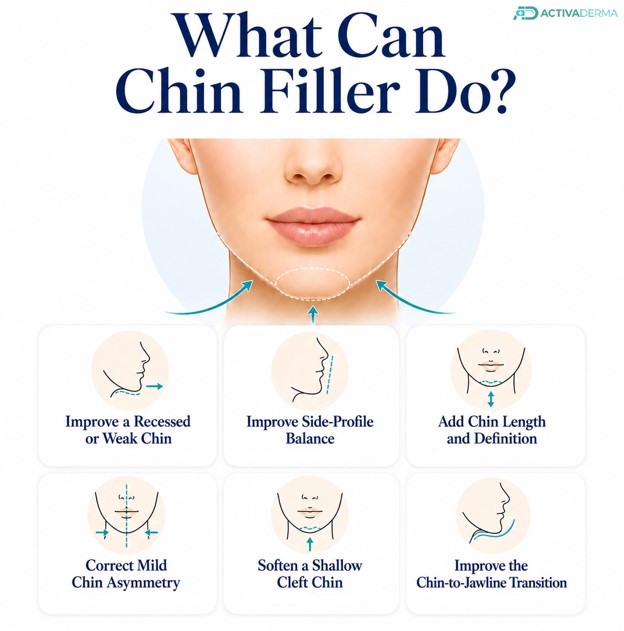
Improve a Recessed or Weak Chin
A structural hyaluronic acid filler can bring a recessed chin forward and create improved chin projection. Mild retrusion responds better than a major skeletal imbalance, which may need surgical chin augmentation.
Improve Side-Profile Balance
Adding projection can make a strong nose appear less dominant without treating the nose itself. This shift may create improved facial harmony and better overall facial balance across nearby facial features.
Add Chin Length and Definition
Careful augmentation can lengthen a short chin or create a more defined chin area. The provider must control width as well, since excess lateral volume can make the lower face appear heavy.
Correct Mild Chin Asymmetry
Chin filler can soften small side-to-side differences by adding volume where support is missing. Marked asymmetry may come from bone, bite, trauma, or muscle activity and needs broader assessment.
Soften the Appearance of a Cleft Chin
Filler may soften a shallow cleft chin or butt chin by supporting the central depression. Deep chin dimpling driven by mentalis movement may need a different or combined cosmetic treatment.
Improve the Transition Between the Chin and Jawline
Supporting the pre-jowl area can create a smoother transition from chin to jawline. This approach improves facial contouring, but it cannot remove jowls or tighten loose skin.
What Chin Filler Cannot Fix
The most useful consultation may end with no chin filler injection at all. Adding more volume can worsen heaviness when the real concern sits in fat, skin, muscle, or bone.
So, don’t expect it to work for:
-
A double chin: Filler cannot remove submental fat and may add unwanted bulk to an already full lower face.
-
Major skeletal retrusion or bite problems: Significant imbalance may need orthodontic review, a chin implant, genioplasty, or orthognathic care.
-
Loose skin and larger jowls: Volume alone cannot tighten lax tissue, and may blur the jawline further.
-
Strong dynamic chin dimpling: Filler provides support, while muscle-led dimpling may require another clinical approach.
-
A complete facial transformation: Chin enhancement changes proportions, but it cannot rebuild every feature or guarantee an ideal chin.
Types of Chin Filler
The longest-lasting syringe is rarely the smartest default. A useful filler type must provide enough support while fitting the treatment goal, risk plan, and patient’s preference for reversibility.
Hyaluronic Acid Chin Fillers
HA fillers are the most adjustable chin filler option because they give immediate structure and may be dissolved.
Cross-linked hyaluronic acid gels vary in firmness, flexibility, cohesivity, and water uptake. The FDA estimates general HA results often last 6 to 12 months, but product-specific chin trials provide more useful estimates. The FDA pivotal study for Restylane Defyne found that 73.7% of treated patients maintained at least one-grade improvement through week 48.
Calcium Hydroxylapatite Fillers
Calcium hydroxylapatite filler provides firm support through CaHA microspheres suspended in a carrier gel.
The FDA gives this material an approximate duration of 18 months, although that is not a chin-specific guarantee.
CaHA cannot be dissolved with hyaluronidase, so product choice and conservative correction matter more.
Collagen-Stimulating Fillers
PLLA fillers work gradually by encouraging collagen production instead of creating a final contour immediately.
Results may last up to two years, but several sessions are commonly required.
They are less useful for precise, reversible chin projection and may be considered for broader deep facial volume loss.
Popular Chin Filler Products Compared
Clinicians should compare exact products, since one familiar brand may contain several gels with different indications.
|
Product |
Material and support |
Common objective |
Expected longevity |
Dissolvable |
Regulatory or indication note |
|
20 mg/mL HA; firm structural gel |
Projection and chin profile |
12-month U.S. chin data; EC listing says up to 18 months |
Yes |
Voluma XC is FDA approved for chin augmentation in adults over 21; linked pack is EC origin |
|
|
25 mg/mL HA; high-density support |
Chin and jawline contouring |
EC listing says 18 to 24 months |
Yes |
Linked product is internationally marketed; U.S. Volux XC approval covers jawline definition |
|
|
20 mg/mL flexible HA |
Chin retrusion and nasolabial folds |
Effects observed through 48 weeks |
Yes |
FDA approved for the chin region in adults over 21 |
|
|
Firm NASHA hyaluronic acid |
Chin projection and deep facial support |
Most patients remained improved through 12 months |
Yes |
FDA approved in 2025 for mild to moderate chin retrusion in adults over 21 |
|
|
CaHA; high structural support |
Lower-face contour and pre-jowl support |
Approximately 12 to 18 months |
No |
No specific FDA chin indication; linked pack is EC origin |
|
|
Cohesive HA; deep volumizing support |
Chin projection and facial contours |
EC listing says up to 12 months |
Yes |
EC-origin product; verify local authorization and instructions |
|
|
25 mg/mL HA; volumizing gel |
Chin, cheek, and contour support |
Check current local instructions |
Yes |
EC-origin product without a U.S. chin approval |
|
|
26 mg/mL PEG-cross-linked HA |
Chin and jawline definition |
Listing says up to 15 months |
Yes |
EC-origin product; approved uses differ by market |
Regulatory status belongs to the exact device, packaging, and indication. Providers should check local rules and current instructions before ordering any injectable dermal filler.
Chin Filler vs. Jawline Filler
These dermal filler treatments often share one appointment, yet they solve different shape problems.
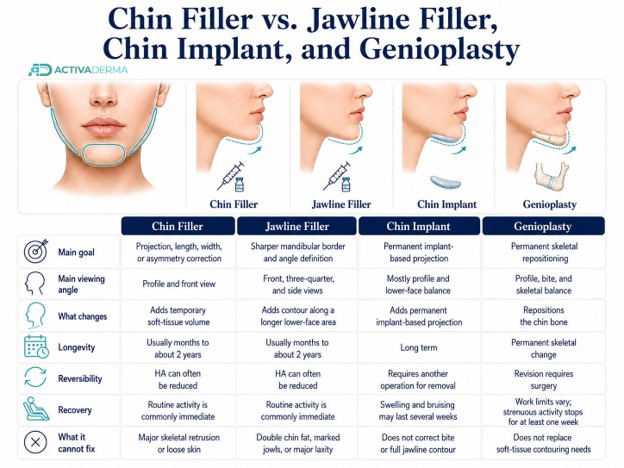
Chin filler changes the central anchor of the face, while jawline contouring builds definition along the mandibular border.
|
Chin Filler |
Jawline Filler |
|
|
Main goal |
Projection, length, width, or asymmetry correction |
Sharper mandibular border and angle definition |
|
Main viewing angle |
Profile and front view |
Front, three-quarter, and side views |
|
Typical product need |
Often concentrated centrally |
Usually spread across a longer treatment area |
|
What it cannot fix |
Major skeletal retrusion or loose skin |
Double chin fat, marked jowls, or major laxity |
Chin Filler vs. Chin Implant and Genioplasty
Filler can preview a new facial profile before someone commits to surgical facial contouring. Unlike many surgical cosmetic procedures, injectable dermal fillers provide temporary change without an incision.
|
Option |
What changes |
Longevity |
Reversibility |
Recovery |
|
Chin filler |
Adds temporary soft-tissue volume |
Usually months to about two years |
HA can often be reduced |
Routine activity is commonly immediate |
|
Surgical chin implant |
Adds permanent implant-based projection |
Long term |
Requires another operation for removal |
Swelling and bruising may last several weeks |
|
Sliding genioplasty |
Repositions the patient’s chin bone |
Permanent skeletal change |
Revision requires surgery |
Work limits vary; strenuous activity stops for at least one week |
What Happens During a Chin Filler Treatment?
The appointment usually moves from facial assessment to treatment and an immediate safety check. A responsible plan should compare the face at rest, in profile, and during movement.
|
Stage |
What Usually Happens |
|
Consultation and facial assessment |
The provider reviews medical history, prior fillers, bite, skin laxity, chin profile, lower lip support, and standardized photographs. |
|
During treatment |
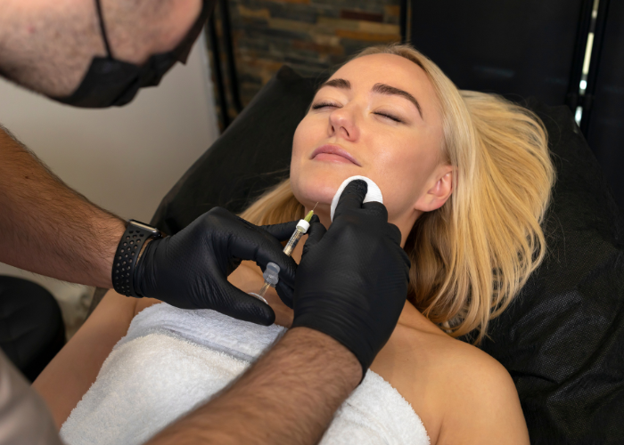
After antiseptic preparation, topical numbing cream may be used; many chin fillers also contain lidocaine. |
|
Immediately after treatment |
The provider checks color, capillary refill, symmetry, movement, discomfort, and the early filler result before discharge. |
How Long Does Chin Filler Last?
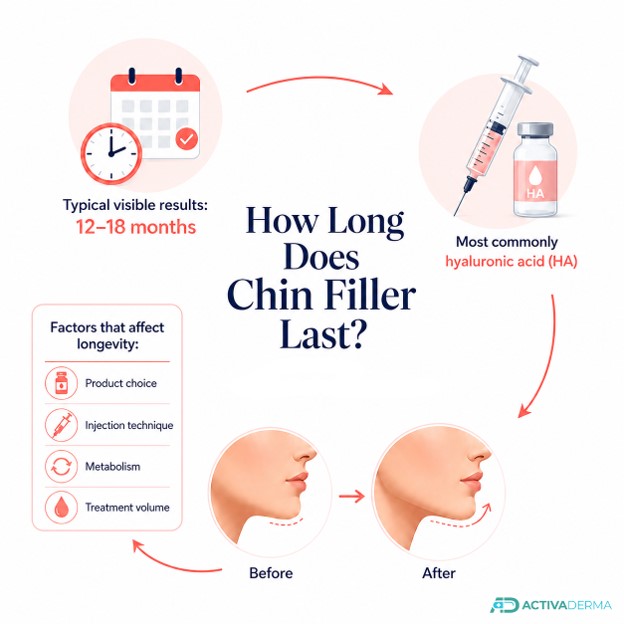
Chin filler commonly lasts about 12 to 18 months, but product-specific evidence gives the better answer.
In one U.S. trial, 73.7% of Restylane Defyne patients still showed improvement at week 48.
Gel structure, injection volume, metabolism, chin movement, and maintenance all affect longevity.
How Much Does Chin Filler Cost?
The average U.S. cost for HA dermal fillers is $715, although this is not a fixed syringe price. Product choice, provider credentials, location, treatment complexity, and maintenance frequency change the quote.
Combined chin and jawline contouring generally costs more because it often needs additional volume.
Chin Filler Recovery and Aftercare
Most patients return to normal tasks immediately, although tenderness, firmness, bruising, and swelling are expected side effects.
Initial swelling may distort the face for several days, so filler results need time before final judgment. We also advise avoiding strenuous exercise and extensive heat or sun exposure for 24 hours to minimize swelling and redness.
Patients should avoid pressing, massaging, or sleeping directly on the chin unless their provider gives different aftercare. New severe pain, skin color change, or vision symptoms need urgent contact rather than waiting for a routine review.
Chin Filler Side Effects and Risks
Most reactions are temporary, but every filler injection carries vascular and delayed risks.
- Common temporary side effects: Swelling, bruising, redness, tenderness, itching, firmness, lumps, and temporary asymmetry may follow dermal filler injections.
- Less common complications: Infection, delayed inflammation, nodules, granulomas, migration, prolonged pain, and an unsatisfactory filler result may require treatment.
- Vascular occlusion: Accidental intravascular injection can cause skin necrosis, stroke, or blindness. The FDA calls this the most serious filler risk; unusual pain, blanching, blue-gray skin, or visual change demands urgent action.
Can Chin Filler Migrate?
Yes, chin filler can move beyond the intended chin region, although strong data cannot give one reliable chin-specific rate.
Excess product, shallow placement, repeated filler injections, and pressure may contribute. Swelling, nodules, and residual acid fillers can also mimic migration, so the face needs professional assessment before correction.
Can Chin Filler Be Dissolved?
Hyaluronic acid filler can often be reduced with hyaluronidase, although cosmetic dissolution is an off-label use in America.
Different gels break down at different rates, and repeated sessions may be necessary. Radiesse and collagen-stimulating fillers provide no comparable enzyme reversal.
How to Choose the Best Chin Filler
The right filler should make the plan easier to control, rather than simply promising the longest result. Three questions keep chin augmentation centered on the patient.
- Match the product to the treatment goal: Projection needs firmer support, while mild asymmetry may need smaller, carefully placed correction.
- Compare structure and flexibility: A highly structured gel holds shape, while some movement helps the chin look natural during speech and smiling.
- Balance longevity with reversibility: HA fillers offer an exit route, while CaHA and PLLA demand greater confidence before treatment begins.
Strong chin results begin before the syringe opens, with a product chosen for the exact contour each patient needs.
Explore Activa Derma’s professional dermal fillers to compare flexible gels, structural options, and trusted brands without the usual product hunt.
Once a filler fits the plan, confirm its local approval and authentic packaging before it reaches your treatment room.
Frequently Asked Questions
How long will chin fillers last?
Most chin fillers remain visible for 12 to 18 months, although some structural products may last longer. Metabolism, product, volume, and repeat treatments change that timeline.
Is chin filler a good idea?
It can work well for mild projection, definition, or asymmetry when anatomy and expectations fit. Significant skeletal retrusion, laxity, or bite problems deserve surgical assessment.
How painful is chin filler?
Discomfort is usually brief and manageable with topical numbing or lidocaine-containing filler. In the Voluma chin trial, mean treatment pain measured 1.3 out of 10.
What are the disadvantages of chin fillers?
Results are temporary, maintenance costs continue, and swelling may briefly alter speech or smiling. Rare risks include infection, nodules, vascular occlusion, tissue loss, and blindness.
What’s the best age to get chin filler?
There is no ideal age, although U.S. chin-approved fillers generally start after age 21. Stable anatomy, realistic goals, and the product indication matter more.
Will chin fillers slim my face?
They can make the face appear longer or better balanced by increasing chin projection. They do not remove fat, tighten skin, or treat a double chin.
What is forbidden after fillers?
Avoid strenuous exercise and extensive heat or sun exposure for 24 hours after many filler procedures. Follow the exact aftercare supplied by the treating provider.
What hurts more, chin or lip fillers?
Lip injections often feel more sensitive because the lips contain dense nerve endings. Pain still varies with technique, topical numbing, product, and individual sensitivity.
Can chin fillers migrate?
Yes, migration is possible. Careful product selection, correct depth, conservative volume, and reassessment before repeat treatment reduce avoidable risk.
Why can’t I smile after chin fillers?
Temporary tightness, numbness, swelling, or tenderness can make smiling feel strange for several days. Persistent weakness, worsening pain, or color change needs prompt provider review.