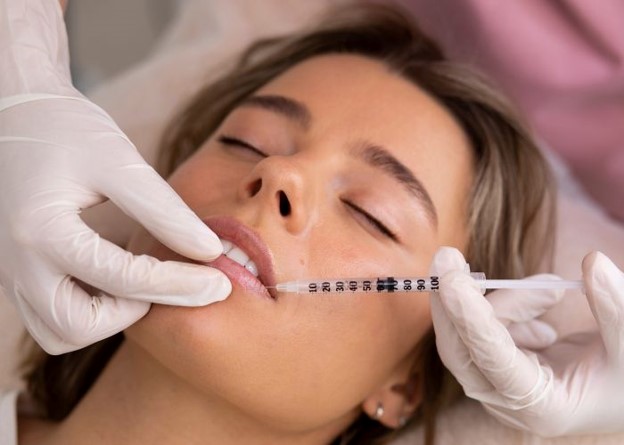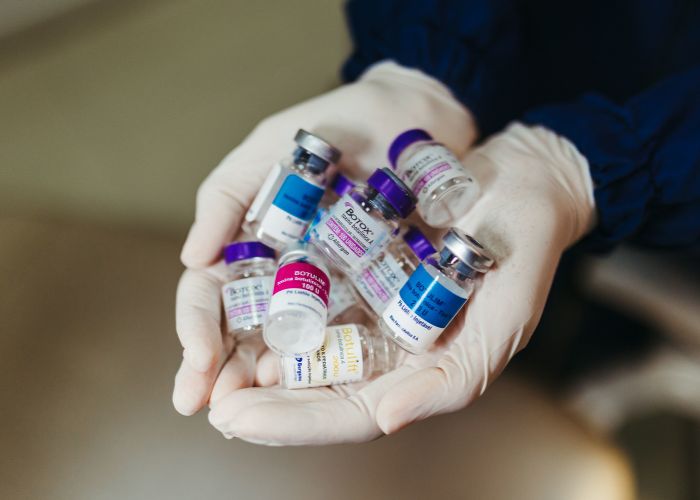

Botulinum toxin is a neurotoxin that temporarily reduces signaling between nerves and selected muscles or glands. It comes from the toxin produced by Clostridium botulinum, then purified and formulated for controlled prescription dosing.
Botox is one branded product, while botulism develops when uncontrolled toxin causes dangerous, widespread nerve blockade.
In 2024, American clinicians performed 9,883,711 neuromodulator procedures, making them the country's leading minimally invasive cosmetic treatment.
Botulinum Toxin at a Glance
|
Main aesthetic toxin type |
Botulinum toxin type A |
|
Main mechanism |
Temporarily blocks acetylcholine release at targeted cholinergic nerve endings |
|
Common aesthetic goal |
Reduce dynamic facial wrinkles caused by repeated muscle contraction |
|
Typical cosmetic duration |
About 3 to 4 months for many established products, with product-specific variation |
|
Is Botox the same thing? |
No. Botox Cosmetic is one brand within the wider botulinum toxin class |
|
Are toxin brands interchangeable? |
No. Formulations, evidence, approved indications, and handling instructions differ |
|
Can units be directly converted? |
No. Every FDA label states that its potency units are product-specific |
|
Who should administer it? |
An appropriately licensed clinician trained in facial anatomy, product handling, complication recognition, and local law |
How Botulinum Toxin Works
Botulinum toxin blocks the nerve signal that tells a targeted muscle to contract. After entering the nerve ending, its light chain cleaves specific SNARE proteins needed for acetylcholine release. The exact target depends on the serotype. Type A toxins cleave SNAP-25, while type B targets a different SNARE protein called synaptobrevin.
The nerve ending remains intact, and muscle movement gradually returns as nerve communication recovers. This is why the clinical effect fades over several months instead of permanently changing the nerve.
Botulinum Toxin vs Botox
Botox is a brand name for onabotulinumtoxinA, one prescription formulation of botulinum toxin type A. Other products, including Dysport, Xeomin, Daxxify, Jeuveau, and Letybo, belong to the same wider drug class.
They all reduce acetylcholine release at targeted nerve endings, which temporarily lowers activity in selected muscles. However, their formulations, potency tests, approved treatment areas, storage requirements, and supporting clinical evidence are product-specific.
What Types of Botulinum Toxin Are Used Clinically?
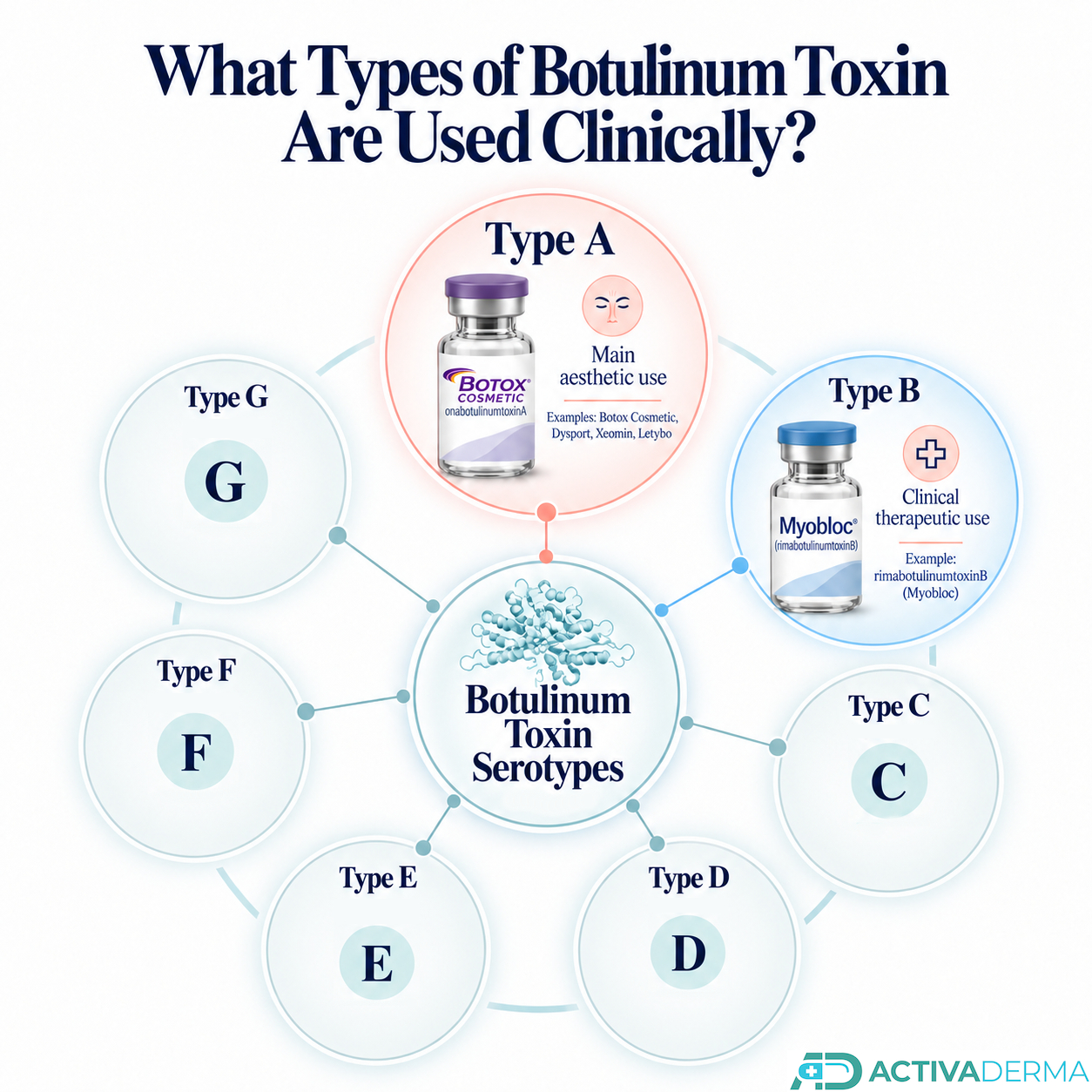
Clinical products mainly use types A and B, although seven classical botulinum toxin serotypes are labeled A through G. The letters describe broad toxin families rather than seven cosmetic choices.
The 7 Classical Botulinum Toxin Serotypes
- Type A cleaves SNAP-25 and supports nearly every botulinum toxin product used routinely in aesthetic practice.
- Type B cleaves VAMP, while rimabotulinumtoxinB is FDA-approved for treating adult cervical dystonia.
- Type C affects SNAP-25 and syntaxin, without a routine human aesthetic product.
- Type D targets VAMP and is linked mainly with animal botulism.
- Type E cleaves SNAP-25 and can cause human foodborne botulism.
- Type F targets VAMP and causes rare human botulism cases.
- Type G targets VAMP but has not been reported to cause human botulism.
Botulinum Toxin Type A
Type A is the main aesthetic neurotoxin because it produces reliable, temporary muscle modulation with extensive supporting evidence.
Available formulations share a serotype, yet differences in manufacturing, accessory proteins, stabilizers, potency assays, and labels keep each product clinically distinct.
Botulinum Toxin Type B
Type B is available as Myobloc, or rimabotulinumtoxinB, for adults with cervical dystonia and chronic sialorrhea. It is not FDA approved for facial wrinkles, although specialists may encounter it when managing a neurological disorder or type A nonresponse.
How Do Botulinum Toxin Products Differ?
Botulinum toxin products can use the same type A neurotoxin while remaining clinically distinct prescription medicines. Manufacturers use different purification methods, accessory proteins, stabilizers, potency assays, vial sizes, and storage instructions.
These differences do not automatically prove one brand works faster or lasts longer in every patient or treatment area. They determine how each product must be prepared, dosed, documented, and judged against its own clinical evidence.
Formulation
Every vial combines an active botulinum neurotoxin with its own stabilizing ingredients and manufacturing profile.
Dysport contains a neurotoxin complex with accessory proteins, while Xeomin's FDA label describes a purified 150 kDa neurotoxin without accessory proteins. Albumin, sucrose, lactose, sodium chloride, and other excipients also vary by product.
Onset of Effect
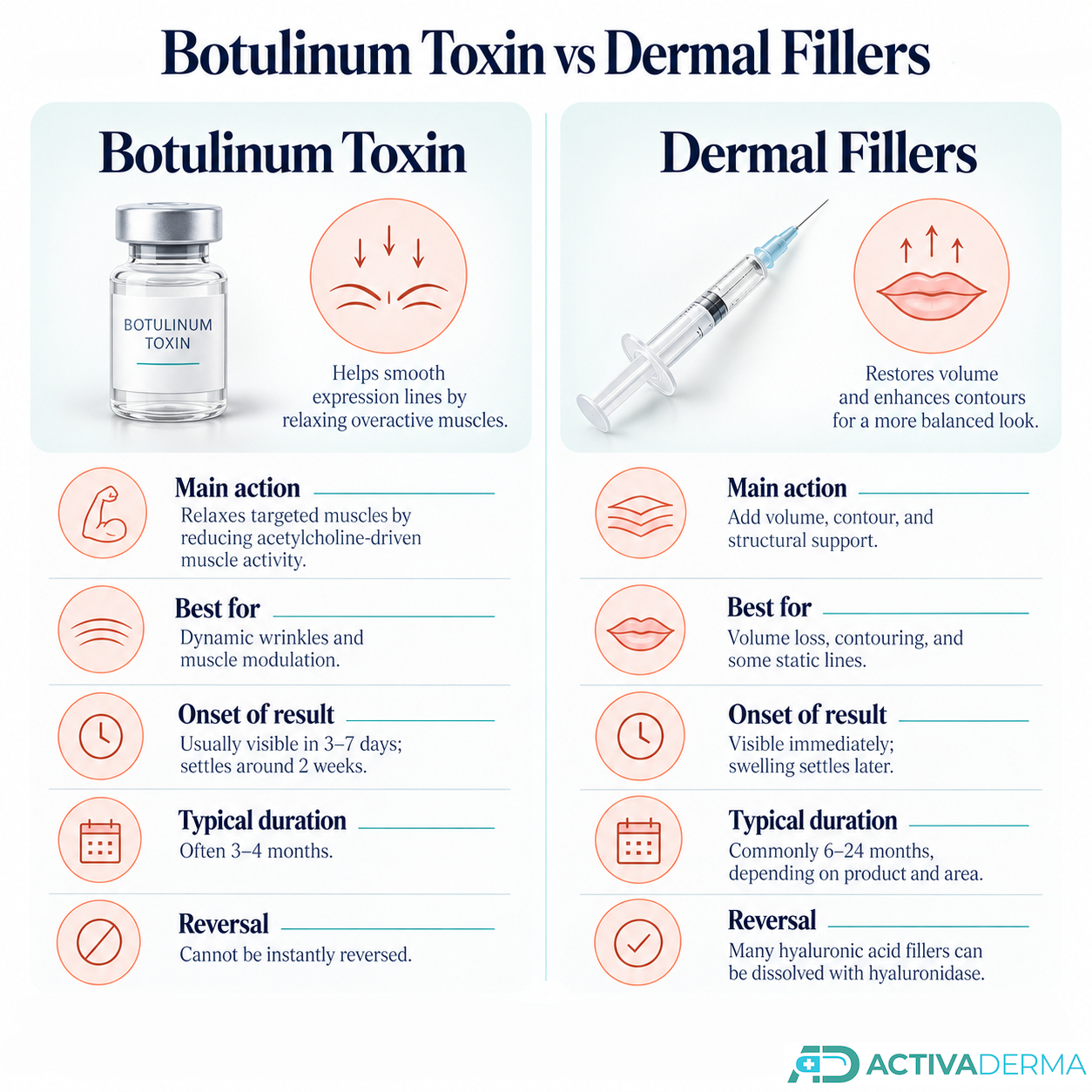
Early muscle weakening can begin within one to three days, although some products and treatment areas respond later. The effect continues to develop during the first week, so the first visible change should not be treated as the final result.
Many providers schedule a review at about two weeks. By then, they can assess movement, symmetry, and whether the treatment met its goal. This is a practical reassessment point, not a universal peak, since timing varies by product, dose, muscle, and treatment area.
Duration of Effect
Many type A aesthetic results remain visible for roughly three to four months, although no timeline applies universally.
Dose, target muscle, treatment goal, previous exposure, and individual biology can shorten or extend the useful effect.
Product-Specific Units
Units measure biological potency through a product's own assay, so direct mathematical conversion is not supported by FDA labels.
A 20-unit onabotulinumtoxinA plan cannot automatically become 20 units of another toxin product.
What Is Botulinum Toxin Used for in Aesthetic Practice?
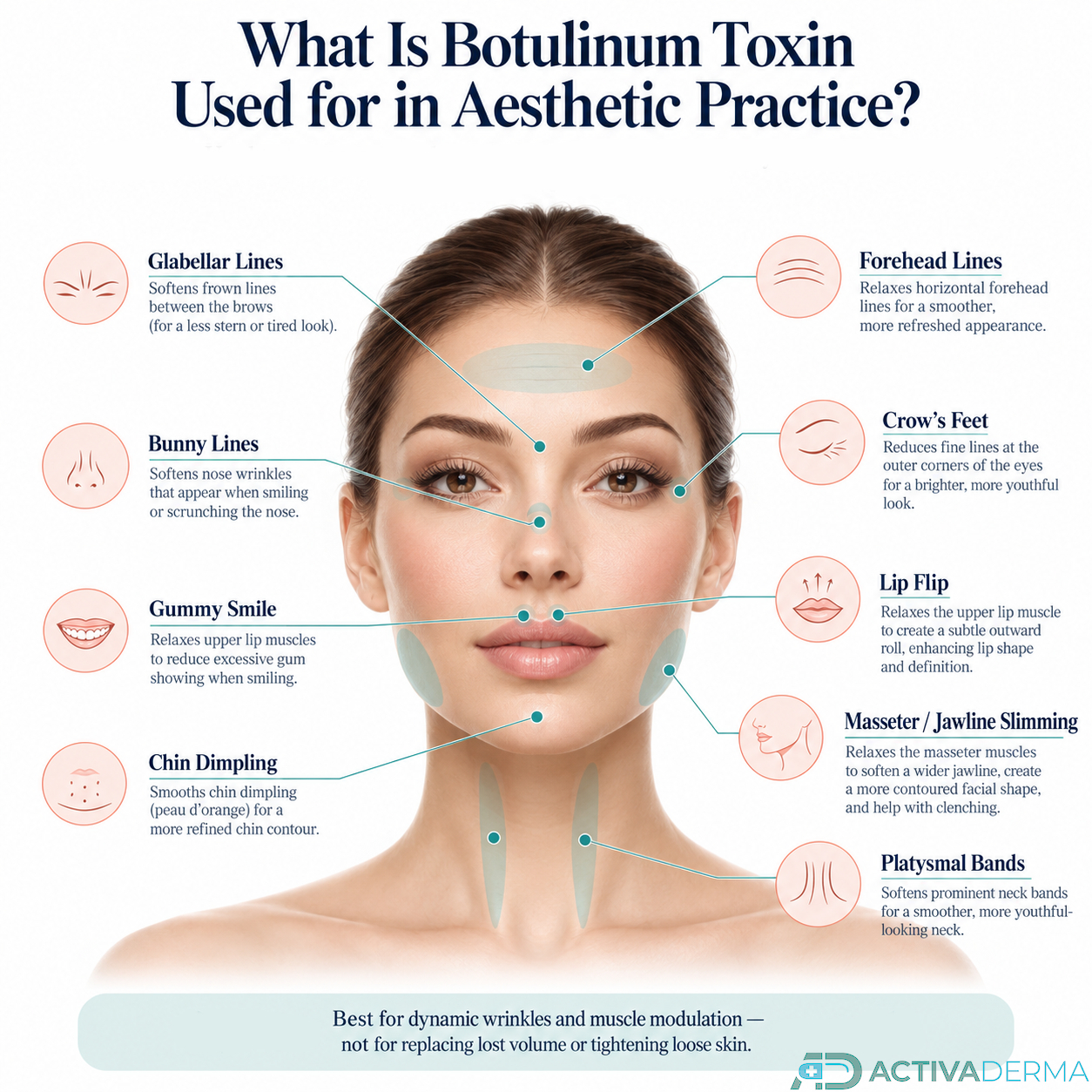
Aesthetic botulinum toxin injections reduce selected muscle activity that creates lines, dimpling, or unwanted lower-face movement. They cannot replace missing volume or tighten loose skin.
Dynamic Facial Lines
Glabellar frown lines, horizontal forehead lines, and lateral canthal lines form as expression repeatedly folds the skin. Reducing corrugator, procerus, forehead muscles, or orbicularis activity can soften these dynamic wrinkles while preserving planned movement.
Static lines remain visible at rest because repeated folding has changed the skin. Established creases may still need resurfacing, skincare, or carefully selected filler.
Facial Shaping and Muscle Modulation
Experienced injectors also use muscle modulation for masseters, chin dimpling, gummy smiles, lip flips, bunny lines, and selected lower-face concerns. Platysmal treatment can refine visible neck bands, while careful balancing protects smile function and lower-face symmetry.
Many uses in this group remain off-label in the United States. Providers should document the rationale, consent clearly, and follow their scope, current evidence, and applicable state rules.
Therapeutic Uses Relevant to Aesthetic Professionals
Botulinum toxin therapy also reaches far beyond dermatologic surgery. Depending on the exact product, labeled medical conditions include chronic migraine, overactive bladder, axillary hyperhidrosis, blepharospasm, dystonia, and upper limb spasticity.
Some formulations also carry indications involving lower limb spasticity or gland activity, each with separate product-specific protocols.
Dynamic Wrinkles vs Volume Loss: When Botulinum Toxin Is the Wrong Tool
Treating every facial line as a muscle problem quickly leads to the wrong injectable. Providers should identify the cause before opening a toxin vial.
- Muscle-driven dynamic wrinkles often respond because botulinum toxin reduces the repeated contraction creating the fold.
- Deep static wrinkles may soften after treatment, although a fixed crease rarely disappears from muscle relaxation alone.
- Volume loss needs support or replacement, often through an appropriate dermal filler, rather than reduced movement.
- Skin laxity or structural change may require energy-based care, surgery, filler, biostimulation, or a combined treatment plan.
- Skin-quality concerns usually need skincare, resurfacing, or collagen-focused treatment chosen for the underlying tissue change.
Botulinum Toxin vs Dermal Fillers
Botox Cosmetic
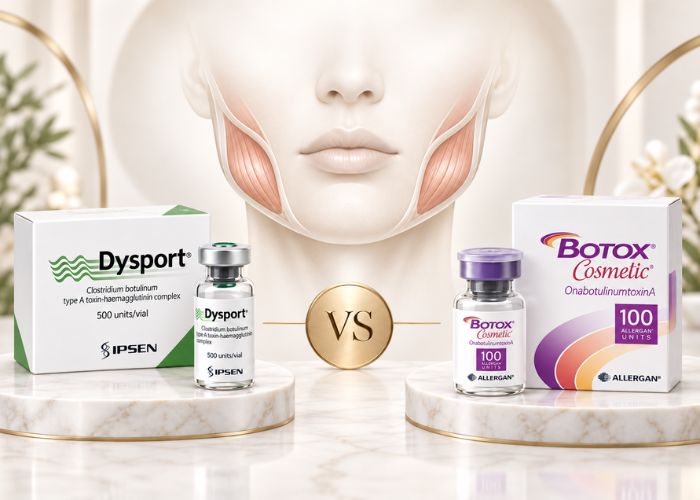
Botox contains onabotulinumtoxinA and has the broadest current U.S. aesthetic label among these four products. Its FDA-approved areas include glabellar lines, crow's feet, forehead lines, and platysma bands, with product-specific dosing for each.
Dysport
Dysport contains abobotulinumtoxinA, and its U.S. aesthetic indication covers moderate-to-severe glabellar lines in adults younger than 65. The labeled dose is 50 Dysport units across five sites, and clinical studies found improvement lasting up to four months.
Xeomin
Xeomin contains incobotulinumtoxinA without accessory proteins. Its June 2026 U.S. label now covers glabellar, horizontal forehead, and lateral canthal lines, including simultaneous treatment of all three upper-face areas.
Letybo
Letybo contains letibotulinumtoxinA-wlbg and received U.S. approval for moderate-to-severe glabellar lines in adults. Its labeled 20-unit treatment uses five sites, and Letybo units cannot be converted into another botulinum toxin product.
Good outcomes begin with a precise plan, then depend on a vial clinicians can trace and trust.
Explore Activa Derma's professional botulinum products to compare established brands, pack sizes, and clinic-ready options before checking local authorization and current labeling.
FAQ
Are Botox and botulinum toxin the same?
No. Botulinum toxin is the wider drug class, while Botox and Botox Cosmetic are branded onabotulinumtoxinA products made by AbbVie.
What is another name for botulinum toxin?
Botulinum neurotoxin, BoNT, and neuromodulator are common terms, although “neuromodulator” can describe a broader treatment category.
What is the best botulinum toxin?
No single product leads every case. The right choice matches the indication, anatomy, prior response, desired duration, label, and available evidence.
Do Botox toxins stay in your body?
The local biological effect is temporary and gradually fades as nerve signaling recovers. Routine cosmetic doses do not create permanent muscle paralysis.
Are botulinum toxin injections safe?
They are generally well tolerated when an appropriately licensed clinician uses authentic product, correct technique, proper screening, and product-specific labeling.
Is botulinum toxin a steroid?
No. It is a bacterial neurotoxin that blocks acetylcholine release, while steroids act through entirely different anti-inflammatory or hormonal pathways.
What is the new Botox called that lasts longer?
Daxxify is daxibotulinumtoxinA-lanm, a separate brand rather than a new Botox. In pivotal studies, over half of patients maintained none-or-mild frown lines at six months.
Who is not a good candidate for Botox?
Treatment may be unsuitable with injection-site infection, product hypersensitivity, pregnancy, or certain neuromuscular conditions. Extra caution applies with swallowing, breathing, bleeding, or medication concerns.