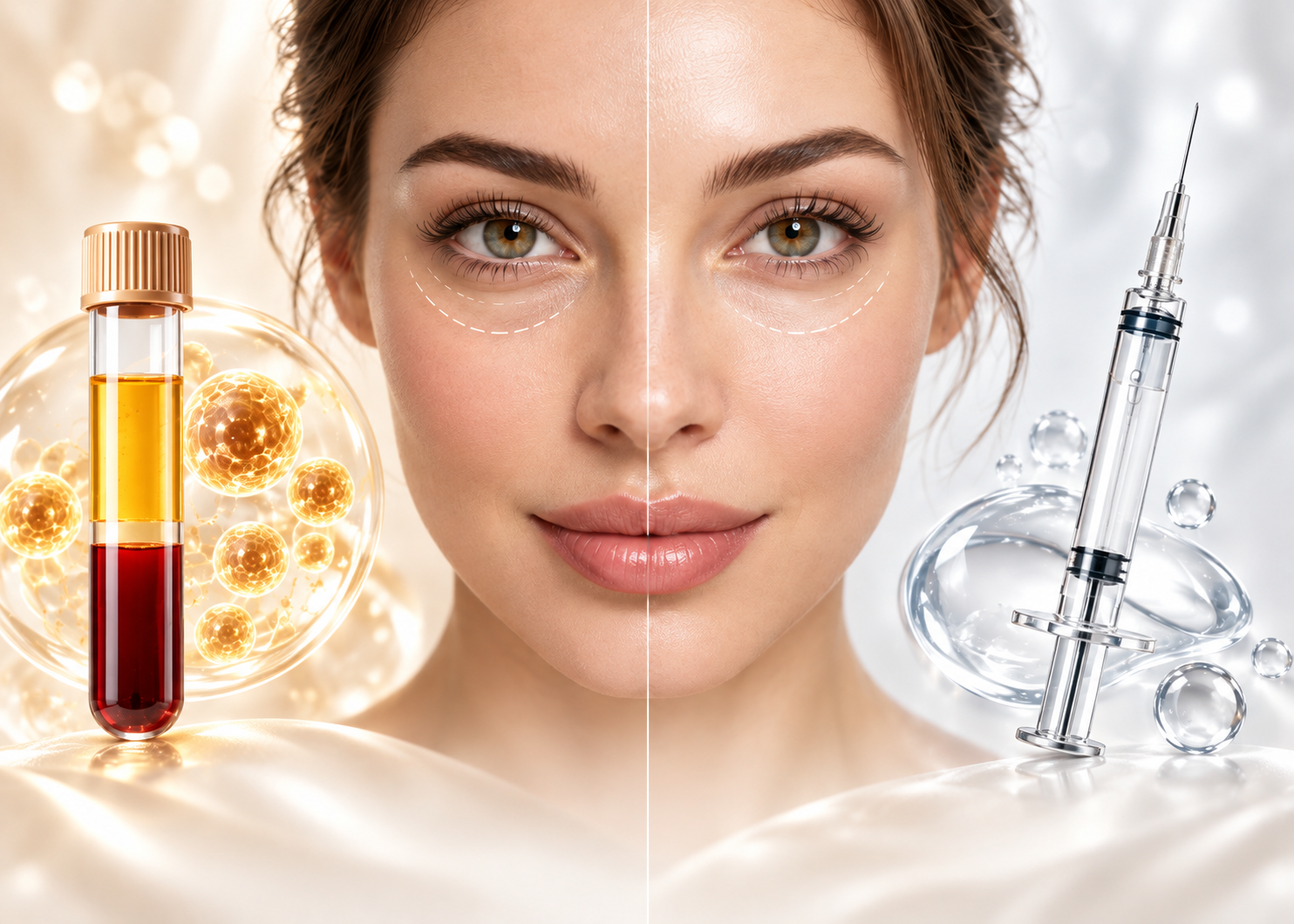

PRP vs Fillers Under Eyes: Factors to Compare
Dark circles are not one diagnosis. A shadow from lost volume calls for a different treatment than thin, crepey skin or true pigment.
In the PRP vs fillers under eyes decision, hyaluronic acid filler is usually the stronger choice for a hollow, while PRP is better suited to gradual skin-quality improvement.
PRP vs Fillers Under Eyes at a Glance
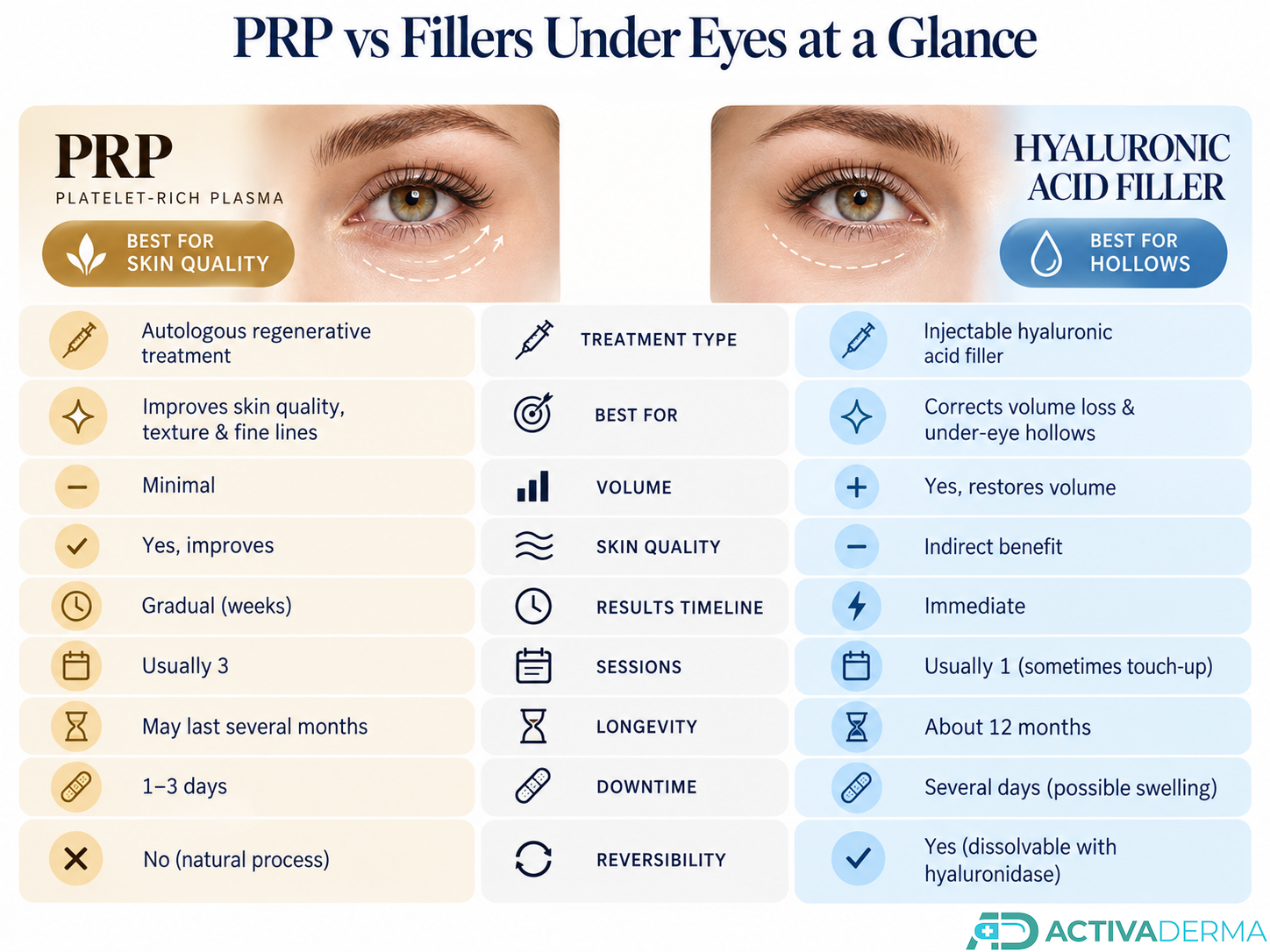
Neither treatment is better across every concern. The useful question is what is creating the tired look, then which option addresses that cause with the fewest compromises.
|
Factor |
PRP |
Hyaluronic acid filler |
|
Treatment type |
Autologous regenerative treatment |
Injectable dermal filler |
|
Material |
Platelet-rich plasma prepared from the patient's own blood |
Cross-linked hyaluronic acid gel |
|
Primary mechanism |
Platelet and growth factor signaling supports tissue repair and remodeling |
Gel restores space and supports the lid-cheek transition |
|
Main objective |
Improve skin quality, texture, and fine lines |
Correct volume loss and soften a tear trough |
|
Best-suited concern |
Thin or crepey eye skin with mild texture change |
A true under-eye hollow that creates a shadow |
|
Volume restoration |
Minimal and not reliably structural |
Yes, when the right product is placed at the right depth |
|
Skin-quality improvement |
Primary treatment goal |
May improve appearance indirectly, but is not a skin treatment |
|
Dark-circle relevance |
May help a mild skin-quality or pigment component |
Helps only when darkness is mainly a shadow from hollowing |
|
Time to visible results |
Gradual, usually over several weeks |
Immediate correction, with the settled result assessed after swelling resolves |
|
Typical initial sessions |
Often 3 |
Usually 1, with an optional touch-up in some protocols |
|
General longevity |
Not standardized; benefits may continue for months |
Exact-product studies support about 12 months for several approved options |
|
Downtime |
Usually 1 to 3 days of redness, swelling, or bruising |
Several days of swelling or bruising; edema can last longer |
|
Reversibility |
No reversal agent; any change develops and fades gradually |
HA filler may be dissolved off-label with hyaluronidase, but reversal is not risk-free |
|
FDA and regulatory point |
A preparation device may be FDA cleared, but PRP is not FDA approved for under-eye rejuvenation |
Only exact products with an infraorbital indication are FDA approved for this use |
Why the Cause of the Under-Eye Concern Matters
The wrong diagnosis produces the wrong treatment. A hollow creates a structural shadow, pigment remains dark in even lighting, and visible vessels can show through thin skin. Edema, festoons, fat prolapse, and skin laxity create still different shapes.
Before recommending PRP therapy or tear trough fillers, examine the patient at rest, in several lighting angles, and from the side.
What Is PRP Under-Eye Treatment?
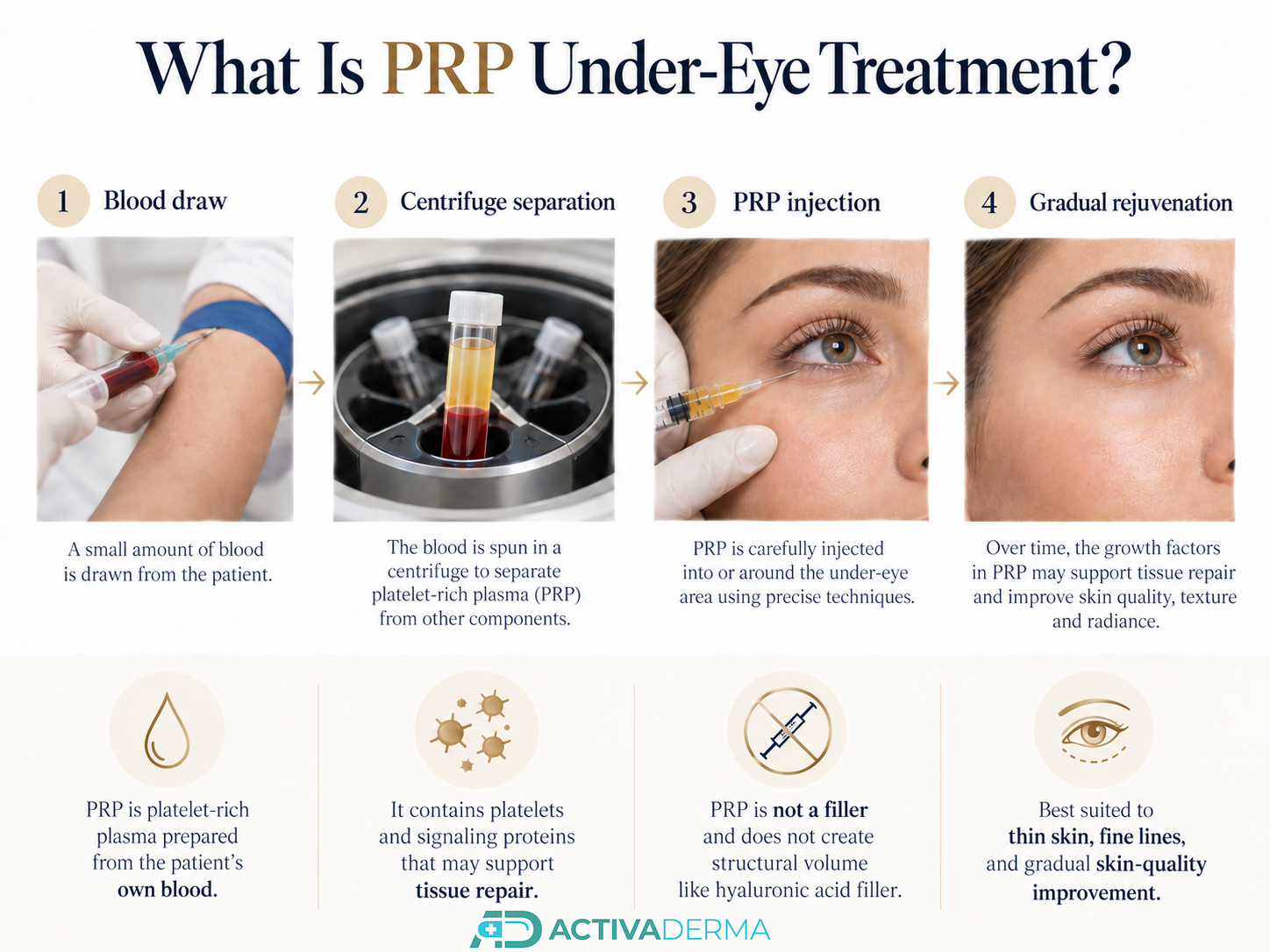
PRP is a concentrated portion of the patient's blood that contains platelets and signaling proteins. After a blood draw, a centrifuge separates the platelet-rich plasma, which is then injected into or around the treated tissue according to the chosen protocol.
Patients sometimes call it a PRP filler treatment, but that name is inaccurate. Concentrated PRP may stimulate collagen production, natural tissue repair, and gradual skin rejuvenation, yet it does not create the controlled volume of a synthetic filler. That makes PRP treatment more relevant to fine lines, thin skin, and texture than to meaningful volume loss.
What Are Under-Eye Fillers?
Under-eye fillers are injectable gels used to restore volume along the infraorbital hollow. Most current tear trough filler options use hyaluronic acid, a substance that binds water and can provide immediate support where the lower eyelid meets the cheek.
This is precise contour work, not a general fix for dark circles. The eye area has thin skin, limited space, and important blood vessels, so not every dermal filler belongs there. A gel that works well in the cheek may be too firm or attract too much water under the eyes, which can lead to puffiness, visible lumps, or an uneven contour.
PRP vs Fillers: How They Work Differently
Filler changes contour by placing material beneath the skin. When hollowing is the cause, that support reduces the drop between the eyelid and cheek, so less shadow forms. The result is visible before the patient leaves, although swelling can temporarily hide the final shape.
PRP works through a biologic process. Platelets release growth factors that may support cell signaling, collagen production, and tissue regeneration over time. It does not provide the controlled projection of a traditional filler.
In simple terms, filler replaces missing volume; PRP works on the condition of the tissue itself.
PRP vs Fillers for Under-Eye Hollows
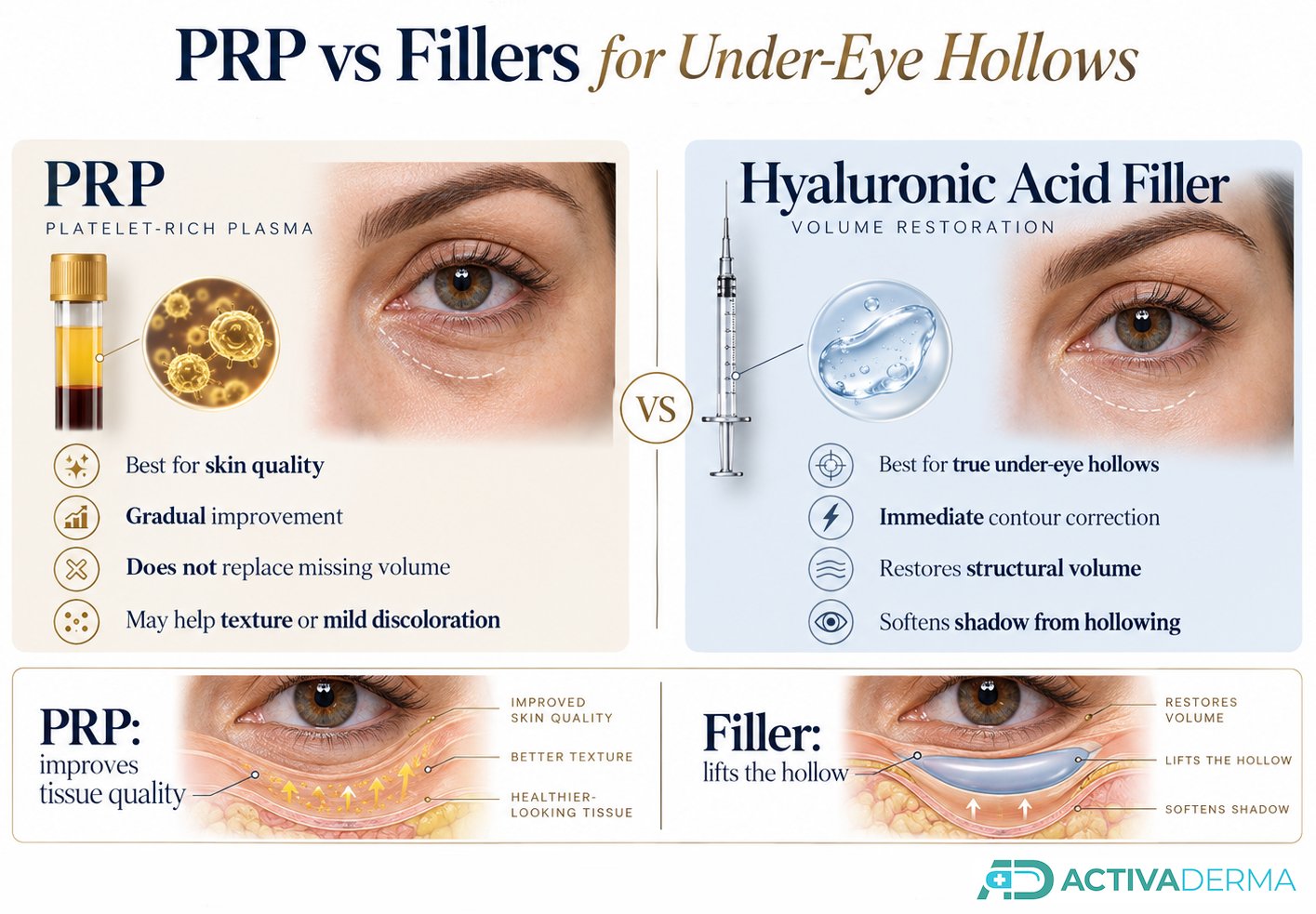
Hyaluronic acid filler is usually better for a true tear trough caused by volume loss. It can lift the hollow directly, soften the tired shadow, and create a more youthful appearance.
PRP cannot recreate missing structure with the same accuracy.
That answer changes when the apparent hollow is actually a bag, festoon, or loose skin. Adding filler beneath significant fat prolapse may make the lower eyelid look heavier, while PRP will not reposition the fat.
PRP vs Fillers for Dark Circles
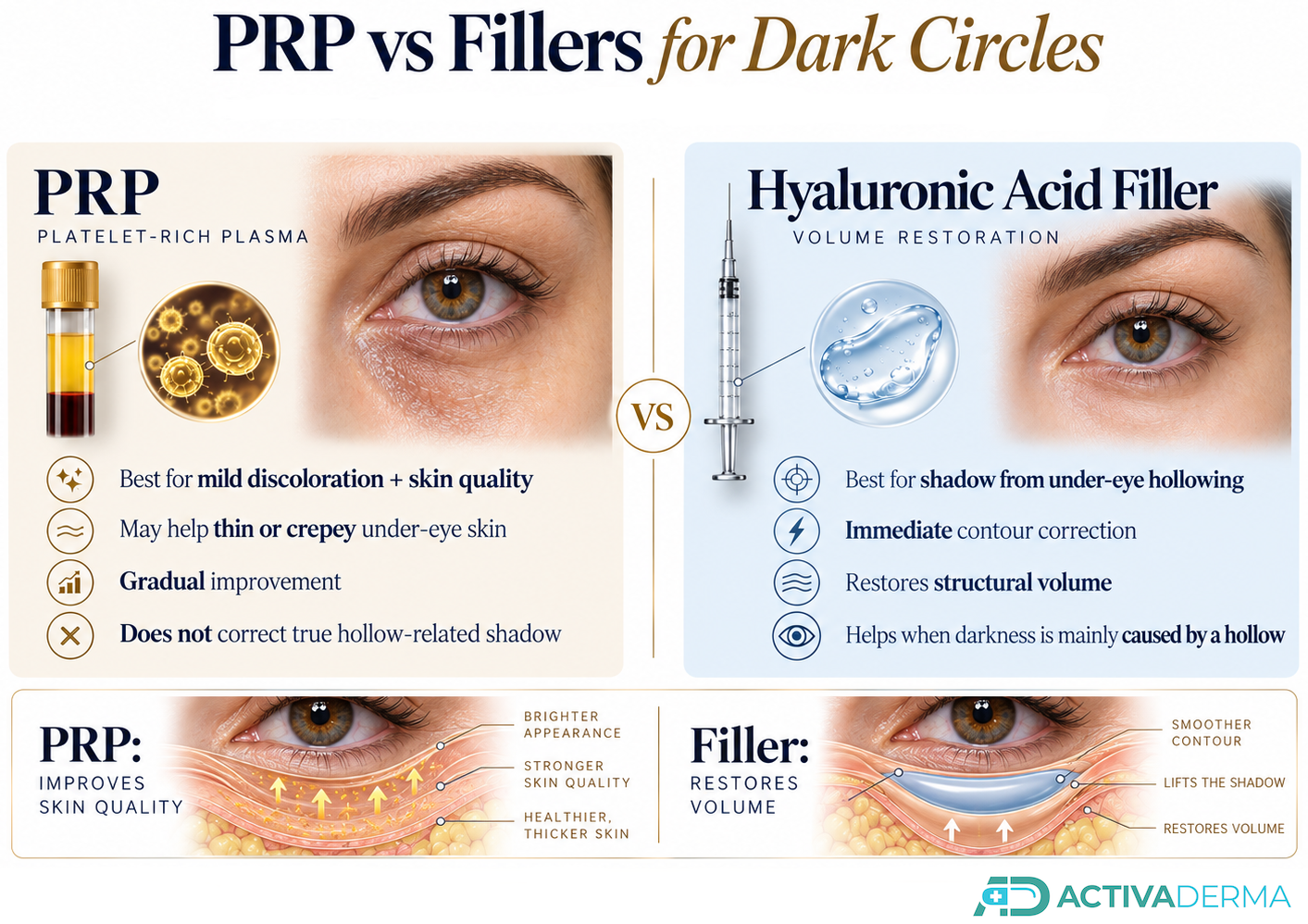
The better option depends on why the circles are dark.
- Choose filler when the darkness disappears as the hollow is gently lifted or under more even lighting, which suggests shadow.
- PRP may be considered when thin, crepey skin or mild discoloration is part of the problem.
Evidence is still limited for this question. A 2026 systematic review of 26 PRP and PRF studies found only a moderate effect on periorbital hyperpigmentation.
PRP vs Fillers for Fine Lines and Crepey Under-Eye Skin
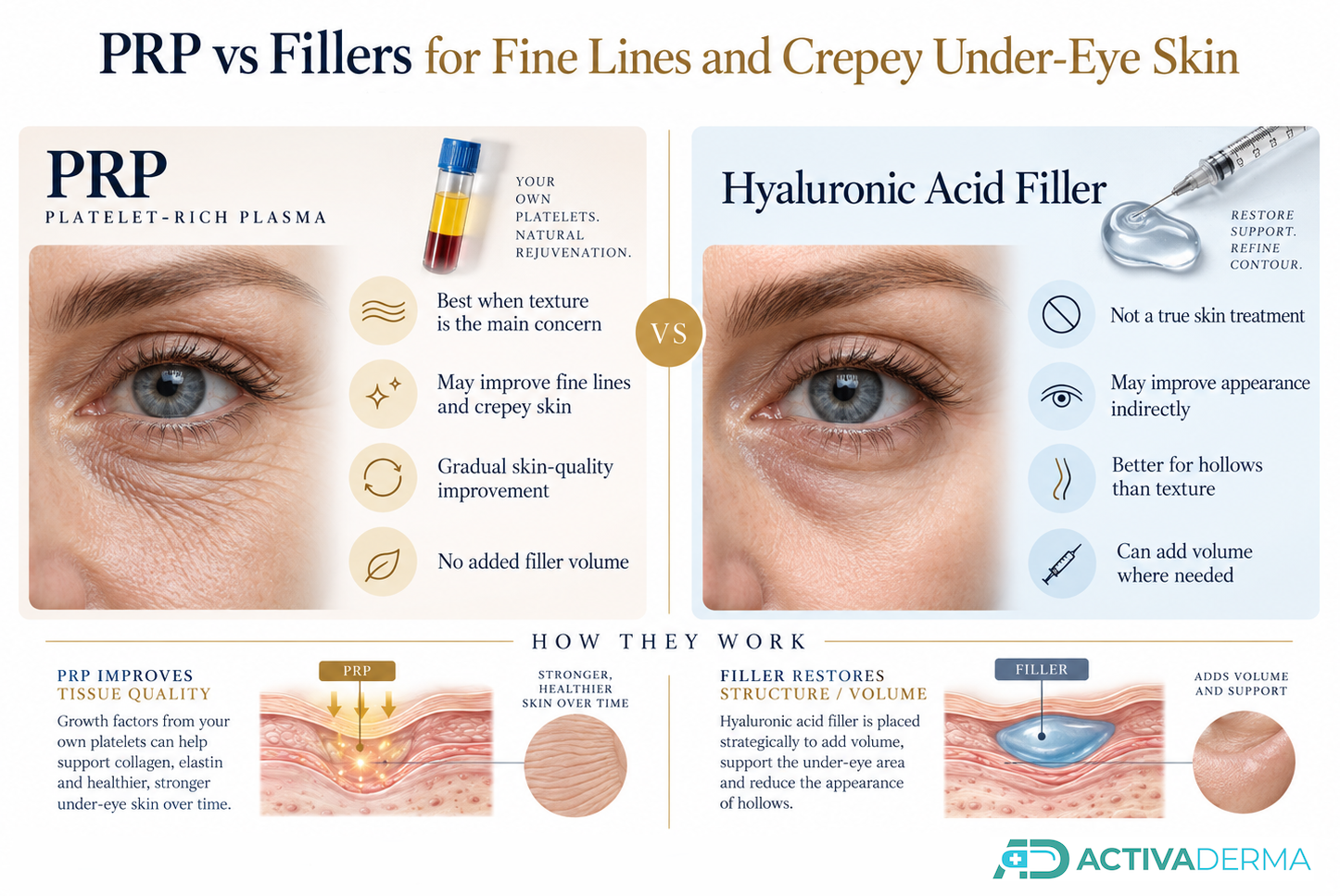
When skin texture is the main concern and volume is already adequate, PRP is usually the more relevant of these two options. That is a goal-based distinction, not proof of superiority in a direct comparison. It may improve skin quality gradually without adding a visible gel layer beneath delicate tissue.
The evidence is encouraging but not definitive. A systematic review of 19 studies and 455 patients found higher satisfaction with PRP than control treatments in three randomized trials, but protocols and follow-up varied.
PRP vs Fillers for Under-Eye Bags
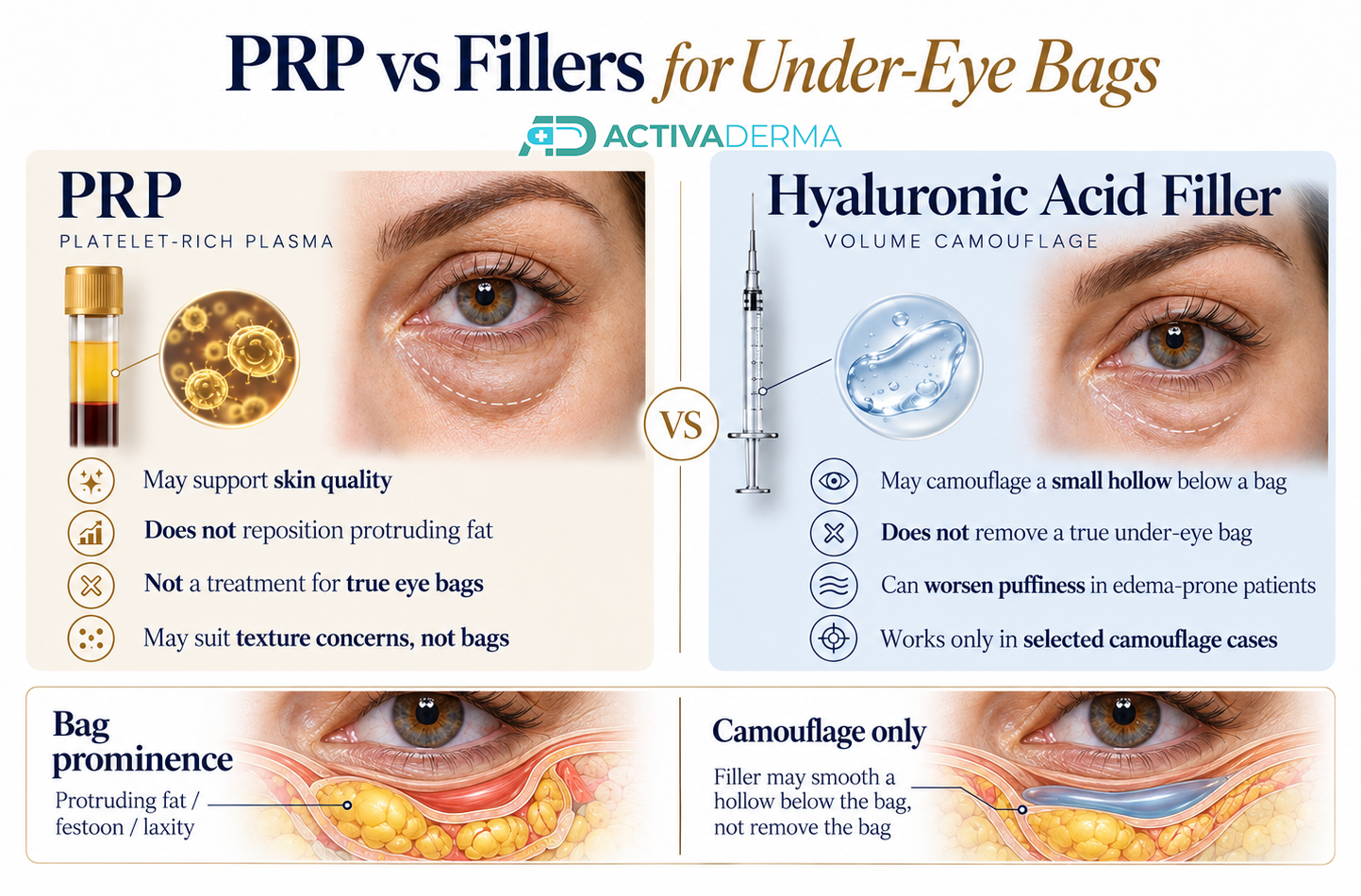
Neither PRP nor filler removes a true under-eye bag. PRP cannot reposition protruding fat, and filler only camouflages selected cases by smoothing a small hollow below the bag. In a patient prone to fluid retention, filler may increase puffiness rather than improve it.
Prominent fat pads, festoons, or sagging skin call for an oculoplastic or facial plastic surgery assessment. Treating the wrong structure simply trades one contour problem for another.
PRP vs Filler Results: Immediate vs Gradual Change
Filler is the faster option. The hollow changes immediately, although practitioners should judge the final result only after early swelling has settled, often at a 2 to 4 week review.
PRP improvement develops over several weeks as the tissue responds. That slower course can suit patients who want a subtle change and accept multiple PRP sessions.
How Long Do PRP and Under-Eye Fillers Last?
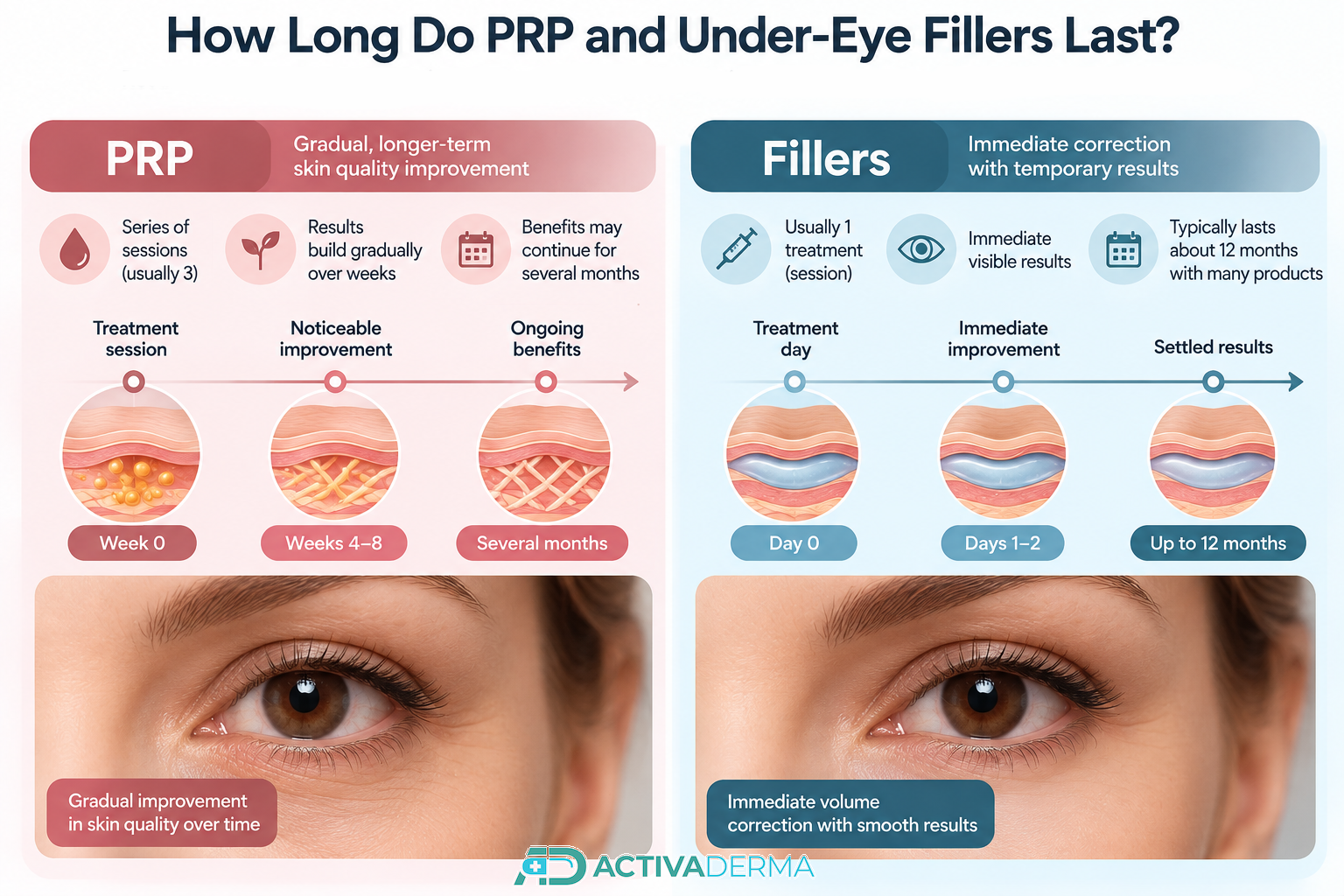
Several FDA-approved HA fillers have evidence near one year.
JUVEDERM VOLBELLA XC data showed a 73.4% responder rate at Month 12, while Restylane Eyelight may provide results for up to 12 months. Belotero Balance (+) has data through 48 weeks.
PRP longevity is harder to state. PRP preparation, platelet concentration, session count, patient biology, and the outcome measured all differ between studies. Benefits may remain for months, but the universal “6 or 12 month” promise is not supported.
How Many Treatments Are Typically Needed?
Filler usually needs fewer appointments. One treatment may correct a mild hollow, although a conservative touch-up can be safer than placing too much gel at once.
PRP is commonly planned as three sessions several weeks apart. The 2021 systematic review and meta-analysis of PRP for periorbital rejuvenation found that patients received a mean of three treatments, although protocols ranged from 1 to 8 sessions with intervals of 14 to 56 days.
Build the treatment plan around the exact PRP preparation and response rather than selling every patient the same package.
PRP vs Under-Eye Filler Patient Selection
Start with anatomy, not the treatment a patient saw online. The best candidates have a concern that matches what the injectable can realistically change.
Patients More Likely to Benefit From PRP
- Patients with fine lines, crepey texture, or thin eye skin but little volume loss.
- Those who want gradual eye rejuvenation without adding filler volume.
- Patients who accept multiple treatments and understand that results vary.
- Those without a condition that makes blood collection or platelet function a concern.
- Patients with a clear infraorbital hollow that improves when the lid-cheek junction is supported.
- Those seeking faster, more predictable volume correction.
- Patients with good skin support and little baseline edema or fat prolapse.
- Those who understand that a tear trough filler treats shadow, not true pigment.
- Anyone with festoons, chronic swelling, marked laxity, or prominent fat bags.
- Patients with active infection, inflammation, a bleeding disorder, low platelets, or significant anemia.
- Those with previous permanent or unidentified filler, relevant allergies, or unrealistic expectations.
Patients More Likely to Benefit From Filler
Patients Requiring Extra Caution
Under-Eye Filler Product Options
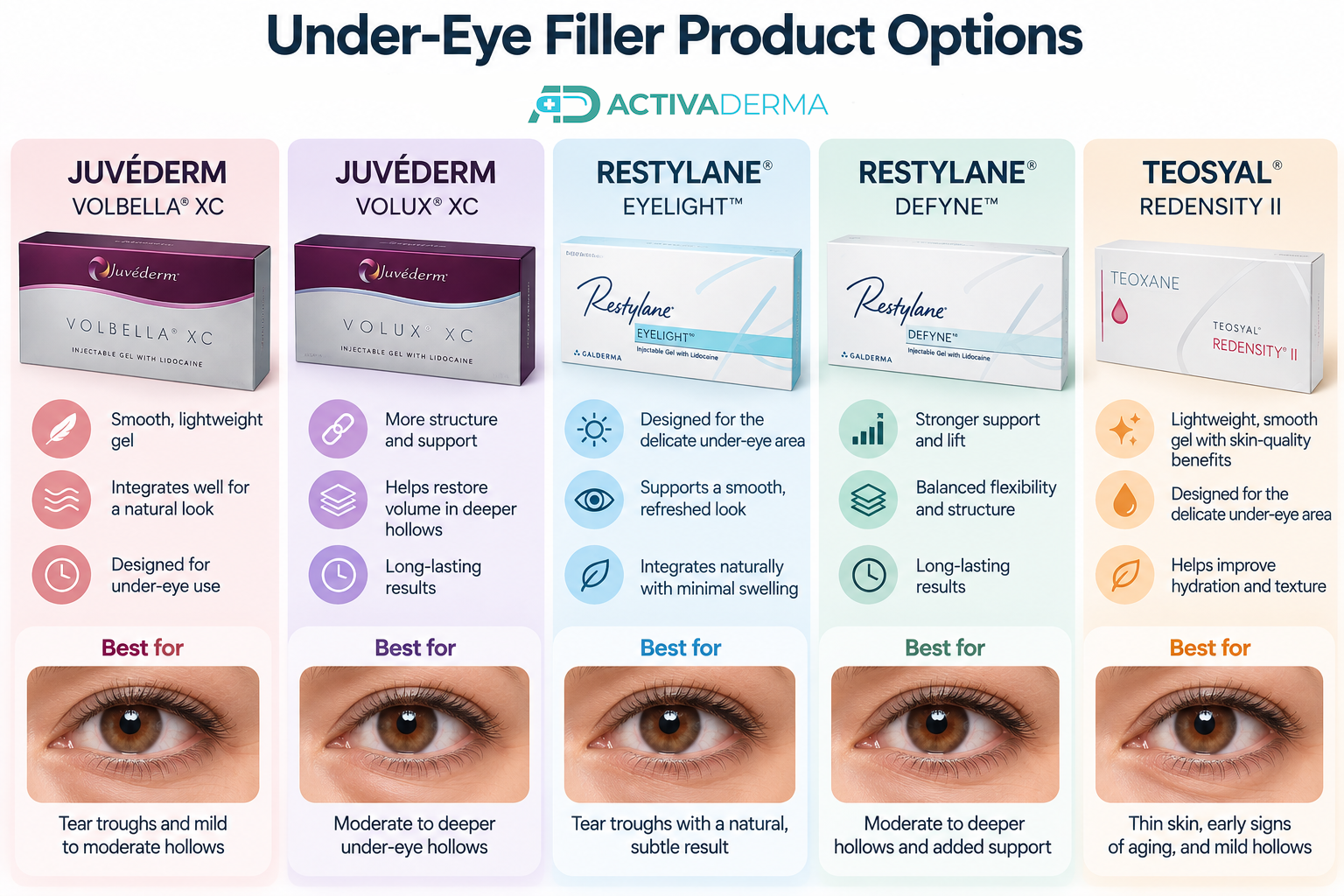
Under-eye fillers are not interchangeable. Practitioners should check the exact U.S. label, gel behavior, supported longevity, and their own training before choosing a product.
JUVEDERM VOLBELLA XC
JUVEDERM VOLBELLA XC is a 15 mg/mL cross-linked HA filler with 0.3% lidocaine. It is FDA approved for infraorbital hollows in adults over 21, and the pivotal study reported 73.4% responders at one year. Its U.S. evidence applies to the exact XC product and indication.
Restylane Eyelight
Restylane Eyelight is an HA filler with 0.3% lidocaine, approved for infraorbital hollowing in adults over 21. In its 333-person study, 87.4% of treated patients responded at Month 3 versus 17.7% of controls, with supported results lasting up to 12 months.
Other Under-Eye Fillers
Belotero Balance (+), an FDA approved filler for infraorbital hollowing in adults over 21. In its trial, 90.7% of initial responders still showed improvement at Week 48.
For international purchasing, practitioners can compare our JUVEDERM Volbella with Lidocaine and Belotero Balance Lidocaine options. These are EC-origin listings, so confirm local authorization and the supplied instructions.
PRP vs Fillers Under Eyes: Safety and Side Effects
Both are minimally invasive injections, but their risk profiles are not equal.
PRP Side Effects
- Expected reactions: Blood-draw discomfort, redness, tenderness, bruising, and short-term swelling.
- Procedure risks: Infection, prolonged inflammation, or an unsatisfactory result can occur.
- Practical limitation: Different kits and PRP preparations can produce inconsistent concentrations and outcomes.
- Common reactions: Swelling, bruising, tenderness, asymmetry, lumps, or temporary discoloration.
- Under-eye concerns: Delayed edema or a blue-gray Tyndall effect may become visible through thin skin.
- Urgent complications: Accidental vascular injection can cause tissue injury, vision loss, or stroke.
Filler Side Effects
PRP vs Fillers Under Eyes: Cost
PRP may look cheaper at first, but most patients need a series of three sessions. Under-eye filler usually costs more on the day, yet one appointment may be enough for a mild hollow.
For context, the American Society of Plastic Surgeons reports a $715 national average for HA filler across treatment areas, although the final cost changes with the product, provider, city, and number of visits.
|
Cost factor |
PRP |
Under-eye HA filler |
|
Typical U.S. price |
About $500 to $1,500 per session |
About $700 to $1,500 per treatment |
|
Common initial plan |
3 sessions |
1 session, sometimes with a touch-up |
|
Estimated initial total |
About $1,500 to $4,500 |
About $700 to $1,500, plus any touch-up |
|
Main cost drivers |
City, blood draw, PRP kit, centrifuge time, session count |
City, provider, exact filler, syringe volume, touch-up policy |
PRP vs Filler From the Practice Perspective
Product price tells only part of the story. PRP may have a lower material cost, but blood collection, preparation, disposable kits, and three visits use more staff and chair time. Filler carries a higher acquisition cost yet may finish in one visit.
Compare full-course margin, appointment time, inventory expiry, follow-up needs, and emergency readiness before setting fees.
Can PRP and Filler Be Used Together?
Yes, when each treatment has a separate job. Filler may correct a true hollow, while PRP can address nearby texture or crepiness. They should not be mixed in one syringe or presented as a standard package for everyone.
Sequence the treatments around anatomy and safety. Document the goal of each one, allow swelling to settle, and reassess before adding the next step. A combined plan should solve two confirmed problems, not compensate for an unclear diagnosis.
PRP vs PRF Under Eyes
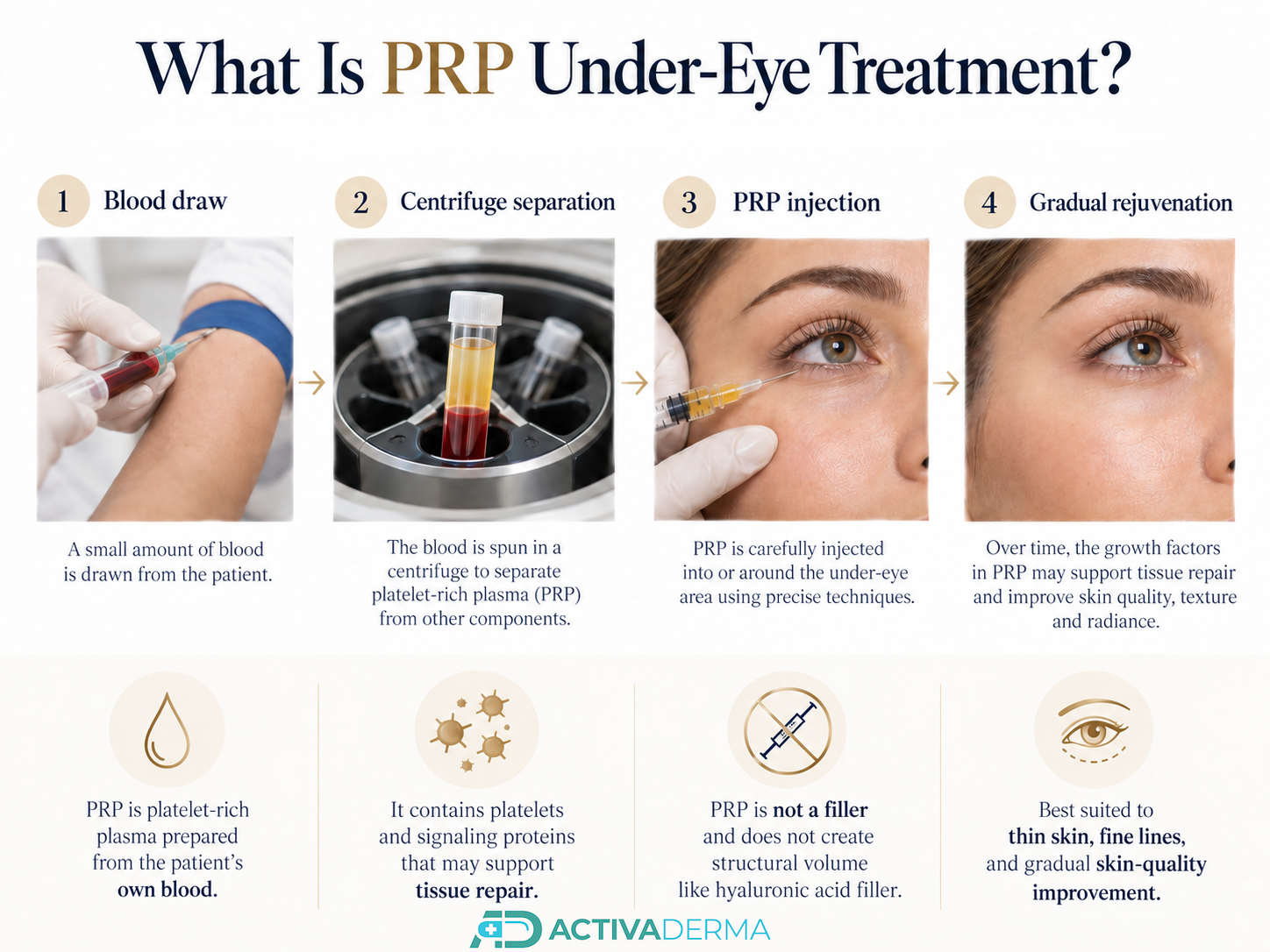
PRP and platelet-rich fibrin both come from the patient's blood, but the preparation is different.
- PRP usually remains liquid and often uses an anticoagulant.
- PRF is prepared without an anticoagulant and forms a fibrin matrix that can release signaling proteins more gradually.
A 2025 systematic review comparing PRP and PRF associated PRF with improvements in texture, wrinkles, and crepiness, while PRP had stronger evidence for hyperpigmentation. Protocols still varied too much to name one universal winner, so preparation, injection method, and the patient's skin condition remain central.
When Neither PRP nor Filler Is the Best Option
Some concerns need a different route. Pause the injection plan when the main issue is:
- Prominent fat prolapse, festoons, or advanced skin laxity.
- Brown pigment without a meaningful hollow.
- Allergy-related congestion or chronic edema.
- Active dermatitis or infection.
- A request for a change that neither treatment can realistically create.
Surgery, pigment treatment, skincare, allergy management, or an energy-based procedure may offer better skin or contour improvement in these cases.
How Practitioners Should Choose Between PRP and Filler
- Name the cause. Separate hollowing and shadow from pigment, vessels, texture, edema, and fat prolapse.
- Check risk and anatomy. Review prior injections, skin thickness, swelling, medical history, and the lid-cheek relationship.
- Match the treatment to the goal. Use filler for structural volume and PRP for gradual skin-quality work.
- Set a measurable plan. Agree on timing, session count, and review point, then track under-eye improvement with the same lighting, angle, and camera settings.
PRP vs Fillers Under Eyes: Which Should You Choose?
Choose by cause, not trend. Filler is usually the better tool for a true hollow, while PRP makes more sense for fine lines, crepey tissue, and gradual skin improvement.
If filler fits the anatomy, explore our professional dermal filler range and confirm the exact product's local authorization before treatment.
FAQ
Is PRP worth it for under eyes?
It can be worthwhile for mild crepiness, fine lines, or skin-quality concerns when the patient accepts gradual, variable results and usually more than one session. It is not a reliable replacement for lost volume.
What's better than PRP for under eyes?
HA filler is more effective for a true hollow. Pigment treatments, allergy care, resurfacing, or surgery may be better when discoloration, edema, laxity, or fat bags cause the concern.
Is PRP under eyes better than fillers?
Not overall. PRP is more relevant to tissue quality, while filler is more predictable for volume loss and tear trough shadowing.
What's the best injectable for under eyes?
For a confirmed hollow, an FDA-approved HA filler such as JUVEDERM VOLBELLA XC, Restylane Eyelight, or Belotero Balance (+) may be considered. The best choice still depends on anatomy and injector training.
Which under-eye filler lasts the longest?
No approved product is proven longest in a direct head-to-head trial. Current U.S. data support up to 12 months for JUVEDERM VOLBELLA XC and Restylane Eyelight, and up to 48 weeks for Belotero Balance (+).
Do under-eye fillers actually work?
Yes, for properly selected patients with infraorbital hollowing. They do not directly treat pigment, poor skin texture, festoons, or prominent fat bags.
Does PRP get rid of bags under eyes?
No. PRP may improve overlying skin quality, but it cannot remove or reposition protruding fat that creates a true under-eye bag.
What is the downside of under-eye fillers?
Swelling, bruising, lumps, asymmetry, blue-gray discoloration, or delayed edema may occur. Rare vascular complications can threaten skin or vision, so experienced placement and emergency readiness are essential.
Is PRP as good as fillers?
It can be useful for different goals, but it is not as predictable as filler for restoring structural volume. Comparing them without naming the concern is misleading.
What is the downside of PRP?
Results are gradual and less standardized, multiple visits are common, and some patients see limited improvement. Blood-draw discomfort, bruising, swelling, and added treatment time also matter.