
For many U.S. patients, the answer is about $600 to $1,000 per treatment. Yet the syringe is only one part of that price. Injector time, trained staff, medical oversight, overhead, product use, and follow-up care all shape the final fee. Clinics need to understand each cost before they can price lip filler fairly and profitably.
Lip Filler Cost at a Glance
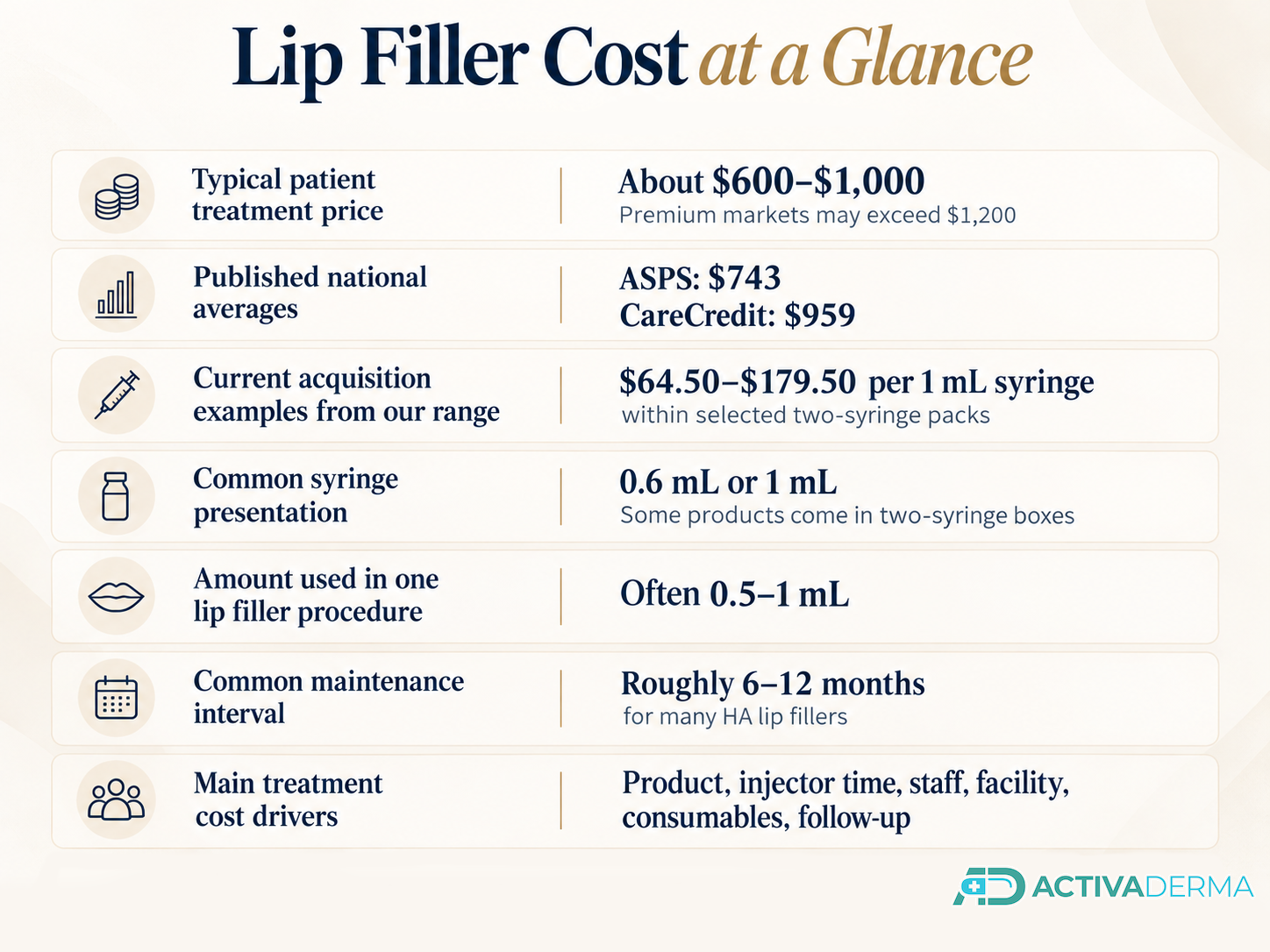
The American Society of Plastic Surgeons reports an average cost of $743 for lip augmentation with dermal fillers, while CareCredit reports a higher average total of $959. Neither number is a clinic's product cost.
|
Cost factor |
Practical U.S. benchmark |
What it means for a practice |
|
Typical patient treatment price |
About $600 to $1,000; premium markets may exceed $1,200 |
The amount charged for the complete visit, not the filler alone |
|
Published national averages |
$743 from ASPS; $959 from CareCredit |
Different methods and included fees can produce different averages |
|
Current acquisition examples from our range |
$64.50 to $179.50 per 1 mL syringe within selected two-syringe packs |
Product cost before labor, supplies, overhead, and follow-up |
|
Common syringe presentation |
0.6 mL or 1 mL; some products come in two-syringe boxes |
Pack size affects cash outlay, inventory, and cost per syringe |
|
Amount used in one lip filler procedure |
Often 0.5 to 1 mL |
Anatomy and the planned result should set the volume |
|
Common maintenance interval |
Roughly 6 to 12 months for many HA lip fillers |
Shorter intervals increase annual patient spend and clinic workload |
|
Main treatment cost drivers |
Product, injector time, staff, facility, consumables, and follow-up |
Sustainable pricing must cover the full care pathway |
How Much Does One Syringe of Lip Filler Cost?
Patients commonly pay about $600 to $1,000 for one 1 mL syringe, although specific prices can fall outside that range. The CareCredit market review found costs ranging from $332 to $2,354 for a lip filler treatment, which shows how strongly location and treatment scope matter.
That patient fee is not the clinic's acquisition cost. It also covers assessment, numbing, injections, records, staff, overhead, and follow-up. Two clinics can buy the same hyaluronic acid filler yet set different prices because their labor and operating costs differ.
What Determines Lip Filler Pricing in a Practice?
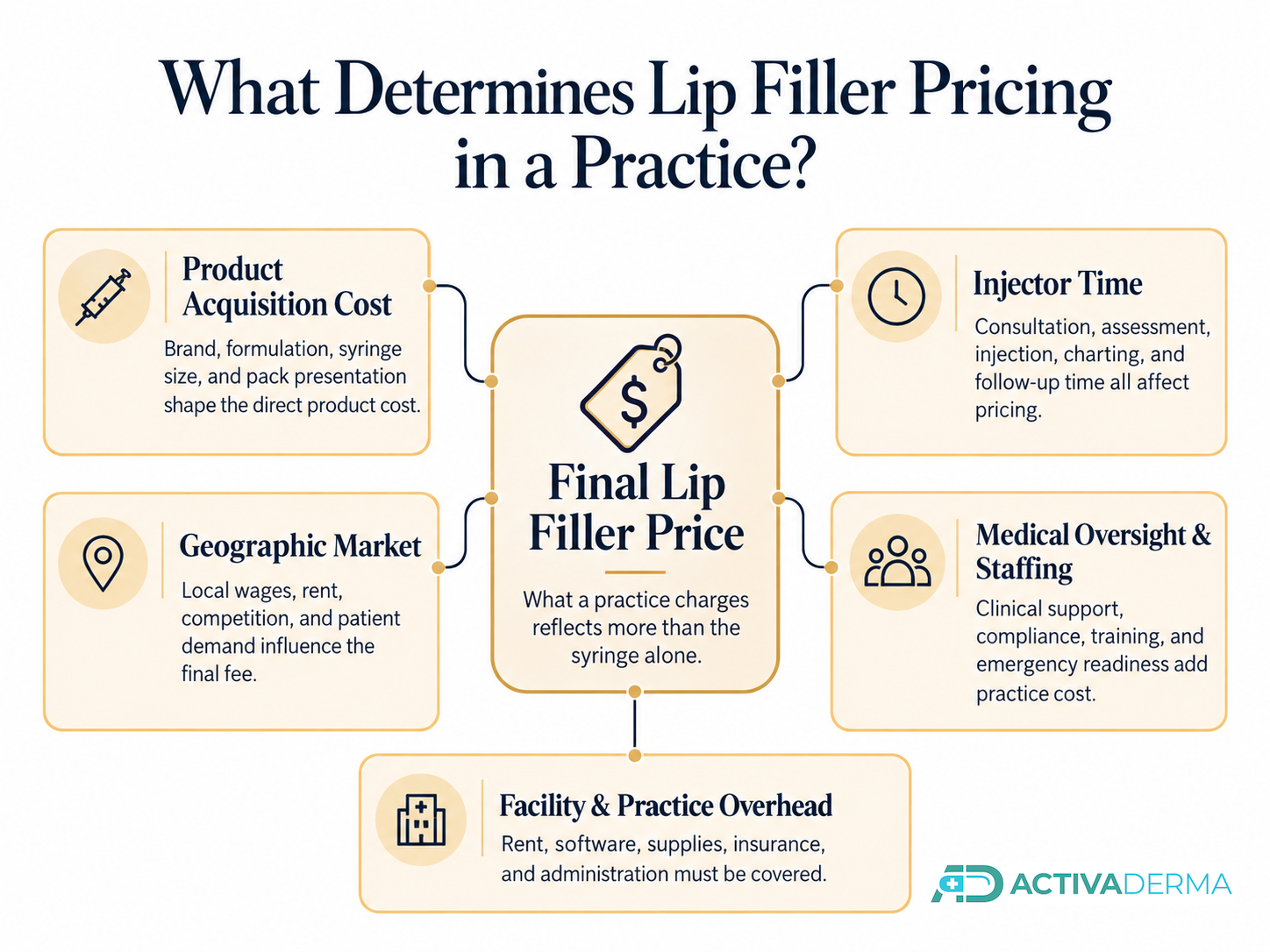
Five factors usually shape the final fee. Looking at them separately makes it easier to see whether a treatment is priced sustainably or simply copied from a nearby clinic.
#1. Product Acquisition Cost
The syringe is the highest direct cost in many lip filler treatments. Brand, formulation, syringe size, pack quantity, and order volume all matter. A two-syringe box may lower the filler cost per treatment, but only if the second syringe is used before it expires.
#2. Injector Time
A 30-minute injection slot may require 60 minutes of real work once consultation, facial assessment, photography, consent, preparation, charting, and follow-up are counted. An experienced injector may charge more because the fee reflects judgment and complication readiness, not only time with a needle.
#3. Medical Oversight and Staffing
Clinical care also depends on medical direction, trained support staff, front-desk time, continuing education, emergency protocols, and state compliance. These costs continue even on a quiet day, so leaving them out can make a busy filler service look more profitable than it is.
#4. Facility and Practice Overhead
Rent, insurance, software, secure storage, consumables, marketing, and administration belong in the treatment cost. For example, $18,000 in monthly overhead divided across 240 completed visits adds $75 to each visit before the filler or injector is paid.
#5. Geographic Market
Lip fillers vary in price with rent, wages, competition, and local patient demand. A major-city practice may support a higher fee than a smaller market, but copying the highest local price without matching its service, expertise, and patient experience rarely works.
How Filler Brand Affects Lip Filler Cost
Well-known families such as JUVÉDERM and Restylane often carry strong patient recognition and lip-specific clinical evidence. Names such as Restylane Silk and JUVÉDERM Volbella may therefore support premium positioning for volume or perioral wrinkles. Other filler types from Belotero, Teosyal, and Aliaxin give practices different textures, pack sizes, and acquisition costs.
Price alone does not identify the better choice. A higher-cost product may earn its place when the gel suits the lip shape, the injector knows it well, patients request it, and the expected maintenance interval supports the overall cost.
For a closer look at which gels suit hydration, soft volume, sharper definition, or stronger projection, compare the six main types of lip fillers before choosing a product for the treatment.
Lip Filler Cost by Product
|
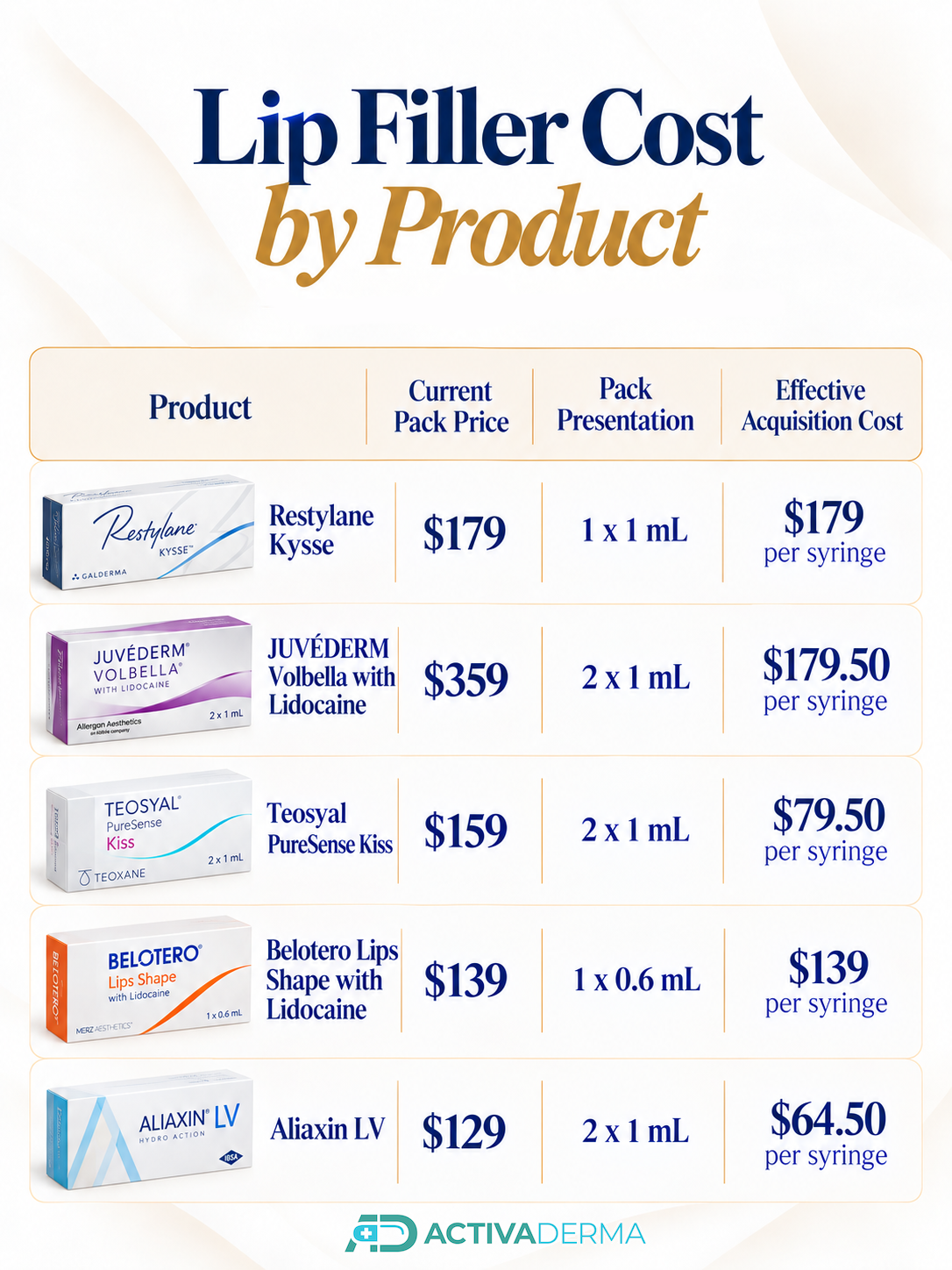
Product |
Current pack price |
Pack presentation |
Effective acquisition cost |
Reported longevity |
Practice consideration |
|
$179 |
1 x 1 mL |
$179 per syringe |
Commonly 6 to 9 months; lip response has been studied through 48 weeks |
Single-syringe purchase limits upfront stock |
|
|
$359 |
2 x 1 mL |
$179.50 per syringe |
Up to 12 months |
Higher box outlay, but two treatment units |
|
|
$159 |
2 x 1 mL |
$79.50 per syringe |
Up to 9 months |
Lower unit cost depends on using both syringes efficiently |
|
|
$139 |
1 x 0.6 mL |
$139 per syringe |
Product and patient dependent |
Smaller presentation can fit modest lip volume goals |
|
|
$129 |
2 x 1 mL |
$64.50 per syringe |
Commonly 6 to 12 months |
Low unit cost is useful only with reliable stock turnover |
These are EC-origin listings. A U.S. practice must confirm that the exact product, pack, indication, and instructions are authorized for its market. FDA approval applies to the exact filler and indication, not every version sold under a familiar family name.
How Much Does 0.5 mL of Lip Filler Cost?
Our review of current U.S. treatment menus puts half-syringe treatment at about $350 to $600. It is not usually half the price of 1 mL because the consultation, setup, injector time, photography, documentation, and follow-up stay almost the same.
Some practices do not sell 0.5 mL from a 1 mL syringe. Once a single-patient syringe is opened, the unused filler cannot become stock for another patient. A dedicated 0.6 mL presentation can make small amounts easier to price without planned waste.
How Much Does 1 mL of Lip Filler Cost?
About $600 to $1,000, with some experienced injectors and high-cost markets charging $1,200 or more. Many hyaluronic acid dermal fillers come in a 1 mL syringe, so this is the clearest unit for comparing menus. Still, the typical total cost should reflect the exact filler used and the full service included.
How Much Product Is Typically Used for Lip Filler?
Many first lip filler procedures use 0.5 to 1 mL, but there is no safe universal amount. A small amount may soften asymmetry or define the upper lip, while 1 mL may better support thin lips or add volume across both lips.
Larger changes are often easier to control through staged treatments instead of forcing the desired lip volume into one visit. Anatomy, previous filler, tissue capacity, and the goal for a natural lip should decide the plan.
How Long Lip Filler Lasts and Why It Matters for Pricing
Most hyaluronic acid fillers used in the lips last about 6 to 12 months, although movement, metabolism, formulation, and volume affect the result.
Product-specific evidence is more useful. U.S.-labeled Restylane Kysse was studied through 48 weeks, while U.S.-labeled JUVÉDERM Volbella XC showed results through one year in many study participants. A product that costs more per syringe may still offer good annual value if it fits the tissue and reduces maintenance visits.
How Much Do Lip Fillers Cost Per Year?
Annual cost depends on both price and retreatment timing. Suppose a practice charges $750 and spends $420 to deliver each completed treatment. Two visits produce $1,500 in revenue and $840 in delivery costs, leaving $660 before taxes and other unassigned costs. A $900 annual treatment costing $500 to deliver leaves $400.
How Clinics Should Calculate Lip Filler Treatment Cost
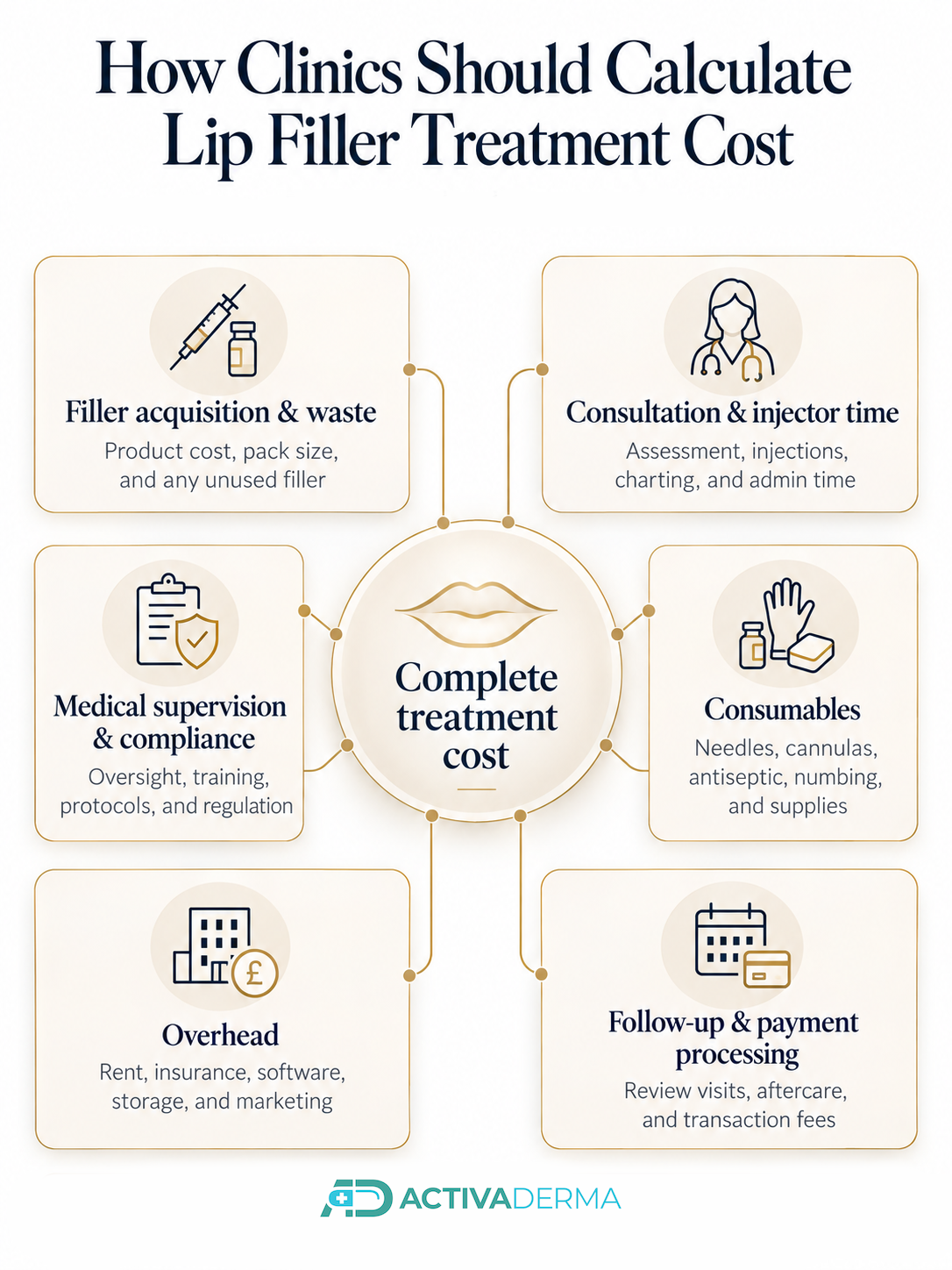
Start with the complete care pathway, not the invoice for the syringe. For example, an $800 treatment could include $180 for filler, $110 for clinical and administrative labor, $20 for supplies, $90 in allocated overhead, $30 for follow-up, $50 in patient acquisition, and a $24 card fee. That is $504 before tax, unexpected care, or profit.
Each price should account for:
- Filler acquisition and possible product waste
- Consultation, injector, documentation, and administrative time
- Medical supervision, training, and compliance
- Needles, cannulas, antiseptic, numbing, and other consumables
- Rent, insurance, software, storage, and marketing
- Payment processing and planned follow-up care
Cost per Syringe vs Cost per Treatment
Cost per syringe is what the practice pays for one unit of filler. Cost per patient adds the resources used for that person's visit. Cost per completed treatment goes further by including consultation, staff, consumables, overhead, follow-up, and waste.
That distinction matters when getting lip fillers involves less than a full syringe. The patient may receive 0.5 mL, but the practice may still consume one single-use syringe and almost the same amount of staff time.
How Provider Experience Influences Lip Filler Pricing
An experienced practitioner may charge more because lip augmentation is not a simple volume sale. Good dermal filler injections require knowledge of facial anatomy, vascular risk, product behavior, symmetry, and proportion. They also require knowing when not to inject. The higher fee may cover more detailed planning and stronger complication protocols, although experience never guarantees a specific result.
How Professional Filler Purchasing Affects Clinic Pricing
The lowest box price is not always the lowest treatment cost. Practices also need authentic supply, reliable delivery, correct storage, traceable lots, usable expiry dates, and pack sizes that match demand. A discounted two-syringe box loses its advantage if the second syringe expires.
We help clinics compare professional dermal fillers by presentation, formulation, and unit price, so purchasing can follow the treatment plan instead of a headline discount.
What Practitioners Should Compare Before Buying Lip Fillers
A useful comparison starts with the patient's lips, then moves to economics. Before adding a product, check:
- The exact FDA indication or other local authorization
- Hyaluronic acid concentration, formulation, and tissue behavior
- Syringe size, units per pack, and true acquisition cost per syringe
- Clinical longevity and the likely maintenance interval
- Injector familiarity and fit with the intended lip shape
- Patient demand, inventory turnover, expiry, and supplier reliability
The FDA treats fillers as medical device implants, so product authenticity and authorization are clinical requirements, not optional purchasing details.
Lip Filler Cost vs Other Injectable Treatments
A lip flip often costs about $80 to $250 because it uses a small botulinum toxin dose, but its effect and goal differ from lip injections with filler. It can relax the upper lip slightly, not add true lip volume, and repeat visits may be needed every few months.
Other facial filler injections may cost more overall because cheeks, chin, or jawline work can require several syringes. Combination cosmetic procedures can also raise the total ticket. Itemizing each treatment keeps the value clear and prevents a low package price from hiding the real cost.
Conclusion
Lip filler cost is shaped by acquisition, product use, clinical time, overhead, demand, and maintenance. A sustainable fee must cover the whole treatment, not just the syringe. When practices connect product choice with patient goals and real delivery costs, both purchasing and pricing become easier to defend.
FAQ
How much does 0.5 ml lip filler cost?
About $350 to $600 is common in the U.S. The fee is more than half of a full treatment in many clinics because consultation, injector time, and follow-up do not shrink with the dose.
Is 0.5 ml of lip filler worth it?
Yes, when the goal is subtle definition, mild asymmetry correction, or a cautious first treatment. It may not create enough change for marked volume loss or a much fuller lip shape.
Is $400 good for lip fillers?
It can be reasonable for 0.5 mL or a promotion. For 1 mL, it is below many U.S. market prices, so confirm the exact product, amount, injector credentials, follow-up, and source before booking.
How much is too much lip filler?
There is no fixed number for every patient. Too much means more volume than the tissue can support naturally, or enough to impair shape, movement, or balance. Staged injections are safer to judge than chasing a large change at once.
How much do lip fillers cost on average?
The ASPS average is $743 for lip augmentation with filler, while CareCredit reports $959. A practical current range for many U.S. treatments is about $600 to $1,000.
How much is one syringe of lip filler?
Patients often pay $600 to $1,000 for one syringe. The clinic's filler cost is much lower, but the patient price also covers professional care and operating expenses.
How much does 1 mL of lip filler cost?
About $600 to $1,000 is typical, with prices above $1,200 in some premium markets. The product, injector, city, and included care set the final fee.
Which lip filler brands cost the most?
JUVÉDERM and Restylane products often sit at the higher end because of brand demand and broad clinical evidence. Actual prices still depend on the exact product, pack, supplier, and local market.
Why do lip filler prices vary between clinics?
Clinics have different product costs, wages, rent, medical oversight, injector experience, service levels, and follow-up policies. Those differences change the total cost of safe treatment.
Are cheaper lip fillers safe?
Price alone cannot prove safety. Confirm that the exact filler is authentic, authorized for the market, stored correctly, and injected by a qualified professional. Most insurance plans do not cover lip fillers because they are elective, so an unusually low cash price deserves careful review.