
A patient may ask for “a little lip filler,” yet that simple request leaves several clinical choices unanswered.
Different types of lip filler vary by material, gel texture, flexibility, longevity, and intended result. The right option depends on lip anatomy, treatment goals, and the exact product indication in your market.
Types of Lip Filler at a Glance
|
Filler type or category |
Common examples |
Best suited for |
Typical texture |
Approximate longevity |
Dissolvable |
Key considerations |
|
Soft hyaluronic acid fillers |
Juvéderm Volbella XC, Restylane Silk, Belotero Lips Contour |
Hydration, light definition, and fine lines |
Smooth and flexible |
About 6 to 12 months |
Yes, with hyaluronidase |
Limited projection; check the exact lip or perioral indication |
|
Medium-structure hyaluronic acid fillers |
Restylane Kysse, RHA 3, Aliaxin LV |
Natural-looking volume, shape, and movement |
Flexible with moderate support |
About 9 to 12 months |
Yes, with hyaluronidase |
Often the useful middle ground between movement and visible volume |
|
Firmer hyaluronic acid fillers |
Juvéderm Ultra XC and selected lip-specific volumizers |
Projection and fuller lips |
More supportive and cohesive |
About 9 to 12 months |
Yes, with hyaluronidase |
A firm facial filler is not automatically suitable for lip injections |
|
Collagen fillers |
Historical bovine or human collagen products |
Temporary line smoothing and mild augmentation |
Soft, with less predictable integration |
Commonly 3 to 4 months |
No direct enzyme reversal |
Rarely chosen now; bovine products may require allergy testing |
|
Fat transfer |
Processed autologous fat |
Longer lip augmentation during a surgical plan |
Soft tissue rather than gel |
Surviving fat may last years |
No |
Greater swelling, donor-site recovery, and variable graft retention |
|
Permanent fillers |
Silicone or PMMA-based products |
No routine standard lip indication in the United States |
Product-dependent |
Permanent or very long term |
No |
Removal can be difficult; Bellafill is contraindicated for lip augmentation |
Hyaluronic Acid Lip Fillers
Hyaluronic acid lip fillers are the most popular types because they provide temporary volume with adjustable gel properties. HA naturally occurs in tissue and binds water, but commercial products use modified, cross-linked HA for better persistence.
The FDA estimates HA filler effects at roughly 6 to 12 months, although exact product studies provide better guidance.
Soft and Flexible HA Fillers
Soft HA fillers work best for patients getting lip fillers mainly for hydration, border refinement, or fine lines. Their lower structural support preserves movement but may provide limited projection in a thin upper lip. A softer filler can also help mature lips without adding heavy volume.
Medium-Structure HA Fillers
Medium-structure gels balance flexibility with enough support to shape the vermilion body and improve mild asymmetry. Restylane Kysse, for example, retained a one-grade lip fullness improvement in 60% of study participants at week 48.
Firmer HA Fillers
A firmer lip filler increases lip volume and projection when the anatomy can support a stronger change. This lip filler procedure demands restraint because added structure can feel heavy in a small mouth. Providers should choose a lip-indicated product, since firm cheek fillers are not automatic lip options.
Popular Lip Filler Brands and Products
Brand recognition may start the conversation, but the exact syringe should finish it. Products within one family can use different HA concentrations, technologies, pack sizes, and approved indications.
|
Brand and product |
Filler material |
Texture or flexibility |
Common treatment goal |
Manufacturer-reported longevity |
Lidocaine included |
Market or regulatory note |
|
Juvéderm Volbella XC |
Cross-linked HA using Vycross technology |
Soft, smooth, and flexible |
Subtle lip volume and perioral lines |
Up to one year; 61.8% remained lip-fullness responders at one year |
Yes, 0.3% |
FDA approved for lips and perioral rhytids in adults over 21 |
|
Juvéderm Ultra XC |
Cross-linked HA |
Smooth with stronger plumping support |
Added fullness and visible lip volume |
Up to one year; 56.4% remained responders at 12 months |
Yes, 0.3% |
FDA approved for lip augmentation in adults over 21 |
|
Restylane Kysse |
Cross-linked HA using XpresHAn technology |
Flexible with moderate support |
Fullness, definition, and upper perioral lines |
Improvement studied through 48 weeks |
Yes, 0.3% |
FDA approved for lips and upper perioral rhytids in adults over 21 |
|
Restylane Silk |
Small-particle cross-linked HA |
Fine and precise |
Subtle shaping and vertical lip lines |
At least six months in its pivotal study |
Yes, 0.3% |
FDA approved for lips and perioral rhytids in adults over 21 |
|
Belotero Lips Shape and Contour |
Cross-linked sodium hyaluronate using CPM technology |
Shape is more supportive; Contour is lighter |
Lip volume or border definition |
Check the local IFU; no single U.S. claim applies |
Yes, 0.3% |
International products; availability and indications vary by country |
|
Teosyal PureSense Kiss |
Cross-linked HA, 25 mg/mL |
Elastic and adapted to lip movement |
Volume, contour, hydration, and mouth lines |
Up to nine months on the international product listing |
Yes, 0.3% |
EC-origin product; verify local authorization before ordering |
|
RHA 3 |
Resilient cross-linked HA |
Flexible with moderate structure |
Lip body, border, and oral commissures |
48% of patients remained responders at one year |
Yes |
FDA approved for lip augmentation in adults aged 22 or older |
|
Revanesse Lips+ |
Cross-linked HA |
Smooth and moderately supportive |
Lip augmentation |
U.S. evidence follows outcomes through 24 weeks |
Yes, 0.3% |
FDA approved for lip augmentation in adults aged 22 or older |
Juvéderm Lip Fillers
Juvéderm Volbella XC favors subtle shaping, while Juvéderm Ultra XC provides a stronger plumping effect. Both can last up to one year with optimal treatment, according to official Juvéderm lip data. Volbella also carries a U.S. indication for perioral lines, making the exact treatment goal important.
International buyers may encounter different names and pack sizes, including Juvéderm Ultra Smile. That product contains two 0.55 mL syringes, 24 mg/mL HA, and 0.3% lidocaine.
Restylane Lip Fillers
Restylane Kysse gives flexible support for volume and movement, while Restylane Silk targets finer correction and lip lines.
Kysse uses XpresHAn technology and showed a 60% fullness response at week 48. Silk remained effective for both lips for at least six months in its FDA-reviewed pivotal study.
Clinics comparing Restylane fillers should also check syringe size and regional packaging before purchasing. Our Restylane Kysse with lidocaine is an EC-origin product, so the supplied instructions remain the controlling reference.
Belotero Lip Fillers
Belotero separates lighter contour work and fine lines from fuller shaping through its Lips Contour and Lips Shape products. Belotero Lips Contour contains 22.5 mg/mL HA, while Shape contains 25.5 mg/mL. Both arrive in 0.6 mL syringes and include 0.3% lidocaine.
Teosyal Lip Fillers
Teosyal offers elastic HA gels for areas that move constantly during speech, smiling, and eating. RHA 3 is FDA approved for the lip body, border, and oral commissures. At one year, 48% of study patients remained responders for measurable lip fullness after their initial treatment.
Internationally, Teosyal PureSense Kiss provides two 1 mL syringes with 25 mg/mL HA and lidocaine. It targets contour, volume, hydration, and fine lines, with reported results lasting up to nine months.
Other Lip Filler Brands
International lip filler families give clinicians more room to match the gel with the patient’s anatomy and preferred result. Within the Aliaxin range, Aliaxin FL supports gentle shaping and fine-line correction, while Aliaxin LV adds more noticeable lip volume.
A similar choice appears within Stylage, where Special Lips supports lighter enhancement and Lips Plus creates a fuller result. Neauvia Organic Intense Lips takes a different approach, combining 24 mg/mL PEG-cross-linked HA with glycine and L-proline.
Revanesse Kiss+, Saypha Lips, and Revolax provide further options for clinics building a more flexible lip filler range. However, formulation, approved use, and availability can change between countries, so clinicians should always check the exact local labeling before ordering.
Types of Lip Filler by Desired Result
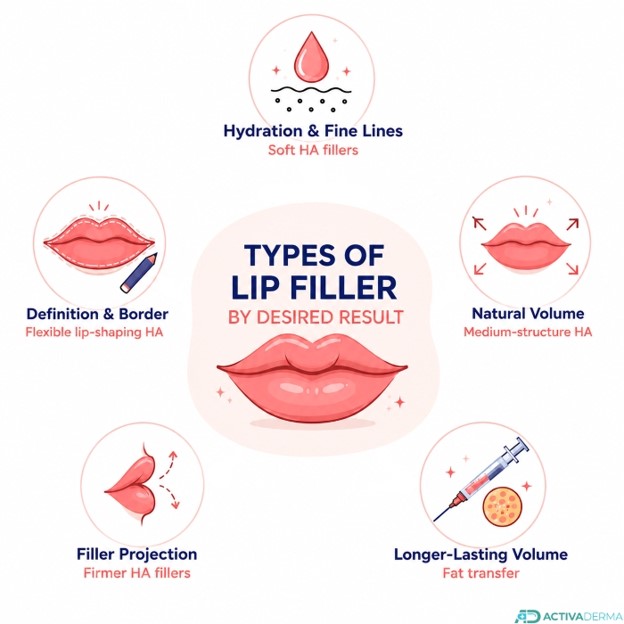
The best lip filler option begins by defining what the patient wants from this cosmetic treatment. “Natural” can mean better hydration, clearer borders, restored age-related volume, or simply less asymmetry.
Lip Filler for Subtle Hydration
A soft HA gel provides the most controlled option for subtle hydration and barely visible fullness. The plan may use less product, but “hydration” still requires a lip filler procedure. It should never be sold as skincare or presented as free from injection risk.
Lip Filler for Natural-Looking Volume
Natural-looking volume usually needs a flexible gel that supports expression without overpowering the patient’s existing lip shape. One milliliter equals only about one-fifth of a teaspoon, yet that amount can create a clear change. Smaller starting volumes may better fit narrow lips, limited tooth show, or a first filler procedure.
Lip Filler for Definition and the Cupid’s Bow
Clearer definition usually calls for controlled placement along selected parts of the vermilion border and Cupid’s bow. The right filler needs enough precision to hold a clean edge without creating a stiff outline. Baseline photographs should include rest, smile, profile, and three-quarter views before the filler procedure.
Lip Filler for Projection and Fuller Lips
Projection requires more structural support than a light hydration treatment, but product firmness has limits. Plump lips should still close comfortably and move naturally during speech. Excess upper lip weight can reduce tooth show, while added lower lip volume can disturb facial balance.
Lip Filler for Asymmetry
Lip filler can soften mild asymmetry, although it cannot correct every skeletal, dental, muscular, or scar-related difference. Providers should compare the upper lip and lower lip at rest and during animation. A careful filler lip plan corrects visible imbalance without adding a second one.
Filler for Lip Lines and the Perioral Area
Fine lines around the mouth need a different plan from lip augmentation, even when both cosmetic procedures share one visit. A low-volume, softer filler may suit vertical lip lines, while deeper support may address surrounding volume loss. The exact product must carry the correct lip or perioral indication for that market.
Lip Filler Types by Texture and Gel Technology
Two clear gels can behave very differently after injection, especially in lips that move constantly. Manufacturing changes their elasticity, cohesivity, water uptake, particle structure, and resistance to repeated lip movement.
What Makes One Lip Filler Softer Than Another?
Softness reflects several linked properties, including elastic modulus, viscosity, cohesivity, HA concentration, and cross-linking. Higher G prime often suggests greater resistance to deformation, but one number cannot predict the full result. Rheology research confirms that manufacturing changes both HA chain integrity and clinical gel behavior.
Monophasic vs. Biphasic HA Fillers
Monophasic fillers form a more continuous gel, while biphasic fillers contain cross-linked particles within a carrier phase. This difference can affect tissue distribution and handling, but neither category wins every clinical task. Product-specific evidence, placement plane, and treatment goal matter more than the label alone.
Fillers With and Without Lidocaine
Lidocaine inside a filler can reduce discomfort as the gel enters tissue, but it does not numb the first puncture. Most listed lip products contain 0.3% lidocaine, so providers must check allergies and total anesthetic exposure. Topical anesthetic or a nerve block can add comfort when clinically appropriate.
Are There Non-HA Types of Lip Filler?
Yes, but non-HA choices have a smaller modern role because they lose the practical advantage of hyaluronidase reversal. Collagen fillers, fat grafting, implants, and permanent materials also bring different recovery, predictability, and removal concerns.
Collagen Lip Fillers
Collagen lip fillers were once popular, but HA fillers largely replaced them. Traditional collagen fillers lasted three to four months, while bovine products could require two allergy tests spaced three to four weeks apart. The old “collagen lips” approach is not interchangeable with collagen-stimulating products such as Sculptra.
Fat Transfer to the Lips
A fat transfer lip procedure harvests fat through liposuction, processes it, and reinjects surviving cells through fat injections. This cosmetic procedure may take 60 to 90 minutes, and surviving fat can remain for years. However, a plastic surgeon should explain variable absorption, donor-site recovery, swelling, and difficult revision.
Permanent Lip Fillers
Permanent filler injections carry an awkward trade-off: the material stays while the face continues changing around it. The FDA-approved PMMA filler Bellafill is specifically contraindicated for lip augmentation and vermilion injection. Injectable silicone is also not an FDA-approved lip filler option, and removal may require surgery.
Why Radiesse and Sculptra Are Not Standard Lip Fillers
Radiesse and Sculptra are facial fillers, but neither is a standard product for direct lip augmentation. Radiesse labeling states that lip safety and effectiveness are unestablished, with published reports of nodules. Sculptra must not enter the lip vermilion, according to its official safety information.
Lip Filler Styles vs. Lip Filler Types
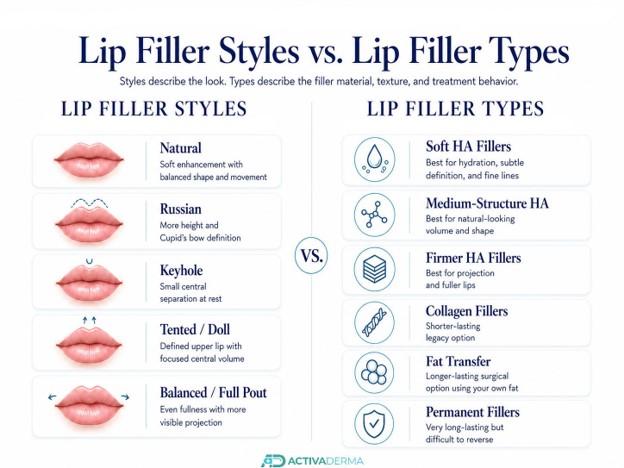
Names such as Russian lips or keyhole lips describe a desired shape or injection approach, not a separate filler material. The same HA-based filler can create different results through product choice, volume, and placement.
Natural Lip Filler
Natural lip filler preserves believable proportions, texture, and movement rather than relying on one special syringe. The provider should build around the patient’s tubercles, Cupid’s bow, dental show, profile, and lip structure. An obvious “filler lip” appearance usually reflects excess volume or poor placement.
Russian Lip Filler
Russian lip filler usually describes vertical shaping intended to increase height and emphasize the Cupid’s bow. The term has no standardized medical definition, so reference photographs and a clear consultation matter. Repeated superficial passes may also increase swelling, bruising, and vascular exposure.
Keyhole Lips
Keyhole lips is a small central gap between the lips when the mouth rests lightly closed. Anatomy does not allow every patient to hold that feature naturally. Forcing the shape with excess filler can impair closure or produce an artificial central mound.
Tented or Doll-Shaped Lips
Tented or doll-shaped lips emphasize upper lip height, a crisp Cupid’s bow, and focused central volume. This look may fit selected anatomy, but it can become top-heavy when the philtrum is long or dental support is limited.
Balanced or Full-Pout Lips
Balanced lips distribute volume across the upper and lower lip while keeping the mouth proportional to nearby features. A full pout uses more visible projection and body volume, yet should preserve closure and animation. Neither result requires a unique filler type, because shape comes from planning, placement, and injection technique.
How to Choose the Best Type of Lip Filler
The smartest choice is often the product that solves one defined problem with the least unnecessary volume. That decision combines anatomy, gel behavior, reversibility, indication, and the clinic’s ability to manage complications.
Start With the Desired Result
Choose the right fillers by turning broad requests into measurable treatment goals. Ask whether the priority is border definition, two-millimeter visual height, central projection, restored volume, symmetry, or fine lines. A hydration request should never quietly become full lip augmentation without a fresh clinical discussion and consent.
Consider the Patient’s Natural Lip Anatomy
Assess vermilion show, philtral length, tubercles, oral commissures, dental support, tooth show, scars, and animation. Older lips may need perioral support and line correction before added body volume. A long upper lip will not reliably shorten through filler alone.
Compare Softness, Flexibility and Structure
Choose gel behavior according to tissue movement and the required endpoint. Softer fillers tend to spread and flex, while more structured gels hold projection and contour. Clinical performance still depends on cohesivity, swelling behavior, injection technique, and the amount placed.
Consider Longevity and Reversibility
Longer duration is useful only when the result remains appropriate as swelling settles and anatomy changes. HA offers an important escape route because clinicians can use hyaluronidase off-label when correction is needed. Different HA formulations may dissolve at different rates, sometimes requiring repeated treatment.
Check the Exact Product Indication
Confirm the product name, treatment area, patient age, market authorization, supplied needles, and current instructions before use. FDA approval belongs to one device and indication, not every regional product carrying the same brand. This check also protects ordering, consent, documentation, traceability, and the clinic’s inventory decisions over time.
How Long Do Different Lip Fillers Last?
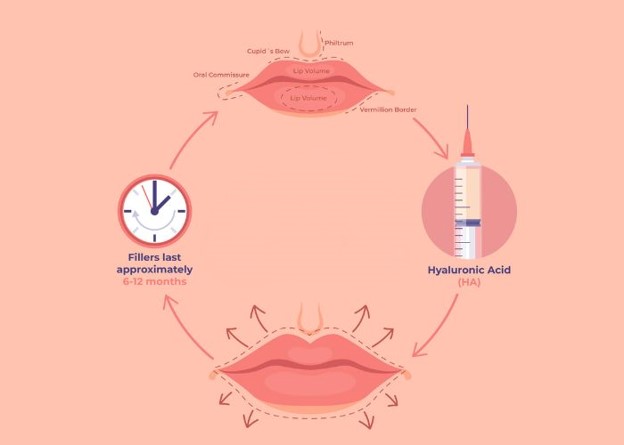
Lip movement, formulation, injection volume, metabolism, and maintenance treatments all affect the filler’s duration. These ranges below are typical visible correction, not guaranteed timelines or proof that every trace of filler has disappeared.
|
Filler category |
Typical duration |
What changes the timeline |
|
Soft HA fillers |
About 6 to 12 months |
Light volume and frequent movement may make subtle results fade sooner |
|
Medium-structure HA fillers |
About 9 to 12 months |
Cross-linking, support, product amount, and metabolism shape persistence |
|
Firmer HA fillers |
About 9 to 12 months in lip-approved products |
Added structure may remain noticeable longer, but does not justify overfilling |
|
Collagen fillers |
About 3 to 4 months |
Product source, tissue response, and repeated treatments affect visible correction |
|
Fat transfer |
Years for surviving grafted fat |
Harvesting, processing, injection technique, healing, and weight change affect retention |
Can Lip Filler Be Dissolved?
HA lip filler can often be reduced with hyaluronidase, although cosmetic filler dissolution is an off-label use in the United States. The enzyme does not reverse collagen, fat, PMMA, silicone, or surgically placed lip implants at all. A 2024 laboratory study also found that HA formulations degrade at different rates, so one session may not fully remove every gel.
Lip Filler Safety and Product Authenticity
In the United States, lip fillers are prescription medical device implants for appropriately licensed, trained professionals. Swelling, bruising, tenderness, firmness, and temporary asymmetry are common, while vascular occlusion can cause tissue loss or blindness. The FDA recommends checking sealed, properly labeled products from authorized sources before any injection begins.
Before each filler procedure, match the carton, syringe, lot number, expiration date, and patient record.
At Activa Derma, we supply authentic professional aesthetic products with clear sourcing details, competitive clinic pricing, and worldwide support. Clinics can compare injectable dermal filler options without losing sight of traceability or regional labeling.
Conclusion: Which Type of Lip Filler Is Best?
The best lip filler is the exact product matching the patient’s anatomy, desired result, and regional indication. Material matters, but gel flexibility, structure, reversibility, and provider judgment shape the final result.
Explore our professional dermal filler range to compare lip filler options for your clinic.
Frequently Asked Questions
Which type of lip filler is best?
HA filler is usually the most practical starting point because it is temporary, adjustable, and potentially dissolvable.
What is the most lasting lip filler?
Permanent materials last longest, but they are generally poor routine lip choices because removal can be difficult.
What is the safest lip filler?
No lip filler is completely safe, although FDA-approved HA products offer strong evidence and possible hyaluronidase reversal.
What type of lip filler looks the most natural?
A soft or medium-flexibility HA filler often produces the most natural movement and texture. The result depends more on matching gel behavior and volume to the patient’s lips than choosing one famous brand.
What is the downside of lip fillers?
Swelling, tenderness, bruising, temporary asymmetry, maintenance costs, and results that may need correction. Rare complications include infection, nodules, migration, vascular occlusion, tissue loss, visual injury, or stroke.
What age is best for lip injections?
There is no ideal cosmetic age, but U.S. lip filler approvals generally begin after age 21.
Do lips go saggy after lip fillers?
Properly planned temporary filler does not automatically make lips sag once it fades. Repeated overfilling may stretch tissue or blur structure, which is why maintenance should follow reassessment rather than a fixed calendar.
Which lip filler is best for older lips?
A softer HA filler often fits older lips needing border support, gentle hydration, or vertical-line correction.
What to avoid after lip filler injections?
Pressing, massaging, or exposing swollen lips to unnecessary irritation. Many protocols also delay strenuous exercise, alcohol, heat, and lip products for about 24 hours.
When do lips look best after fillers?
Lip results usually become easier to judge after major swelling settles, commonly within one to two weeks.
What can ruin lip fillers?
Poor product selection, excessive volume, weak anatomy knowledge, unverified supplies, infection, and repeated premature top-ups can damage results. Normal talking, eating, and facial movement do not suddenly destroy properly placed filler.