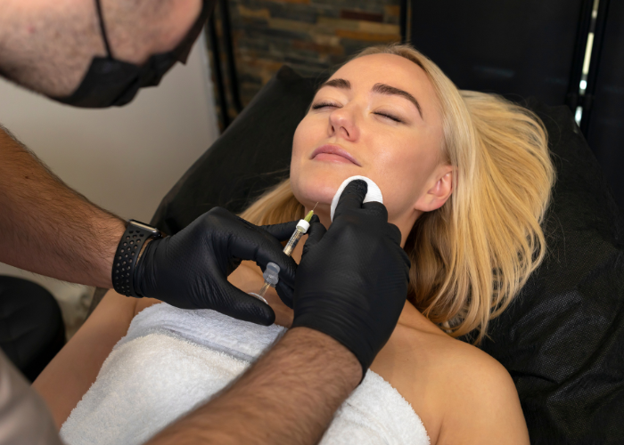

A patient may return because their filler “has gone,” yet the tissue can tell a more complicated story.
How long do fillers last depends on the exact product, treatment area, injection depth, volume, technique, and patient.
Filler Longevity at a Glance
|
Filler or treatment area |
Typical duration |
Main factors affecting longevity |
|
Lip fillers |
6 to 12 months |
Softer gel, constant movement, hydration versus added volume |
|
Cheek fillers |
12 to 24 months |
Product firmness, deep placement, degree of volume loss |
|
Chin fillers |
12 to 18 months |
Structural gel, supraperiosteal or subcutaneous placement, projection goal |
|
Jawline fillers |
12 to 18 months |
Product, total volume, movement, baseline anatomy |
|
Under-eye fillers |
About 12 months visibly; residual HA may remain longer |
Thin tissue, lymphatic drainage, prior treatments, placement |
|
Nasolabial fillers |
6 to 18 months |
Facial movement, filler type, direct fold treatment versus cheek support |
|
Hyaluronic acid fillers |
6 to 18 months; selected products reach 24 months |
Crosslinking, consistency, area, depth, repeated treatment |
|
Calcium hydroxylapatite fillers |
About 12 to 18 months |
Placement, dilution, indication, collagen response |
|
Poly-L-lactic acid fillers |
Up to two years |
Treatment series, collagen production, baseline volume loss |
|
Permanent fillers |
PMMA remains in tissue; five-year correction data exist |
Product indication, placement, aging, limited reversibility |
These ranges describe noticeable correction, not a guaranteed date when every trace disappears completely from treated tissue. Product labeling should guide clinical estimates because the FDA approves each filler for specific tissues and uses.
How Long Do Fillers Last by Treatment Area?

Filler tends to remain visibly useful longer in stable areas treated within the correct deeper tissue plane. Softer tissues that move during speaking, chewing, and expression usually lose their obvious cosmetic correction sooner.
How Long Do Lip Fillers Last?
Lip fillers usually last 6 to 12 months, although exact products can reach one year with optimal treatment. A softer filler used for hydration may lose its visible effect sooner than a larger volume correction because the lips move constantly.
How Long Do Cheek Fillers Last?
Cheek fillers commonly last 12 to 24 months, depending on product, placement, correction goal, and patient anatomy. Firmer HA filler placed deeply for structural support often lasts longer than softer product used superficially. Restoring broad facial volume may also require more product than enhancing cheek projection alone during treatment.
How Long Do Chin Fillers Last?
Chin fillers generally last 12 to 18 months, depending on the selected product and depth of placement. Firm gels placed deeply can hold projection better, but clinicians should follow the label and reassess profile balance before maintenance.
How Long Do Jawline Fillers Last?
Jawline fillers usually remain visible for 12 to 18 months after a well-planned initial treatment. Longevity changes with product firmness, volume, lower-face movement, and bone structure, so similar treatment plans may need different follow-up dates.
How Long Does Under-Eye Filler Last?
Under-eye filler can remain visibly effective for about 12 months, but residual tear trough filler may persist much longer. A 33-patient MRI review found HA in every midface studied at least two years after injection, with one case reaching 15 years.
How Long Do Fillers Last in Smile Lines?
Nasolabial fold correction commonly lasts 6 to 18 months, depending on the product and movement. Directly filling the fold treats the crease, while restoring nearby cheek support may soften the fold through a different anatomical approach.
How Long Do Temple and Hand Fillers Last?
Temple correction commonly lasts 12 to 18 months, while labeled hand treatments often last around 12 months. These areas have different vessels, tissue planes, and approved products, so anatomy and current regional instructions matter more.
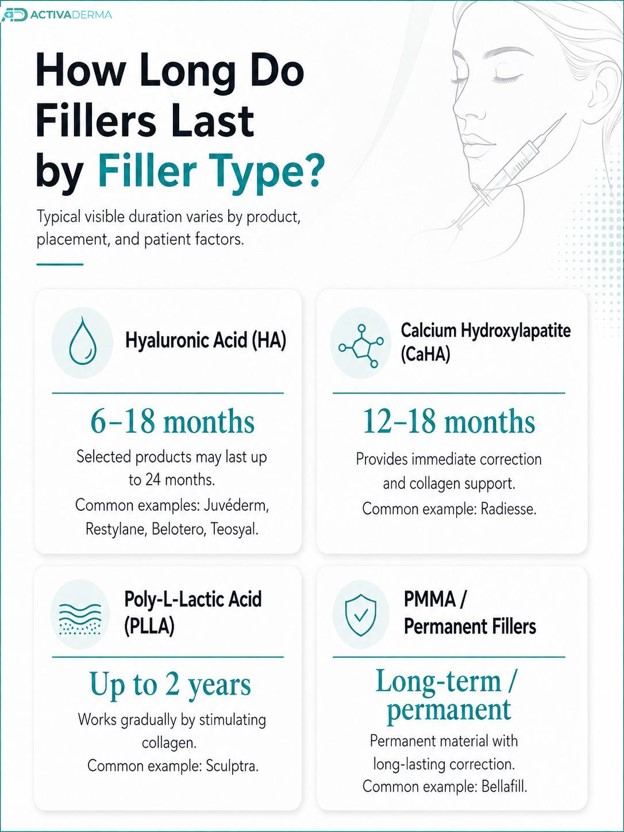
How Long Do Fillers Last by Filler Type?
Material provides a useful starting point, but again, exact product labeling gives the safer and more accurate answer.
Hyaluronic Acid Fillers
Hyaluronic acid fillers usually provide visible results for 6 to 18 months, with selected cheek products lasting up to two years. These HA fillers use crosslinked hyaluronic acid to resist breakdown, attract water, and provide different levels of softness or structural support.
Calcium Hydroxylapatite Fillers
Calcium hydroxylapatite fillers provide immediate correction and usually last about 12 to 18 months across common treatment areas. The FDA describes an approximate 18-month effect, while exact Radiesse claims vary by indication and treatment method. Unlike HA filler, CaHA has no direct dissolving enzyme currently available for routine clinical reversal.
Poly-L-Lactic Acid Fillers
Poly-L-lactic acid fillers work gradually by supporting new collagen production rather than creating their full result immediately. Sculptra results can appear from one month and may last up to two years after treatment. A typical plan uses three treatment sessions spaced at least three to four weeks apart.
Permanent and Non-Absorbable Fillers
PMMA fillers contain microspheres that the body does not absorb, so the implanted material is permanent. Bellafill has five-year follow-up data for nasolabial folds, but removal can be difficult or impossible. That lasting result brings an important tradeoff, demanding conservative patient selection, precise placement, and especially careful informed consent.
How Long Do Popular Dermal Filler Brands Last?
A brand name alone cannot answer how long dermal fillers last across every product, patient, and treatment area.
Each family contains different gels, approved uses, injection depths, durations, and handling requirements for clinicians.
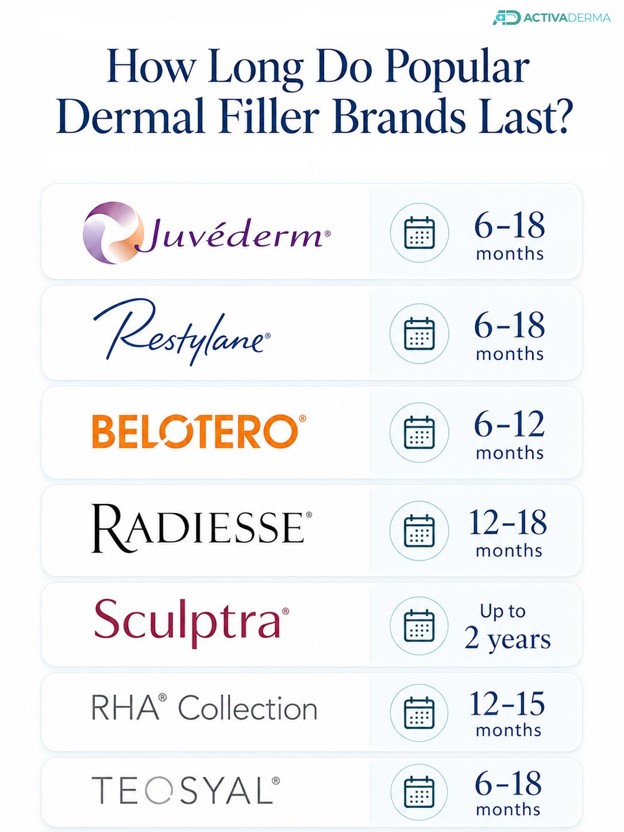
So, match the exact device and indication with current prescribing information for your jurisdiction before selecting or ordering it.
|
Brand or product |
Filler material |
Common treatment areas |
Typical or reported duration |
Key product characteristics |
|
HA |
Lips, cheeks, chin, jawline, temples, folds, under-eyes |
Volbella and Ultra XC lips: up to 1 year; Vollure folds: up to 18 months; Voluma midface: up to 2 years |
Product-specific Vycross or Hylacross gels with different firmness |
|
|
HA |
Lips, cheeks, chin, folds, hands, infraorbital hollows |
Commonly 6 to 18 months; Eyelight shows correction through 12 months |
NASHA or XpresHAn products designed for different movement and support needs |
|
|
Belotero Balance |
HA |
Moderate to severe lower-face lines and folds |
Soft, cohesive gel intended to integrate within facial tissue |
|
|
Teosyal RHA 2, 3, 4 |
HA |
Dynamic wrinkles and nasolabial folds |
Resilient gels designed for moving facial areas |
|
|
HA |
Fine lines, lips, facial volume, contour |
Commonly 6 to 12 months, depending on product |
Different molecular weights and consistencies across the range |
|
|
Revanesse Versa+ and Lips+ |
HA |
Nasolabial folds and lips |
Many patients maintain correction at 6 months; international range averages 6 to 12 months |
Smooth HA gels; approved indication varies by product |
|
Neauvia Intense Rheology |
PEG-crosslinked HA |
Facial soft-tissue volume |
Average degradation time of 6 months |
22 mg/mL HA with medium injection profile |
|
CaHA |
Lower face, jawline, hands, décolleté |
About 18 months by material; selected manufacturer data report up to 2 years |
Immediate volume plus collagen and elastin stimulation |
|
|
PLLA |
Cheek region and facial wrinkles |
Gradual biostimulation, usually delivered as a treatment series |
What Determines How Long Dermal Fillers Last?
Six connected factors affect filler longevity, but none can predict an exact breakdown date for every patient. Typical longevity comes from product studies and clinical follow-up, rather than a biological timer shared by everyone.
Filler Formulation and Consistency
Crosslinking slows HA breakdown, while gel firmness and cohesivity shape how filler responds to pressure. A firmer product may support cheeks or chin, while softer fillers tend to move more naturally in lips and superficial lines.
Treatment Area and Facial Movement
Lips and nasolabial folds repeatedly flex during normal daily speech, eating, drinking, and facial expression. Cheeks experience less direct motion, which helps explain why long dermal filler results are more common in deeper midface treatment.
Injection Depth and Placement
Injection technique changes appearance, durability, complication risk, and how naturally the treated tissue moves afterward. Deep structural filler may remain stable longer, but superficial misplacement can cause lumps, visibility, or a blue Tyndall effect.
Amount of Filler Used
More filler can produce a larger initial correction, but it does not guarantee slower biological breakdown. Record the fillers used, lot numbers, injection plane, and volume per side, since repeated treatments can leave residual material.
Individual Metabolism and Biology
Patients appear to metabolize filler at different rates, yet no dependable formula converts age, weight, or metabolism into an exact month. Anatomy, tissue quality, inflammation, and previous injections often explain differences better than a simple “fast metabolism” label.
Lifestyle and Skin Health
Smoking and ultraviolet exposure damage collagen and speed visible skin aging, which can shorten the useful cosmetic result. However, strong evidence does not show that hydration, supplements, or avoiding exercise for weeks can materially slow filler degradation.
Visible Results vs. Filler Still Present
The mirror and an MRI can tell two very different stories about the same dermal filler treatment.
Peak cosmetic results combine injected gel, early swelling, tissue support, water binding, and the patient’s surrounding anatomy. So, noticeable improvement can decrease as swelling settles and aging continues, while filler material remains detectable beneath the skin.
That difference becomes especially important after repeated treatment, when several earlier filler injections may still affect current facial volume.
When Should Dermal Fillers Be Topped Up?
A top-up should start with the face in front of you, not the date circled after the previous appointment. At six or 12 months, one patient may show clear fading while another still carries enough residual filler.
Before reaching for another syringe, review these five questions with the patient and compare current anatomy against baseline photographs.
- Has the visible correction noticeably reduced?
- Could residual filler still be present?
- Has the treatment goal changed?
- Is the previous product and volume known?
- Would additional filler genuinely improve the result?
Choosing a Filler Based on More Than Longevity
The longest-lasting option can become the longest-lasting problem when its texture, plane, or reversibility is wrong for the patient.
Match the Filler to the Treatment Goal
Subtle lip hydration needs a flexible HA gel, while chin projection generally needs stronger structural support. A 24-month cheek claim has little value when that product is not indicated for the planned facial rejuvenation area.
Consider Reversibility and Safety
HA filler can be treated with hyaluronidase when clinically appropriate, although complete correction is not guaranteed. CaHA, PLLA, and permanent fillers lack an equivalent direct reversal, making conservative placement especially important.
Consider the Full Maintenance Cost
Compare cost across several expected maintenance appointments instead of judging value from one filler treatment alone. According to current ASPS data, the United States average is $715 for HA dermal filler treatment. Three syringes, therefore, average about $2,145 before provider, city, facility, and follow-up differences in practice.
Professional Product Selection
Before ordering, confirm the approved indication, market-specific packaging, storage, expiry, syringe volume, and intended injection depth. Product familiarity matters, but it cannot replace current anatomy training or the applicable instructions for use.
Dermal Filler Safety and Professional Treatment
The United States recorded 5,331,426 HA filler procedures during 2024, making careful product use more important than ever. Longevity matters only when the original dermal filler injection is appropriate, well planned, and safely performed.
The FDA identifies unintended vascular injection as the most serious risk because it can cause tissue death, blindness, or stroke. Every patient needs a qualified professional who understands anatomy, complication management, injection technique, and product-specific labeling.
At Activa Derma, we supply authentic professional dermal fillers from established manufacturers to clinics and licensed medical professionals. Our range of injectable fillers helps clinicians compare HA gels, biostimulators, and structural products alongside pack details and wholesale pricing. Always confirm that the exact product and indication meet the rules in your market before ordering.
Frequently Asked Questions
Which lasts longer, Botox or fillers?
Most dermal fillers last longer than Botox Cosmetic, although these injections correct very different concerns. Botox Cosmetic commonly lasts three to four months, while absorbable fillers often last 6 to 18 months.
What's the best age to start fillers?
In the United States, dermal filler treatments are generally indicated for adults aged 22 or older. They still require careful assessment of anatomy, goals, medical history, and product indication before treatment.
Where does filler go when it wears off?
Absorbable filler gradually breaks down, after which the body clears its components through normal biological processes. PMMA remains, while HA can persist after visible volume fades, so earlier products must be documented.
How much do 3 syringes of fillers cost?
At the current $715 United States average for HA filler, three syringes total about $2,145. Actual charges vary by product, provider, city, treatment complexity, and included follow-up care for patients.
What's the most natural looking filler?
No single filler always gives the most natural-looking result across every treatment area and patient. Flexible gels fit moving lips, while firm products support cheeks or chins when assessment, placement, and volume are appropriate.
Does face go back to normal after fillers?
Absorbable filler results often fade gradually, although aging continues, and some residual material may remain. Permanent filler remains, while complications or tissue changes can also alter the final appearance significantly for patients.
Do fillers change your face shape?
Yes, facial fillers can noticeably change contour by adding projection, replacing volume loss, or improving symmetry. The degree depends on product firmness, total volume, placement, and anatomy, so conservative treatment usually creates subtler changes.
When do face fillers look their best?
Most HA filler results are judged after swelling settles, commonly around two weeks after treatment. Sculptra develops gradually from around one month, while pain, blanching, or vision changes require immediate earlier review.
What is the most painful area for fillers?
Lips are often more sensitive during filler injections because they contain many nerve endings and move constantly. Pain varies with technique, needle or cannula use, anesthetic, lidocaine-containing filler, and individual sensitivity during treatment.