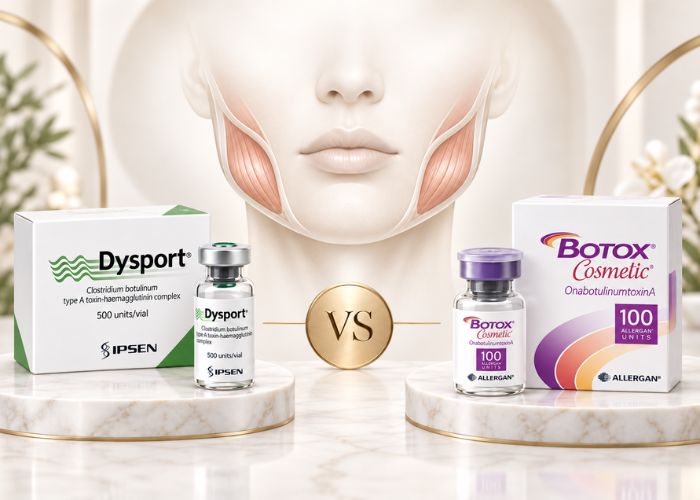

Dysport vs Botox for Masseter: 8 Factors to Compare
Botox and Dysport both relax the masseter, which can reduce jaw tension and gradually slim the lower face.
However, choosing between them is not as simple as comparing units. Botox uses onabotulinumtoxinA, while Dysport uses abobotulinumtoxinA, and each is measured differently.
The right option depends on the patient’s anatomy, treatment goal, previous results, and the clinician’s experience with each product.
Dysport vs Botox for Masseter at a Glance
The biggest mistake in a Dysport vs Botox for masseter reduction comparison is treating units or prices as if they were equal. They are not.
Let’s separate what is known from what is often assumed.
|
Factor |
Botox |
Dysport |
|
Active ingredient |
OnabotulinumtoxinA |
AbobotulinumtoxinA |
|
Formulation |
Contains human albumin and sodium chloride |
Contains human albumin and lactose; may contain trace cow's milk protein |
|
Masseter evidence |
Supported by large phase 2 and phase 3 trials for masseter prominence |
Supported mainly by smaller studies, including a 25-patient comparison with Botox |
|
Visible results in direct studies |
Improvement was measured by day 30, peaked near day 90, and remained through day 180 in a 376-patient phase 3 trial |
A 25-patient split-face study found results similar to Botox at weeks 8 and 12, but longer follow-up was limited |
|
U.S. masseter status |
Off-label; the FDA is reviewing an application for masseter prominence |
Off-label, with no FDA-approved masseter indication |
|
When it may be preferred |
When stronger direct masseter evidence, previous Botox results, or existing treatment records guide the plan |
When the clinician has an established Dysport technique and the patient has responded well to it before |
Why Treat the Masseter With Botulinum Toxin?
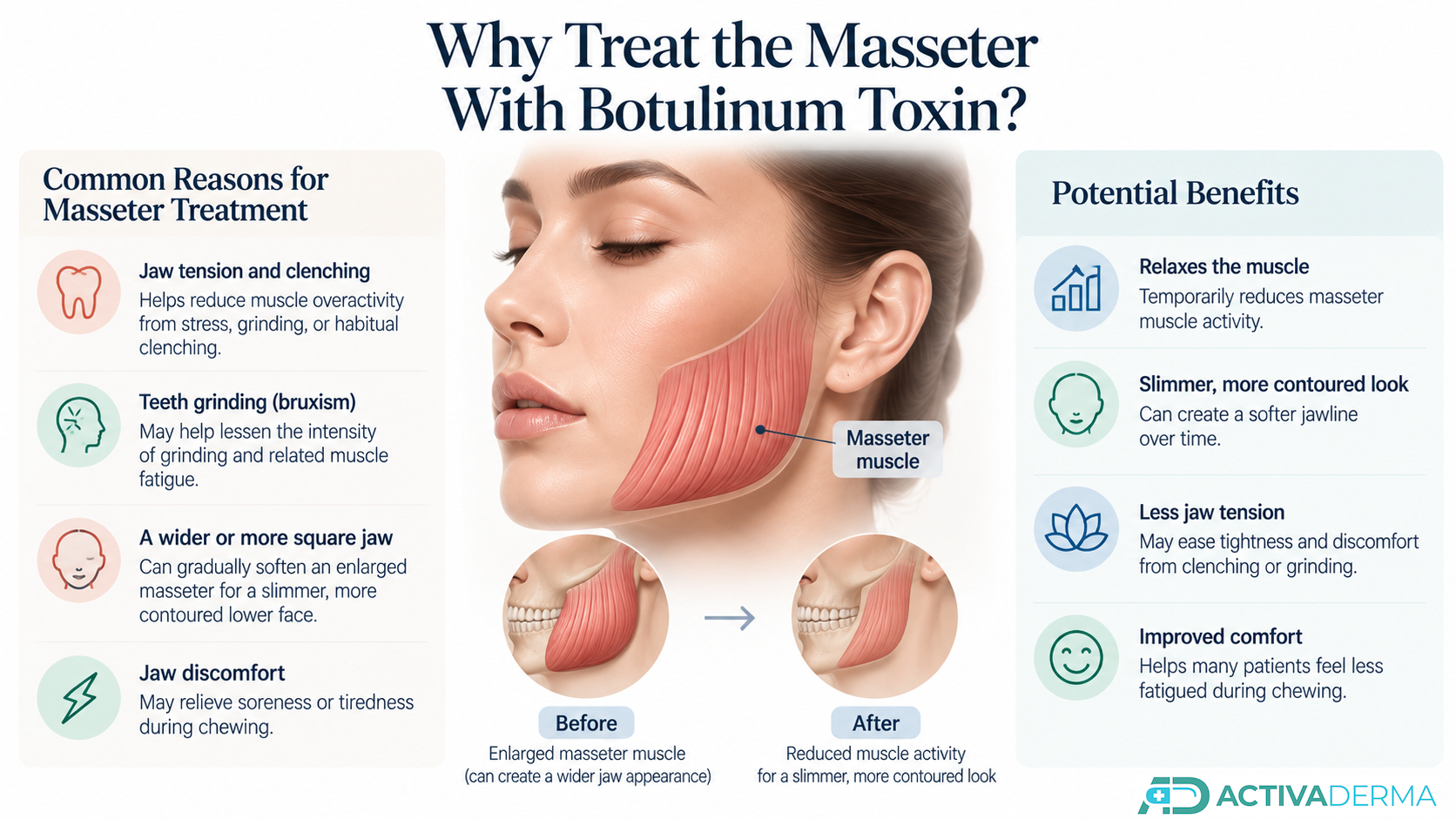
The masseter is one of the main muscles used to close the jaw and chew food. In some patients, it becomes larger from genetics, frequent clenching, or teeth grinding.
This extra muscle activity can create a wider lower face, constant jaw tension, or tiredness during mastication.
Botox and Dysport temporarily relax the muscle, which may ease these symptoms and gradually reduce its size.
Masseter Muscle Prominence and Lower-Face Contouring
Masseter reduction works best when enlarged muscles are causing the wide or square jaw.
A simple clench test helps show this. Ask the patient to bite down firmly and feel for a strong bulge near the back of the jaw. If that bulge creates much of the lower-face width, botulinum toxin may produce noticeable jaw slimming.
However, Botox and Dysport cannot narrow bone, remove facial fat, or reduce an enlarged parotid gland. Providers should also check for loose skin before treatment. Reducing a large masseter can uncover existing jowling, especially in patients with thinner or less elastic skin. Full slimming should never be promised until the real cause of the width is clear.
Bruxism, Jaw Clenching and TMJ-Related Symptoms
Botox or Dysport may help when jaw tension comes from an overactive masseter. By reducing contraction strength, treatment can lower the force behind clenching and teeth grinding. Some patients may notice less morning tightness, muscle tenderness, or chewing fatigue.
Still, masseter treatment does not stop the habit of grinding, protect worn teeth, or repair the TMJ. Pain, jaw locking, clicking, damaged teeth, headaches, or limited mouth opening may have several causes. These patients need a proper dental or orofacial pain assessment before botulinum toxin becomes part of the treatment plan.
How Do Botox and Dysport Work in the Masseter?
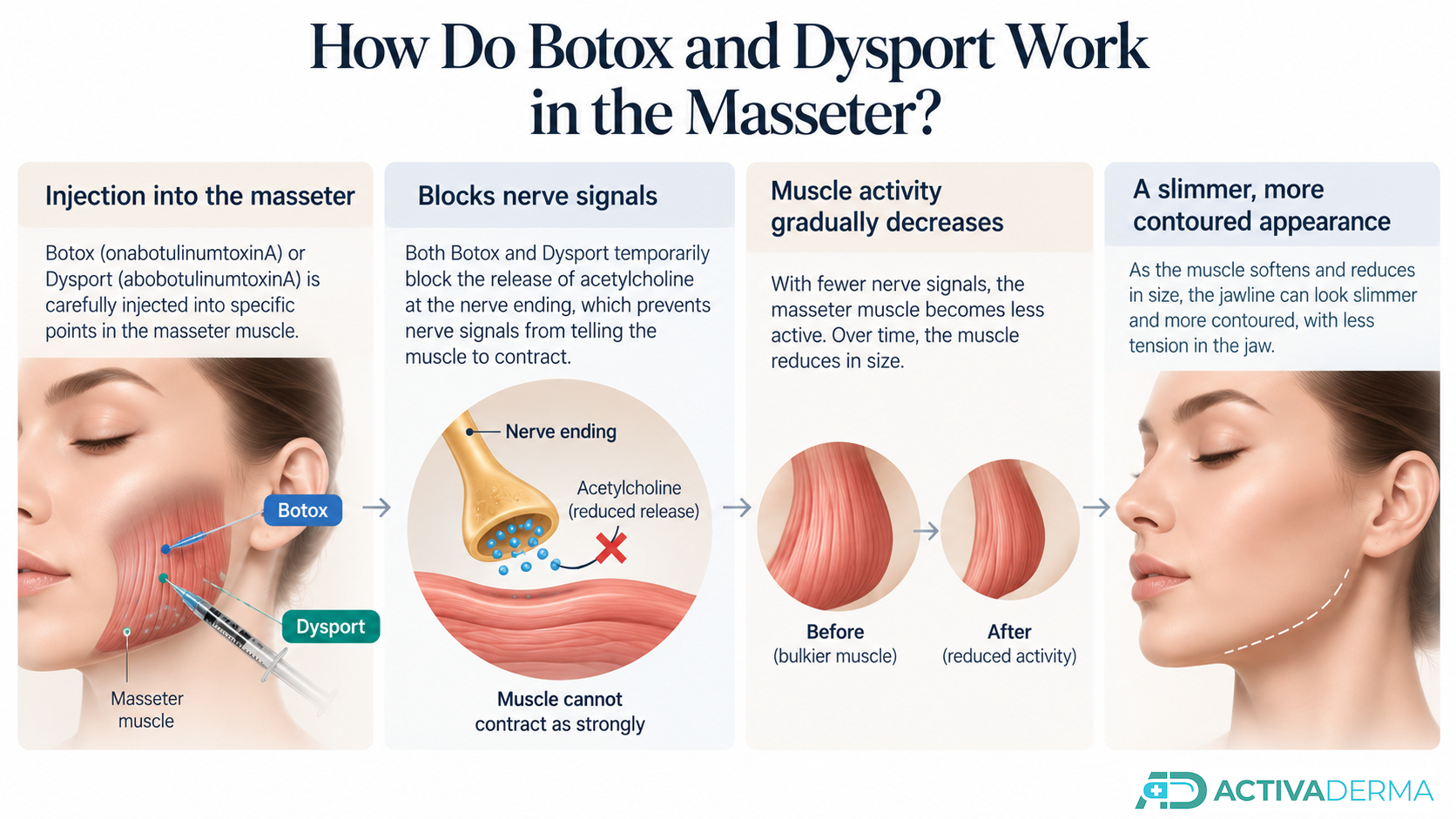
Dysport and Botox work by interrupting acetylcholine release where motor nerves meet the targeted muscle. This creates temporary muscle relaxation.
Activity falls first, then volume decreases with reduced use to produce masseter reduction. As nerve signaling recovers, chewing strength and prominence gradually return.
Botox vs Dysport: What Actually Makes the Products Different?
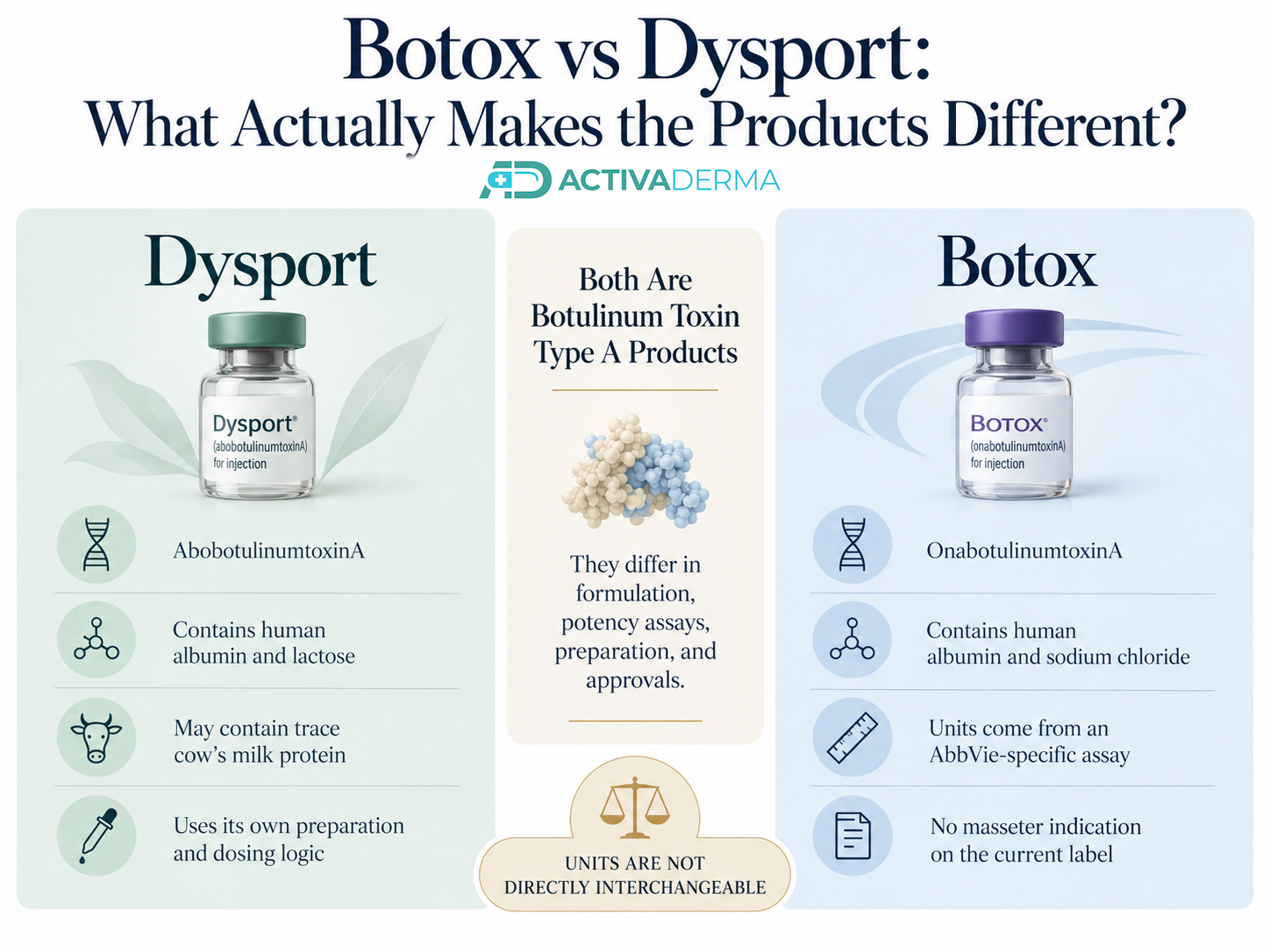
Both are botulinum toxin type A products, but their formulations, potency assays, excipients, preparation, and approvals differ. Their cosmetic and medical uses also differ.
Botox: OnabotulinumtoxinA
Botox uses onabotulinumtoxinA with human albumin and sodium chloride. Its units come from an AbbVie-specific assay. The current Botox Cosmetic label prohibits conversion to another toxin type, and it does not yet include masseter use.
Dysport: AbobotulinumtoxinA
Dysport uses abobotulinumtoxinA with human albumin and lactose, and it may contain trace cow's milk protein. That allergy is a product-specific contraindication. The Dysport prescribing information requires its own preparation and dosing logic.
Dysport vs Botox Masseter Units: Why They Cannot Be Compared 1:1
One Dysport unit is not equal to one Botox unit. Each manufacturer measures potency with its own laboratory test, so 20 units of Botox and 20 units of Dysport would not provide an equivalent masseter treatment.
A 25-patient comparison used 2.5 Dysport units for every Botox unit and found similar improvement at weeks 8 and 12. However, that small study did not create a standard conversion formula. Dysport often requires a higher number of units, but this does not mean it is weaker.
When changing products, clinicians should create a new treatment plan based on the chosen toxin, masseter size, previous response, dilution, and injection technique. The last Botox dose should never be copied directly into Dysport units.
Dysport vs Botox for Masseter Results
Botox has stronger clinical evidence for visible masseter reduction, but current research does not prove that it produces better results than Dysport.
Both can reduce muscle activity, masseter prominence, and lower-face width when the jaw looks wide because of muscle bulk. Baseline size, asymmetry, injection placement, and dose planning often affect the final result more than the brand.
Reduction in Masseter Activity
Botox and Dysport both reduce the nerve signals that make the masseter contract. Patients may notice less clenching force and jaw tension within several days, although visible jaw slimming takes longer. Mild chewing fatigue can occur as muscle activity falls. Trouble eating a normal diet or increasing muscle weakness is not an expected cosmetic result and should be reviewed.
Reduction in Masseter Prominence
Both products can gradually shrink an enlarged masseter, but Botox has been studied more closely. A 25-patient split-face study used a 2.5:1 Dysport-to-Botox unit ratio. At week 12, the average improvement score was 2.9 with Dysport and 2.7 with Botox. That small difference was not enough to establish Dysport as the better option.
With either product, noticeable masseter muscle reduction usually begins within several weeks. The fuller result often appears between weeks 8 and 12.
Facial Shape and Lower-Face Contour
The strongest evidence for jaw slimming currently belongs to Botox. In a phase 3 trial with 376 patients, 72 total Botox units reduced lower-face width by an average of 5.24 mm at day 90. The placebo group changed by only 0.04 mm.
This does not mean every patient needs 72 Botox units, and it does not prove Dysport produces less slimming. It shows that Botox has stronger product-specific evidence for lower-face contouring.
Does Dysport or Botox Work Faster in the Masseter?
Neither has proved faster in a large masseter head-to-head trial. Relaxation may start within days, yet visible masseter reduction takes weeks because the muscle must lose volume.
Botox takes longer to change contour than to reduce activity, as does Dysport.
Recent Botox trials measured improvement at day 30, with the strongest change near three months. Claims of faster Dysport onset mostly come from other treatment areas.
Which Lasts Longer in the Masseter: Dysport or Botox?
Botox has stronger evidence for results lasting up to six months, but this does not prove that Botox lasts longer than Dysport. It simply means Dysport has not been studied for masseter reduction as thoroughly.
For either product, reduced muscle activity often lasts about 3 to 4 months. The slimmer facial contour may remain visible for 4 to 6 months because the masseter needs time to rebuild its previous size.
Dysport vs Botox for Masseter Hypertrophy
Botox is currently better supported by clinical research for masseter hypertrophy. In a phase 3 trial, 51.2% of treated patients achieved at least a two-grade improvement by day 90, compared with 2.2% of the placebo group.
But before choosing either treatment, confirm that muscle growth is causing the wide jaw. Compare both sides while the patient is relaxed and again during a firm clench. A prominent bulge near the mandibular angle during clenching suggests that the masseter contributes to lower-face width, but it does not confirm true hypertrophy on its own. If the width changes very little during clenching, bone, fat, or gland tissue may be the larger cause.
Dysport is still a suitable option when the clinician has strong experience with it or the patient has responded well before.
Dysport vs Botox for Bruxism and Jaw Clenching
Neither Botox nor Dysport has proved better for bruxism or jaw clenching. Both can relax an overactive masseter and reduce the force behind teeth grinding. This may ease morning jaw tension, muscle tenderness, headaches, or chewing fatigue in selected patients.
However, botulinum toxin weakens the contraction rather than stopping the grinding behavior itself. It cannot protect damaged teeth, treat a sleep disorder, or repair the TMJ. Pain, clicking, locking, limited mouth opening, or heavy tooth wear should therefore lead to a proper dental or orofacial pain assessment.
The National Institute of Dental and Craniofacial Research still considers the evidence inconclusive for botulinum toxin injections into the chewing muscles for TMDs. For that reason, Botox or Dysport should be used as one part of a wider treatment plan when appropriate.
Patient Selection: Who Is a Good Candidate for Masseter Toxin?
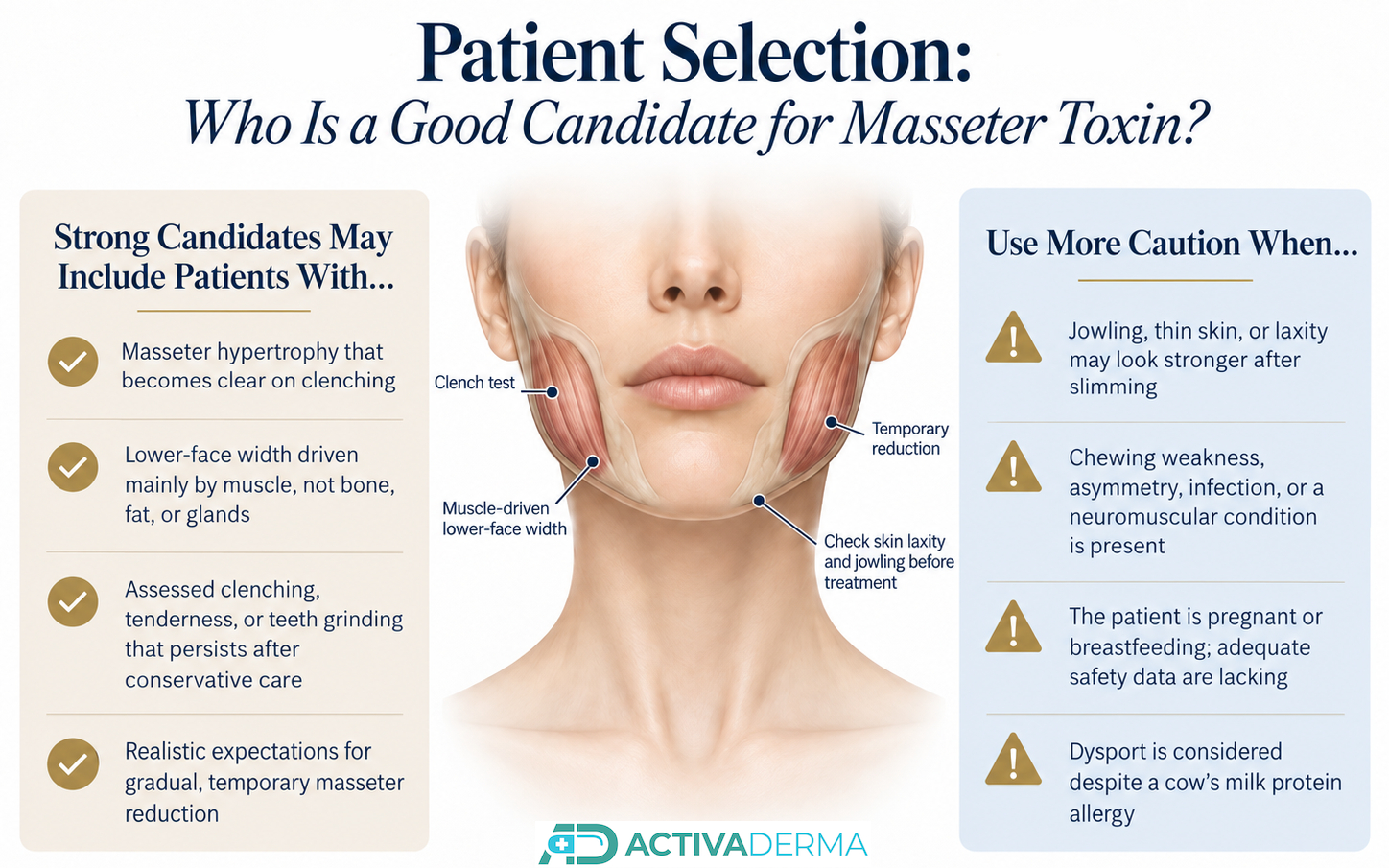
Before masseter treatments, providers should confirm that muscle bulk, rather than bone, facial fat, or loose skin, is causing the concern before planning masseter reduction.
Strong Candidates May Include Patients With...
- Masseter hypertrophy that becomes clear on clenching.
- Lower-face width driven mainly by muscle, not bone, fat, or glands.
- Assessed clenching, tenderness, or teeth grinding that persists after conservative care.
- Realistic expectations for gradual, temporary masseter reduction.
- Jowling, thin skin, or laxity may look stronger after slimming.
- Chewing weakness, asymmetry, infection, or a neuromuscular condition is present.
- The patient is pregnant or breastfeeding; adequate safety data are lacking.
- Dysport is considered despite a cow's milk protein allergy.
Use More Caution When...
When Might Botox Be Preferred Over Dysport?
When the provider wants the product with stronger direct evidence for masseter reduction. Phase 2 and phase 3 trials have measured changes in masseter prominence, lower-face width, and patient satisfaction for up to six months.
Previous experience matters too. If a patient had predictable Botox results with comfortable chewing and balanced jaw slimming, staying with the same product gives the provider useful records for future treatment.
The FDA is reviewing Botox for masseter prominence, but the treatment remains off-label unless approval is granted.
When Might Dysport Be Preferred Over Botox?
When the provider has a reliable technique for it or the patient has already achieved good masseter reduction with Dysport. It may also work well for practices that regularly use the product across several approved treatment areas and can manage the larger vial efficiently.
However, Dysport should not be chosen only because it is said to spread farther. Masseter results depend on muscle size, injection placement, depth, dilution, and volume. A wider spread does not automatically create smoother jaw slimming, and it may affect nearby muscles if placement is poor.
Dysport vs Botox Safety for Masseter Treatment
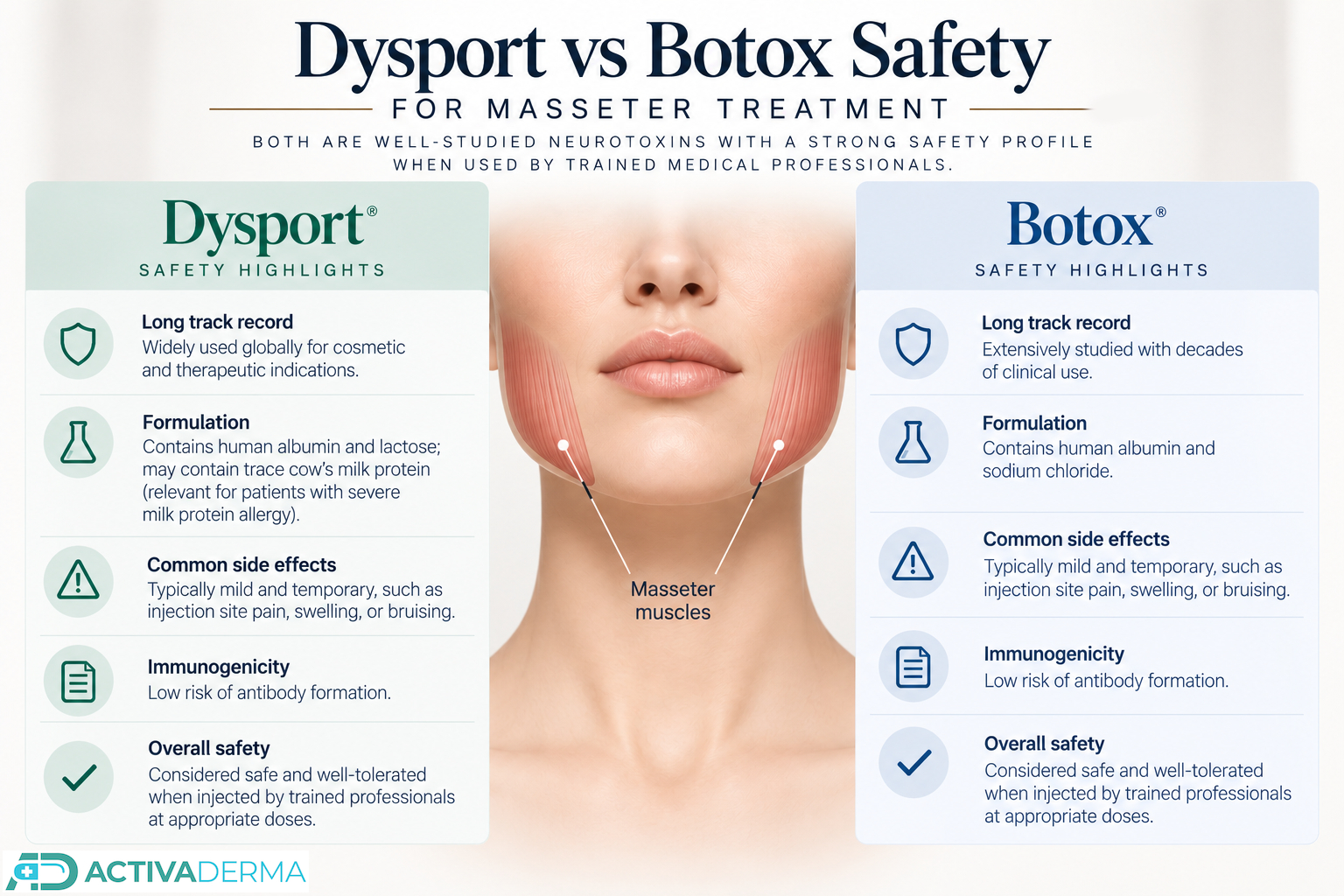
Both neurotoxins have overlapping side effects, but product contraindications and masseter anatomy still matter. This minimally invasive injection procedure is not risk-free.
Expected Temporary Reactions
- Injection sites: Small injections can cause brief pain, bruising, swelling, or tenderness in the treated area.
- Temporary muscle weakness: Mild chewing fatigue can appear as activity falls.
If a clinic advises avoiding pressure, exercise, or lying flat for 4 hours, present that as the clinic's aftercare protocol, not a masseter-specific FDA rule.
Masseter-Specific Functional Considerations
- Chewing: Excess reduction can lower bite force or make firm foods tiring.
- Smile: Spread to nearby muscles, including the risorius, may alter smile mechanics.
- Contour: Incomplete coverage can cause asymmetry or paradoxical bulging.
- Over-slimming: Aggressive dosing can expose hollows, jowling, or laxity.
Botulinum Toxin Class Warnings
Rarely, the effects of Botox or Dysport can spread beyond the injected masseter and weaken muscles elsewhere in the body. This is different from mild, temporary chewing fatigue.
Warning signs include generalized muscle weakness, double vision, drooping eyelids, slurred speech, and difficulty swallowing or breathing. These symptoms may appear within hours or several weeks after treatment and require urgent medical care.
Before treatment, providers should check for myasthenia gravis, Lambert-Eaton syndrome, ALS, existing swallowing or breathing problems, and recent botulinum toxin injections. Aminoglycoside antibiotics, muscle relaxants, and other drugs that affect neuromuscular transmission may also increase weakness.
Repeat Treatment: Should Masseter Toxin Follow a Fixed Schedule?
No. Reassess strength, width, symmetry, chewing, laxity, and goals before repeating masseter reduction. Progressive atrophy can make the previous dose unsuitable.
Studies have also raised questions about possible mandibular bone changes after repeated injections into the chewing muscles. However, the evidence is limited and mixed, so the clinical importance of these findings remains uncertain.
Regular maintenance treatments every three or four months may overtreat a patient whose contour remains reduced. Compare standardized photographs taken in the same clench position.
Dysport vs Botox for Masseter: Which Should You Choose?
For masseter reduction, neither brand wins for every patient. Botox has stronger current prominence data, while Dysport remains an effective option in experienced hands.
Product selection should follow anatomy, clinical objective, prior response, regulatory status, and product-specific evidence, never an assumed unit conversion.
At Activa Derma, we help practices compare Botox options in 50 IU and 100 IU formats with Dysport options in 300 IU and 500 IU formats.
Choose for your treatment volume, then confirm local authorization and current instructions.
FAQ
How long does Dysport last in masseter?
Relaxation often lasts 3 to 4 months; visible masseter reduction may remain for 4 to 6. Assess returning movement and contour.
Why is Dysport so much less than Botox?
Dysport units are not equal to Botox units. Compare total treatment cost and response, not price per unit.
Is Dysport more natural looking than Botox?
Not inherently. Natural results depend more on patient selection, dose distribution, symmetry, and injector skill than on the brand.
Why do people prefer Dysport over Botox?
Past response, perceived faster onset, price, or practitioner experience can drive preference. Dysport is not universally better.
Should I get Dysport or Botox for masseter?
Choose the product your provider uses most predictably for your anatomy and goal. Both uses remain off-label in the United States.
Which is safer, Dysport or Botox?
Neither is universally safer. Both share class warnings; Dysport also has a cow's milk protein allergy contraindication.
Which is better for reducing masseter muscles, Botox or Dysport?
Both can produce masseter reduction. Botox has stronger direct aesthetic evidence; Dysport remains sound with appropriate training and patient history.
Which lasts longer, Dysport or Botox?
Masseter reduction is not proven to last longer with either brand. Expect roughly 3 to 6 months and reassess before retreatment.