
JUVÉDERM for Nasolabial Folds: 3 Fillers to Compare
Choosing a JUVÉDERM filler for nasolabial folds starts with the face, not the syringe. Fold depth matters, but so do cheek support, skin thickness, movement, and the amount of correction the patient wants.
VOLLURE XC, Ultra Plus XC, and Ultra XC all have U.S. facial-fold indications, yet each fits a different treatment plan.
JUVÉDERM for Nasolabial Folds at a Glance
The three options use hyaluronic acid and contain lidocaine, but their gel technology and clinical positioning differ.
|
Factor |
JUVÉDERM VOLLURE XC |
JUVÉDERM Ultra Plus XC |
JUVÉDERM Ultra XC |
|
HA technology |
Vycross |
Hylacross |
Hylacross |
|
HA concentration |
17.5 mg/mL |
24 mg/mL |
24 mg/mL |
|
Lidocaine |
0.3% |
0.3% |
0.3% |
|
U.S. fold indication |
Moderate to severe facial wrinkles and folds, including nasolabial folds, in adults over 21 |
Moderate to severe facial wrinkles and folds, including nasolabial folds |
Moderate to severe facial wrinkles and folds, including nasolabial folds |
|
General positioning |
Flexible correction in a mobile area |
More structural than Ultra XC |
Softer correction within the Ultra family |
|
Supported duration |
Up to 18 months with optimal treatment |
Up to 1 year with optimal treatment |
Original fold studies followed correction through 1 year |
|
Other U.S. aesthetic indication |
None |
None |
Lip and perioral augmentation in adults over 21 |
|
Main selection question |
Is flexibility plus longer duration the priority? |
Does a deeper fold need more support? |
Is a lighter correction more appropriate? |
What Are Nasolabial Folds?
Nasolabial folds are the natural creases that run from the sides of the nose toward the corners of the mouth. Everyone has them. They become more noticeable when the cheek loses support, tissue shifts downward, skin becomes less elastic, or repeated movement deepens the nasolabial region.
A visible fold is not automatically a problem. Treatment makes sense when the patient dislikes a clinically significant deepening and understands that the aim is usually to soften the nasolabial groove, not erase normal facial anatomy.
Why Nasolabial Fold Assessment Should Start With the Midface
A deep line beside the mouth may be a local tissue deficit, a sign of structural aging higher in the cheek, or both. Midface research links loss of deep support with sagging tissue and deeper nasolabial folds.
Before treating nasolabial folds, decide whether the plan should soften the fold directly, rebuild adjacent midface support, or combine both in stages.
Which JUVÉDERM Fillers Are FDA-Approved for Nasolabial Folds?
FDA approval belongs to the exact product, indication, depth, and patient group on its label. It does not apply to every JUVÉDERM formulation or to a similarly named product sold in another market.
JUVÉDERM VOLLURE XC
FDA approval covers mid-to-deep dermal injection for moderate to severe facial wrinkles and folds, including nasolabial folds, in adults over 21. Its pivotal program followed results for 18 months.
JUVÉDERM Ultra Plus XC
Ultra Plus XC is approved for mid-to-deep dermal correction of moderate to severe facial wrinkles and folds, including nasolabial folds. Within the traditional Ultra family, it is the more structurally supportive option.
JUVÉDERM Ultra XC
Ultra XC carries the same facial-fold indication, plus FDA approval for lip and perioral augmentation in adults over 21. That versatility does not make it the first choice for every fold depth.
JUVÉDERM VOLLURE XC for Nasolabial Folds
VOLLURE XC is often the strongest all-around choice when a patient needs flexible correction and values longer duration. This 17.5 mg/mL Vycross gel contains 0.3% lidocaine and is designed for the movement around the nose and mouth.
In the 123-patient U.S. pivotal trial, VOLLURE improved moderate to severe folds and remained effective for many patients at 18 months. Its lower HA concentration does not mean weaker correction because cross-linking and tissue behavior also shape performance.
JUVÉDERM Ultra Plus XC for Nasolabial Folds
The Ultra Plus dermal filler is a practical choice for deeper folds that need more lift than Ultra XC typically provides. It uses 24 mg/mL Hylacross HA with 0.3% lidocaine and is FDA approved for moderate to severe facial wrinkles and folds.
For JUVÉDERM smile line correction, the manufacturer supports results for up to one year with optimal treatment. It also suits practices with reliable techniques and response records for the product.
JUVÉDERM Ultra XC for Nasolabial Folds
Ultra XC can suit a moderate fold when the goal is smoother correction with less structural effect than Ultra Plus XC. This 24 mg/mL Hylacross gel contains lidocaine and is included in the current FDA language for moderate to severe folds.
Its additional lip and perioral indication adds versatility, but fold depth and skin thickness should still guide selection.
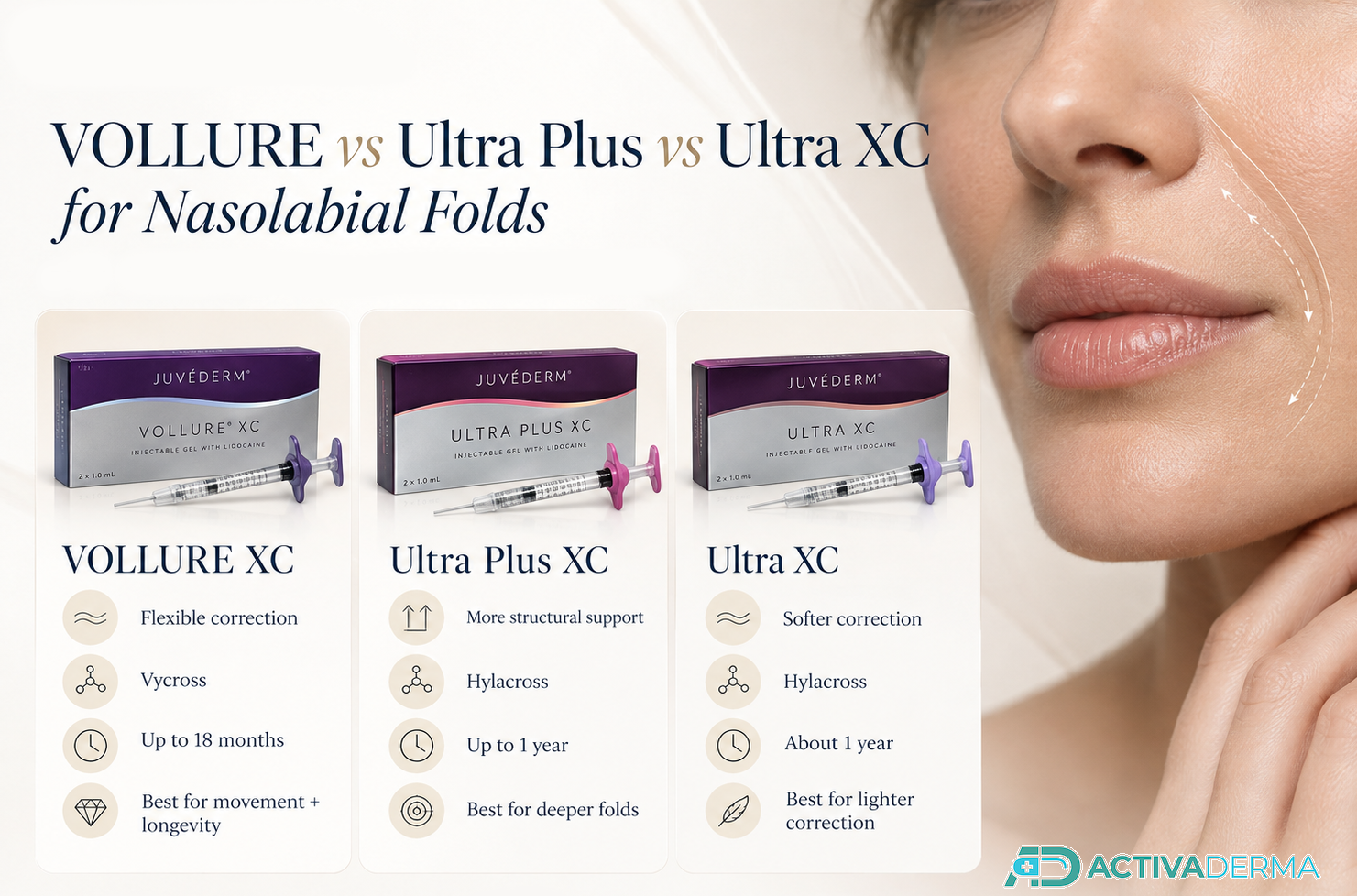
VOLLURE vs Ultra Plus vs Ultra XC for Nasolabial Folds
No product wins every JUVÉDERM nasolabial folds case. VOLLURE brings the longest manufacturer-supported timeline, Ultra Plus adds more structural support within the Hylacross pair, and Ultra offers the lighter option.
|
|
VOLLURE XC |
Ultra Plus XC |
Ultra XC |
|
Technology |
Vycross |
Hylacross |
Hylacross |
|
FDA approved for folds |
Yes |
Yes |
Yes |
|
Relative structure |
Moderate |
Highest of these three |
Lowest of these three |
|
Tissue behavior |
Flexible, suited to dynamic correction |
More supportive and shape-holding |
Smoother, softer correction |
|
Supported duration |
Up to 18 months |
Up to 1 year |
Improvement documented through 1 year in the original fold program |
|
Other approved use |
None |
None |
Lips and perioral area |
|
Best reason to compare |
Duration and movement |
Deeper correction |
Moderate correction and versatility |
Vycross vs Hylacross Technology
Vycross and Hylacross are different ways of building a cross-linked HA gel. VOLLURE uses Vycross and a 17.5 mg/mL HA concentration. Ultra and Ultra Plus use Hylacross, which is based on high-molecular-weight HA at 24 mg/mL.
These differences affect extrusion force, flexibility, cohesivity, and duration, so concentration alone cannot predict how a filler will perform in tissue.
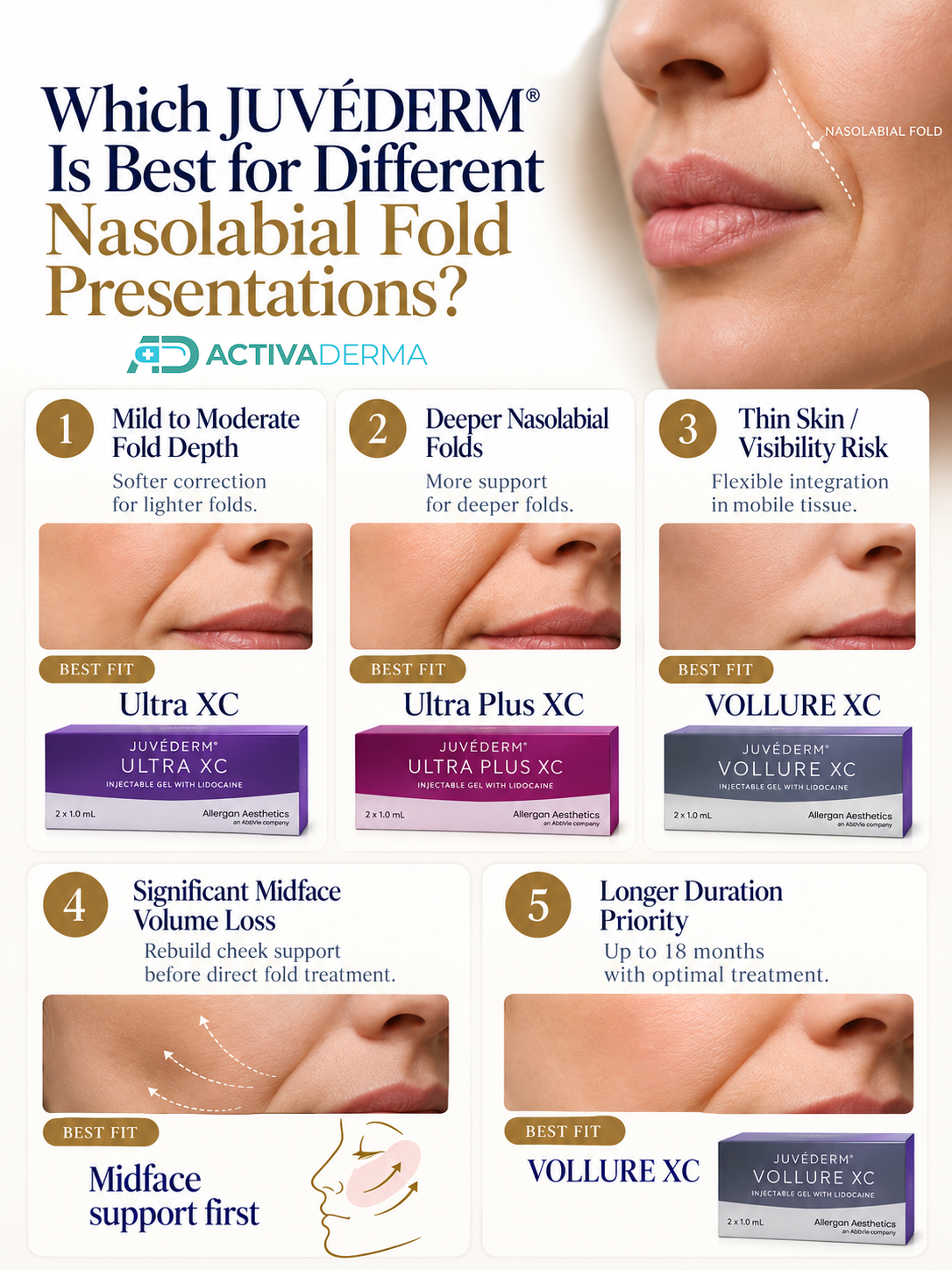
Which JUVÉDERM Is Best for Different Nasolabial Fold Presentations?
Mild to Moderate Fold Depth
Ultra XC may suit a fold that needs gentle correction rather than firm support.
VOLLURE is worth comparing when natural movement and a longer treatment interval matter more.
Deeper Nasolabial Folds
Ultra Plus XC is often the more logical Hylacross choice for deep nasolabial folds because it provides more structure than Ultra XC.
VOLLURE remains an option when flexibility and duration are priorities.
Thin Skin or Greater Product Visibility Risk
VOLLURE may fit thin, mobile tissue when flexible integration is important. Still, a conservative volume and correct plane matter more than the brand name when visibility risk is high.
Significant Midface Volume Loss
None of these fold fillers should automatically become the whole plan. Restore appropriate midface support first when cheek deflation drives the crease, then reassess how much direct fold treatment is still needed.
Patients Prioritizing Longer Duration
VOLLURE has the clearest advantage on labeled longevity, with results supported for up to 18 months. Explain that this is an upper estimate with optimal treatment, not a guarantee for every patient.
Direct Nasolabial Fold Filler vs Midface Support
Direct filler is better when the main deficit sits within the fold. Midface support makes more sense when cheek volume loss and tissue descent create the shadow.
A randomized split-face study found that low-volume cheek placement and local fold injection produced similar fold improvement, while combining both did not automatically create a better result. Anatomy should decide the route.
JUVÉDERM Nasolabial Fold Results: What Should Practitioners Expect?
Good results soften the crease while keeping the smile natural. Trying to erase it may flatten normal contours or overload the tissue.
- Immediate change: Volume appears at once, although swelling can exaggerate it.
- Settled result: Reassess symmetry, movement, and contour after swelling eases.
- Gradual fade: HA breaks down over time, so correction recedes slowly.
- Variable response: Product, volume, placement, motion, and biology affect longevity.
How Long Does JUVÉDERM Last in Nasolabial Folds?
Expect roughly 12 months for Ultra Plus XC and up to 18 months for VOLLURE XC with optimal treatment. Ultra XC also has fold data extending through one year, but visible correction varies.
A pooled analysis of nasolabial fold fillers found that improvement generally declines between 6 and 12 months, so follow-up should track the patient rather than a calendar alone.
How Much JUVÉDERM Is Needed for Nasolabial Folds?
There is no universal syringe count. One syringe can make a visible difference in mild, fairly symmetric folds, while deeper or uneven folds may need more.
In the VOLLURE pivotal program, the typical volume for optimal correction was 1.7 mL per fold, including any touch-up. That study figure is not a dosing rule. Start with anatomy, treatment goals, and safe tissue capacity.
JUVÉDERM for Nasolabial Folds vs Other HA Fillers
JUVÉDERM is one established dermal filler family, not the only sound choice. Other hyaluronic acid fillers differ in particle design, flexibility, lift, tissue integration, and labeled duration.
A systematic review of randomized trials found sustained fold improvement across several filler types, so prior response, evidence, and injector experience may matter more than brand recognition.
JUVÉDERM Nasolabial Fold Treatment: Practice and Purchasing Considerations
Stock should support real treatment patterns. Before adding another fold filler, confirm that it fills a clear clinical gap.
- Pack and cost: Compare syringes per box, acquisition price, expected volume, and waste.
- Clinical fit: Count how often the practice sees mild, deep, mobile, or midface-driven folds.
- Workflow: Factor in training, documentation, demand, and retreatment cadence.
- Range overlap: Stock multiple options only when they serve different clinical needs.
- Local authorization: Our current JUVÉDERM range includes international formulations. Confirm the supplied instructions and local authorization because U.S. XC indications do not automatically apply to an EC-origin pack.
Choosing JUVÉDERM for Nasolabial Folds
VOLLURE XC offers the longest supported duration, Ultra Plus XC brings more structure, and Ultra XC provides a lighter, versatile option.
The better choice is the one that matches fold depth, skin, movement, midface support, and the clinician's proven technique.
Compare the JUVÉDERM family with the treatment objective already clear, then buy the formulation the plan actually needs.
FAQ
How many syringes of Juvederm for nasolabial folds?
One syringe may soften mild folds. Bilateral moderate or severe folds may require more, especially when asymmetry or midface loss is present.
Which Juvederm filler is best for nasolabial folds?
VOLLURE XC leads on flexibility and duration. Ultra Plus XC may suit deeper folds, while Ultra XC fits lighter correction.
Will one syringe of Juvederm make a difference?
Yes, especially in mild folds. Deep, asymmetric, or midface-driven folds may show only partial correction.
How much does a Juvederm treatment for nasolabial folds cost?
The latest U.S. plastic surgery data put the average physician fee for HA filler at $715. Product, volume, provider, and location change the total.
How long does one syringe of Juvederm last?
Syringe size does not set duration. Correction may last about 12 months, while VOLLURE can last up to 18 months with optimal treatment.
Is Juvederm a good filler for nasolabial folds?
Yes. All three compared here have U.S. facial-fold indications. Results still depend on matching gel and treatment plane to anatomy.
Where does Juvederm go when it wears off?
The body gradually breaks down and clears the hyaluronic acid, so added volume fades while aging continues.
What are the downsides of Juvederm?
Swelling, bruising, tenderness, firmness, and lumps can occur. Unintended injection into a blood vessel can cause tissue death, blindness, or stroke.