
A patient may ask for Botox when the real concern is hollow cheeks. Another wants filler for a forehead line that deepens with every raised brow. Botulinum toxins soften lines by reducing muscle activity, while dermal fillers add fullness or improve contour. Choosing the right treatment means looking beyond the wrinkle to assess facial movement, underlying support, and the change the patient wants.
Botox vs Fillers at a Glance
|
|
Botulinum toxins |
Dermal fillers |
|
Mechanism |
Temporarily reduce nerve signaling to selected muscles |
Add volume, support tissue, or stimulate collagen, depending on material |
|
Main objective |
Reduce muscle-driven lines or unwanted contraction |
Restore fullness, soften folds, or improve contour |
|
Dynamic wrinkles |
Usually the more relevant option |
Do not reduce muscle contraction |
|
Static wrinkles and folds |
May soften lines with a muscular component |
Useful when local depth or lost support contributes |
|
Volume restoration |
None directly |
Main role of volumizing fillers |
|
Facial contouring |
Can reduce muscle bulk in selected off-label uses |
Can add cheek, chin, lip, or jawline projection |
|
Onset |
First changes over several days |
HA volume is immediate; collagen stimulation develops gradually |
|
General longevity |
Often 3 to 4 months; product-specific exceptions |
HA commonly 6 to 12 months; selected cheek products reach 24 months |
|
Reversibility |
No routine immediate cosmetic reversal |
HA can be reduced with hyaluronidase; other materials have no equivalent enzyme reversal |
|
Pricing model |
Units or treatment area |
Usually syringes; some biostimulators by vial |
|
Main risks |
Bruising, unwanted weakness, drooping; rare distant toxin effects |
Swelling, nodules, infection; vascular occlusion can threaten tissue or vision |
|
Best fit |
Expression lines and selected muscle-driven concerns |
Volume loss, local folds, and contour deficiencies |
What Is the Difference Between Botox and Fillers?
Botulinum toxin reduces muscle contraction, while filler changes tissue volume or structure. Cosmetic toxins are botulinum toxin type A products that temporarily reduce the signal telling a muscle to contract. They do not replace cheek fat or build chin projection.
Fillers are injectable implants. Hyaluronic acid, or HA, is the most common temporary filler material. Its gels bind water and provide volume. Other materials work partly through collagen stimulation. The difference between temporary and permanent filler materials also affects maintenance and options for correction.
Our botulinum toxin range and dermal filler selection serve different clinical goals. Diagnose the concern before comparing products.
Botox vs Fillers by Treatment Area
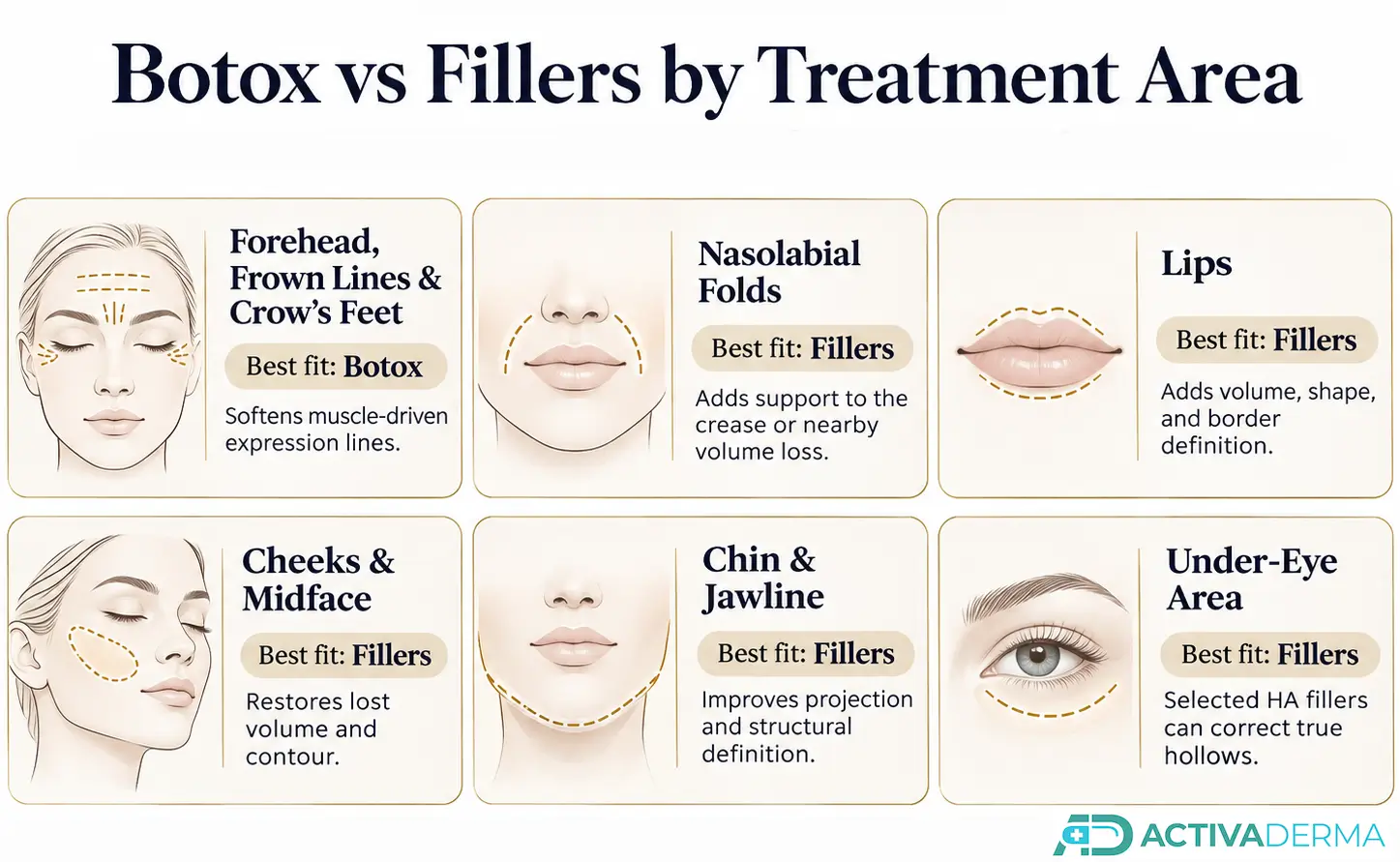
The six areas below show why the treatment goal comes first. FDA indications vary by product, so an approval for one area does not cover every use.
Forehead, Frown Lines and Crow’s Feet
Botulinum toxin is usually the better fit because these lines deepen with muscle contraction. Assess brow position before treatment, especially when the forehead muscle helps hold a heavy brow up.
BOTOX Cosmetic has indications for all three regions, but labels differ by brand. Filler is not a routine substitute for an etched forehead line, given this region’s vascular risks.
Nasolabial Folds
Filler is more relevant for a crease from the nose to the mouth or lost nearby support. Relaxing smile muscles does not replace that support and may affect expression. Assess local fold depth separately from cheek volume. Restoring a deficient cheek may soften the transition, but cheek filler does not reliably pull the fold upward.
Lips
Choose filler for added volume, a defined border, or mild asymmetry. A toxin “lip flip” exposes slightly more upper-lip tissue without adding volume. This off-label treatment relaxes part of the muscle around the mouth. Discuss possible effects on lip function, including drinking through a straw. Different lip filler types also provide different levels of softness and support.
Cheeks and Midface
Fillers are the better choice for hollow cheeks or lost midface volume. They add fullness beneath the skin and can give flatter cheeks more shape and definition. Botulinum toxin relaxes muscles, so it cannot replace missing volume. Duration depends on the product, for example, VOLUMA XC cheek results can last up to 24 months after optimal treatment, while other fillers may need earlier maintenance.
Chin and Jawline
Filler adds projection or definition; toxin targets a muscle problem. Chin dimpling from mentalis contraction and enlarged masseter chewing muscles may respond to selected off-label toxin treatment. Neither is chin augmentation.
Our chin filler comparison explains how support and contour goals differ.
Under-Eye Area
Selected HA fillers correct true hollows beneath the eyes; toxin treats dynamic crow’s feet beside them. Neither automatically treats dark circles. Pigment, visible vessels, fluid retention, and protruding fat can all cause a tired look. With festoons or chronic puffiness, filler may worsen the concern. Separate a hollow from an under-eye bag before treatment.
Dynamic Wrinkles vs Volume Loss
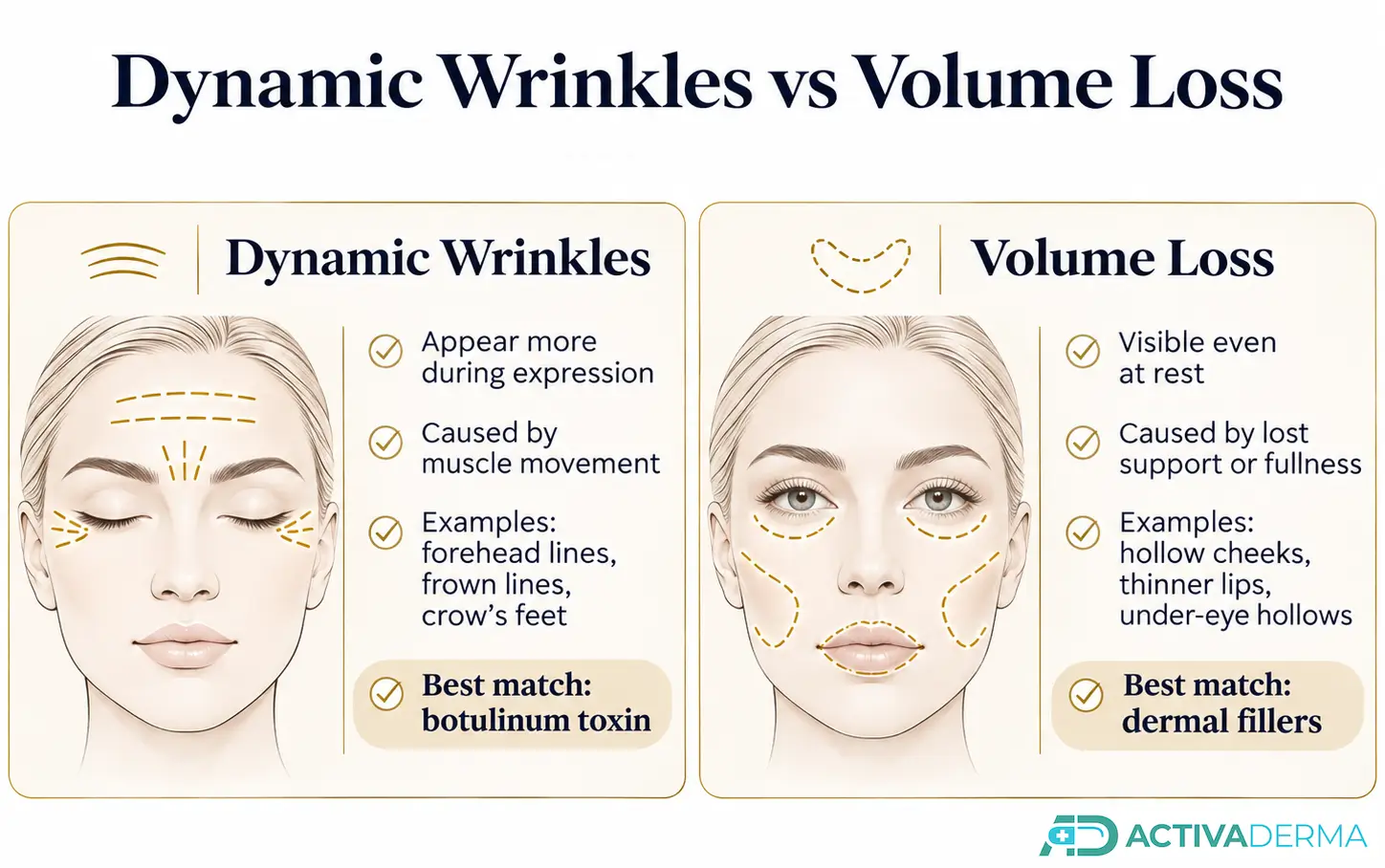
Dynamic wrinkles become more visible when facial muscles contract. Think of forehead lines when a patient raises their brows or crow’s feet when they smile. Botulinum toxin reduces that muscle activity, so the skin folds less deeply during expression.
Volume loss is a different problem. Cheeks may look hollow or lips may lose fullness even when the face is relaxed. Filler can replace some of that missing volume, but relaxing a muscle cannot.
A patient can have both concerns. Someone with strong frown lines and hollow cheeks may benefit from toxin between the brows and filler in the cheeks, with each treatment serving a separate purpose.
Botox vs Fillers: Results, Onset and Longevity
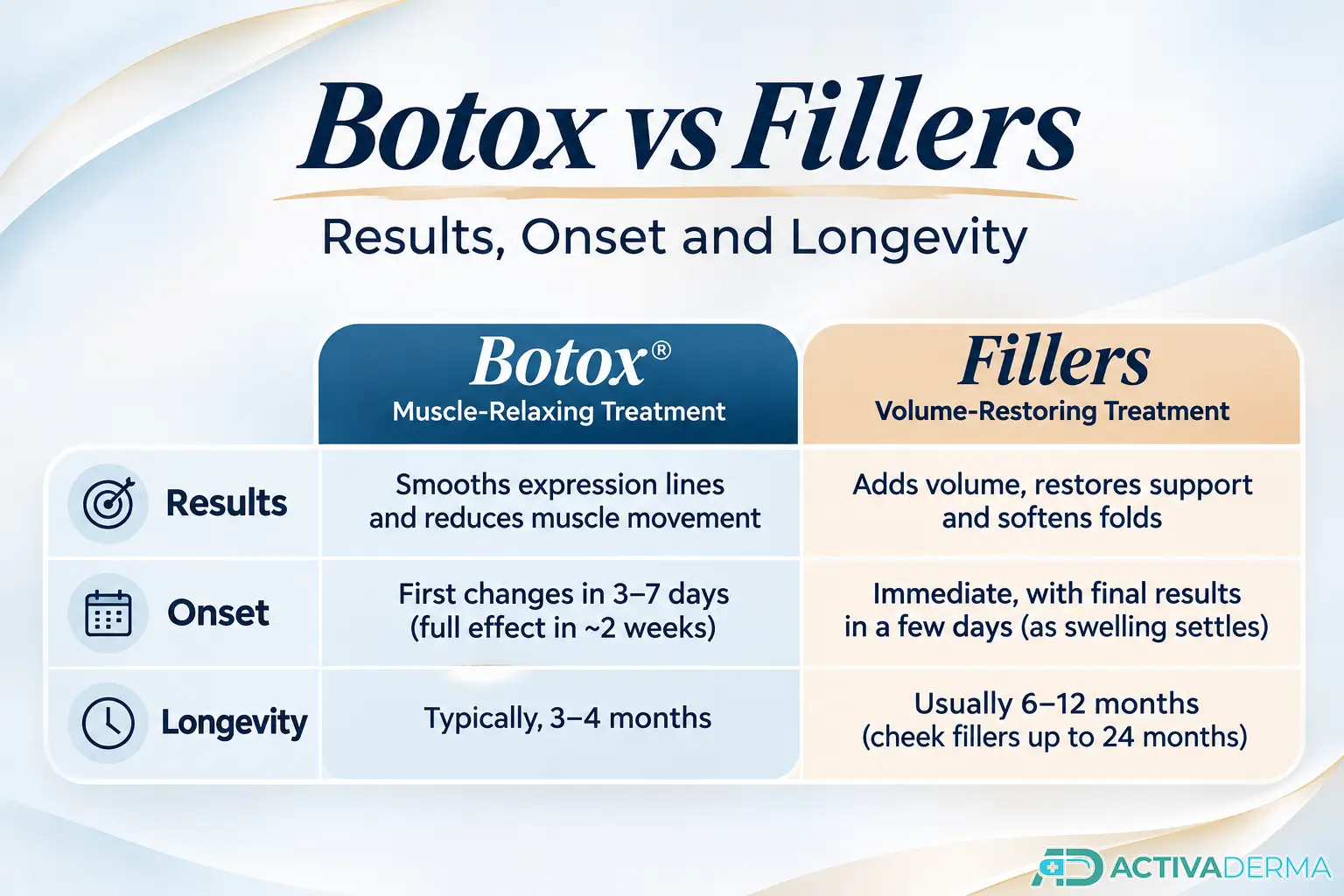
Set separate expectations for the first visible change and the time to judge the result.
Results and Onset
The American Academy of Dermatology reports visible toxin results within 3 to 7 days. BOTOX Cosmetic’s manufacturer describes initial upper-face changes in 1 to 2 days and full results at 30 days.
HA filler changes shape immediately, but swelling can distort the early result. Review after swelling settles, often around two weeks; collagen-stimulating fillers need longer.
Longevity
Many toxin results last 3 to 4 months. Dermal fillers last 6 to 12 months, with selected cheek products reaching 24 months.
Material, location, volume, patient biology, and previous treatment change the timeline. Visible fading does not prove all filler has disappeared, so reassess before topping up.
Botox vs Fillers: Patient Selection
The right candidate has a concern the treatment can actually change and accepts its limits. Age alone does not choose the injectable.
When Botox May Be More Appropriate
- Expression lines deepen clearly with smiling, squinting, or frowning.
- A diagnosed muscle-driven concern is the main issue, rather than missing volume.
- The patient wants temporary movement reduction and accepts that toxin cannot restore fullness.
Review baseline asymmetry and functional muscle use. Too much reduction can change brow support or smile balance.
When Filler May Be More Appropriate
- Cheek deflation or a local fold needs added support.
- The patient wants fuller lips or improved chin projection.
- A contour deficiency is present without marked laxity or heavy overlying tissue.
Check previous filler type, location, and response. Unknown or permanent filler needs extra caution before placing another material in the same area.
When Both May Be Considered
Both may fit when movement and missing volume cause separate concerns. A patient with frown lines and hollow cheeks needs two different corrections. If muscle pull and a fixed crease overlap, treating the muscle first can help clarify what remains. Combination treatment should follow a documented goal for each area, not an automatic package.
Botox vs Fillers: Cost
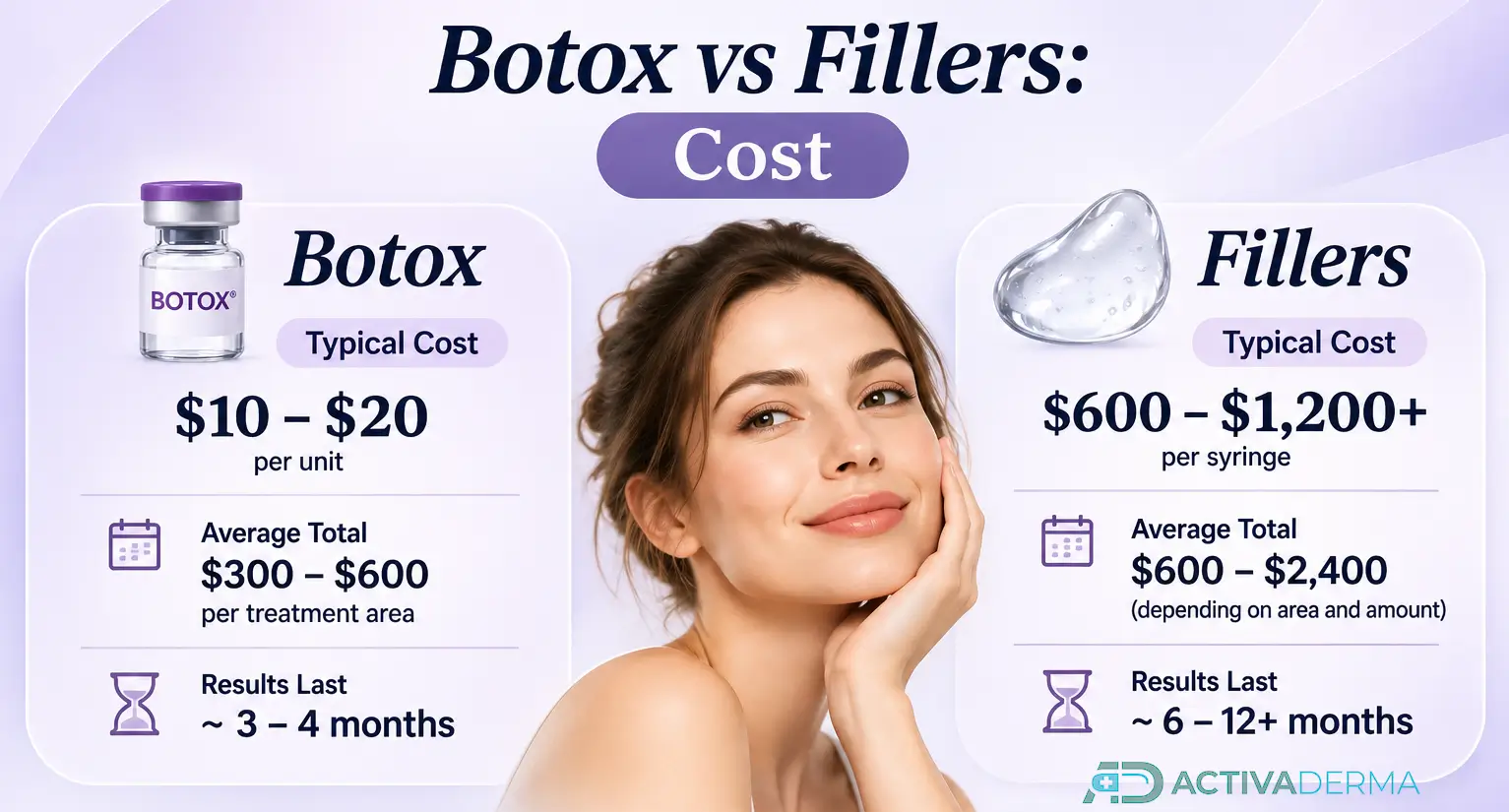
Fillers usually cost more per visit, although larger toxin plans can exceed a small filler treatment. ASPS lists averages of $435 for botulinum toxin and $715 for HA fillers.
Clinics usually price toxin by the number of units used or charge a set fee for each area. Treating several areas generally costs more than treating frown lines alone. Unit measurements differ between toxin brands, so a lower price per unit does not necessarily mean a cheaper treatment.
Filler pricing usually depends on the product and number of syringes needed. A broader cheek correction may require more product than a small lip enhancement.
Botox vs Fillers From the Practice Perspective
Purchase price alone cannot tell you the treatment margin. For example, BOTOX requires use within 24 hours of reconstitution with refrigerated storage. Its single-dose vial must not be shared between patients; discard remaining solution.
Filler comes in product-specific syringes or vials; unused opened product cannot become stock for another patient.
Include consultation, numbing, documentation, follow-up, and waste in the cost. A simple toxin visit may take about 10 minutes, while filler often needs 15 to 30 minutes plus preparation. More frequent toxin maintenance also changes appointment demand and inventory turnover.
How Practitioners Should Choose Between Botox and Fillers
Make the treatment decision before opening the vial or syringe:
- Compare photographs at rest and during movement. Identify muscle activity, local depth, missing volume, or laxity as the main concern.
- Assess skeletal support, fat distribution, facial proportions, and previous injections. Define the intended change in one sentence.
- Match the exact product’s indication, evidence, formulation, and duration to that goal.
- Screen for infection, allergies, relevant medicines, and neuromuscular disease. Confirm the emergency plan and explain warning signs before consent.
Both treatments can cause bruising. Toxin can cause unwanted weakness or drooping; rare distant effects can impair swallowing or breathing. The most serious filler risk is vascular occlusion, which can damage tissue or vision. Unexpected severe pain, skin blanching, or visual symptoms require urgent action.
Conclusion
Botox vs fillers starts with the cause: muscle activity, missing volume, or a combination. Choose for the patient’s anatomy and agreed goal, then check the exact product’s evidence and indication.
At Activa Derma, we offer both botulinum toxins and dermal fillers, so your clinic can stock for the treatments its patients actually need.
FAQ
How long do Botox and fillers last?
Many toxin treatments last 3 to 4 months. HA fillers commonly last 6 to 12 months, with selected cheek products lasting up to 24 months after optimal treatment.
What are the benefits of Botox and fillers?
Toxins soften muscle-driven wrinkles. Fillers restore fullness, reduce local fold depth, or improve contour. Neither reliably replaces surgery for marked tissue descent.
What are the different types of Botox and fillers?
Cosmetic toxin brands include Botox Cosmetic, Dysport, Xeomin, Jeuveau, Daxxify, and Letybo. Filler materials include HA, calcium hydroxylapatite, PLLA, and permanent PMMA microspheres.
What is the recovery process for Botox and fillers?
Most patients resume everyday tasks promptly. Filler swelling and bruising often settle within 7 to 14 days. Follow product-specific aftercare and avoid strenuous exercise until the next day after filler.
Which is better, Botox or fillers?
Toxin fits muscle-driven lines; filler fits missing volume or local contour needs. The better choice follows the cause, not wrinkle depth alone.
What makes you look younger, Botox or fillers?
Either can help when matched to the concern. Smoothing frown lines will not replace hollow cheek volume, and adding cheek volume will not stop forehead contraction.
Which is more painful, Botox or fillers?
Toxin often involves brief pinches. Filler can cause more pressure or stinging, especially in sensitive areas such as the lips. Numbing, lidocaine, technique, and patient sensitivity change the experience.
Which is better for jowls, Botox or filler?
Neither removes significant jowls. Filler may camouflage a selected pre-jowl hollow; toxin can reduce selected muscular pull. Marked sagging skin or displaced tissue may need surgical assessment.