
A fuller cheek can soften a nasolabial fold in the right face, but it does not pull the fold upward like a thread or facelift. The result depends on why the line is there. Midface volume loss may respond to cheek filler, while a deep local crease may still need direct treatment. Anatomy, product choice, and honest expectations decide whether this plan works.
Cheek Filler for Nasolabial Folds at a Glance
|
Primary treatment area |
Zygomatic, anteromedial, and selected submalar cheek areas |
|
Main objective |
Restore volume, projection, or contour |
|
Effect on nasolabial folds |
Indirect softening in selected faces, not reliable lift |
|
Best-suited anatomy |
Deflated cheeks with a mild to moderate fold |
|
When improvement may be limited |
Fixed creases, full cheeks, marked laxity, or pyriform deficiency |
|
Common filler type |
Cross-linked HA labeled for deep cheek placement |
|
Time to visible results |
Immediate; reassess at about 2 weeks |
|
General longevity |
About 12 to 24 months, depending on product |
|
Direct fold treatment still needed? |
Often, if local depth remains |
|
Main practitioner consideration |
Treat a cheek deficit, not a distant crease |
Why Nasolabial Folds Become More Prominent
Nasolabial folds are normal facial boundaries that run from the side of the nose toward the corner of the mouth. They deepen with a mix of local anatomy and age-related change. Skin thins, the maxilla and pyriform region remodel, and fat does not simply disappear. It can shift within separate facial compartments.
A computed tomography study of midface aging found inferior migration of midfacial fat and volume loss in the deep medial cheek. That combination can flatten the cheek above the fold while making the fold look heavier below it. Genetics, sun damage, weight loss, and repeated facial movement can add to the change.
Can Cheek Filler Really Lift Nasolabial Folds?
It can soften their appearance in selected patients, especially when age-related midface loss has changed the cheek-to-fold transition. Calling that result a “lift,” however, gives filler more pulling power than it has.
In a 3D imaging study of 77 patients, 3 mL of cheek filler expanded tissue outward from the injection site but did not pull the intervening skin toward the cheek or improve the fold in standardized photographs.
Also, a smaller randomized split-face study found that low-volume deep cheek placement and direct fold injection produced similar fold improvement. So, the evidence supports a possible indirect benefit, not a guaranteed mechanical lift.
How Cheek Filler Can Affect the Nasolabial Fold
Cheek filler works by adding volume where the midface has lost projection. This can rebuild the curve of the cheek, support adjacent soft tissue, and create a smoother transition into the nasolabial area.
Better contour also changes how light falls across the face, so a shadow beside the fold may look lighter even if the crease has not moved. The gel expands and shapes tissue around the cheeks. It does not grab the lower face and pull the smile lines upward.
When Cheek Filler May Improve Nasolabial Folds
The best candidate has a real cheek deficit and a fold that became more noticeable as the midface flattened. Useful signs include:
- Mild to moderate fold depth with visible loss through the anteromedial or lateral cheek
- Less malar projection than the patient had in earlier photographs
- A hollow or abrupt cheek-to-fold transition rather than a sharply etched skin line
- The cheek itself is part of the patient’s concern
- Enough skin elasticity to accept added support without creating heaviness
When Cheek Filler Is Unlikely to Correct Nasolabial Folds
Some folds are local problems. Adding volume higher in the face may leave them unchanged and can make the cheeks look too wide or round.
- The fold is deep at rest while cheek volume remains adequate
- Marked skin laxity or soft-tissue descent is the dominant issue
- A marked pyriform or maxillary deficiency creates a local shadow beside the nose
- The concern is an etched surface line rather than lost support
- The midface is already full or contains previous filler
- The patient expects the fold to disappear completely
Cheek Filler vs Direct Nasolabial Fold Filler
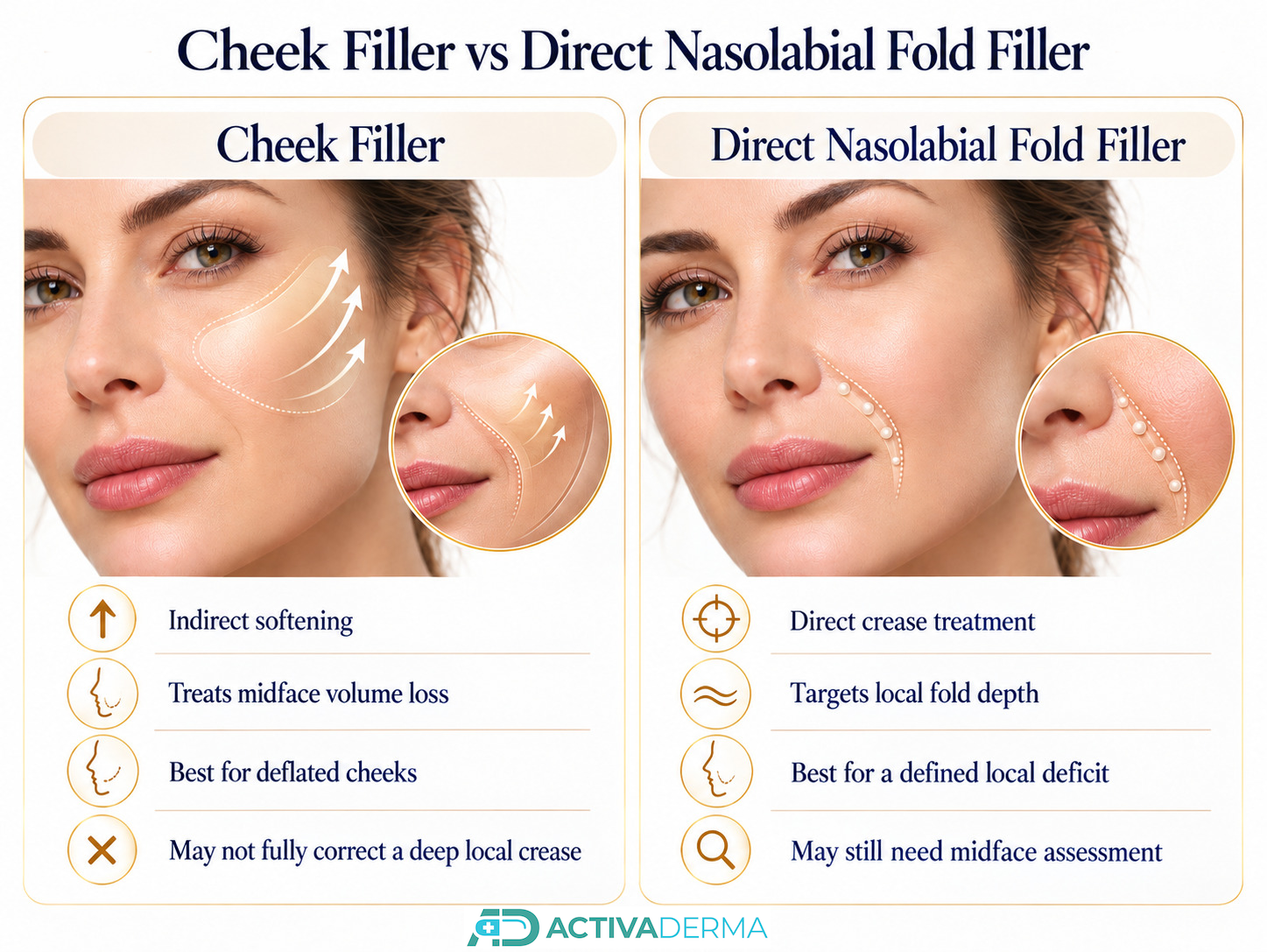
Neither route is always better.
- Cheek filler treats a deficient midface and may soften the fold as a secondary effect.
- Direct filler places volume into or beside the crease, so the correction is more local and predictable.
Many patients have both problems, which is why the assessment should separate cheek loss from fold depth before a syringe is opened.
|
|
Cheek or midface filler |
Direct nasolabial fold filler |
|
Primary objective |
Restore cheek contour |
Reduce fold depth |
|
Main anatomical target |
Deep cheek compartments |
Tissue within or beside the fold |
|
Effect on fold |
Indirect and variable |
Direct and more predictable |
|
Best-suited patient |
Deflated cheek with secondary fold prominence |
Good cheek support with a local crease |
|
Structural support |
Broader |
Localized |
|
Local correction |
Limited |
Higher |
|
Risk of overcorrection |
Excess width or anterior heaviness |
Puffiness or a bulky upper lip-cheek junction |
|
Planning question |
Does the cheek need volume? |
Does the crease need local correction? |
When a Combined Cheek and Nasolabial Fold Approach May Make Sense
When the patient has both midface deflation and a deep residual fold. Treating the cheek first can restore the broader contour. The provider can then reassess the crease instead of estimating both corrections at once.
Staging also helps control volume. Photograph and grade each area at baseline, restore only the missing cheek volume, then review the patient at about two weeks. If a clear fold remains, direct treatment can be planned around what is actually left.
Patient Selection for Cheek Filler to Improve Nasolabial Folds
Good selection starts with the untreated face at rest and in motion. Old photographs often reveal whether the cheek has truly flattened or the patient has always had a strong fold.
Patients More Likely to Benefit
- Adults with mild to moderate cheek volume loss and reduced malar projection
- Patients whose fold appeared or deepened as their cheeks became flatter
- Faces with enough tissue room for restoration without unwanted width
- Patients who accept softening rather than complete removal
- A deep crease that remains when cheek shape is adequate
- A local depression near the nasal base or pyriform area
- Static smile lines with visible dermal etching
- A residual fold after conservative cheek correction has settled
- Previous filler, especially when the product, plane, or amount is unknown
- Active skin inflammation or infection near the planned area
- Bleeding disorders, severe allergies, lidocaine sensitivity, or relevant medication use
- Marked laxity, facial edema, or expectations beyond what filler can change
- Recent dental work or planned procedures that may complicate timing or inflammation risk
Patients Who May Need Direct Fold Treatment
Patients Requiring Extra Caution
Which Cheek Fillers Can Be Considered?
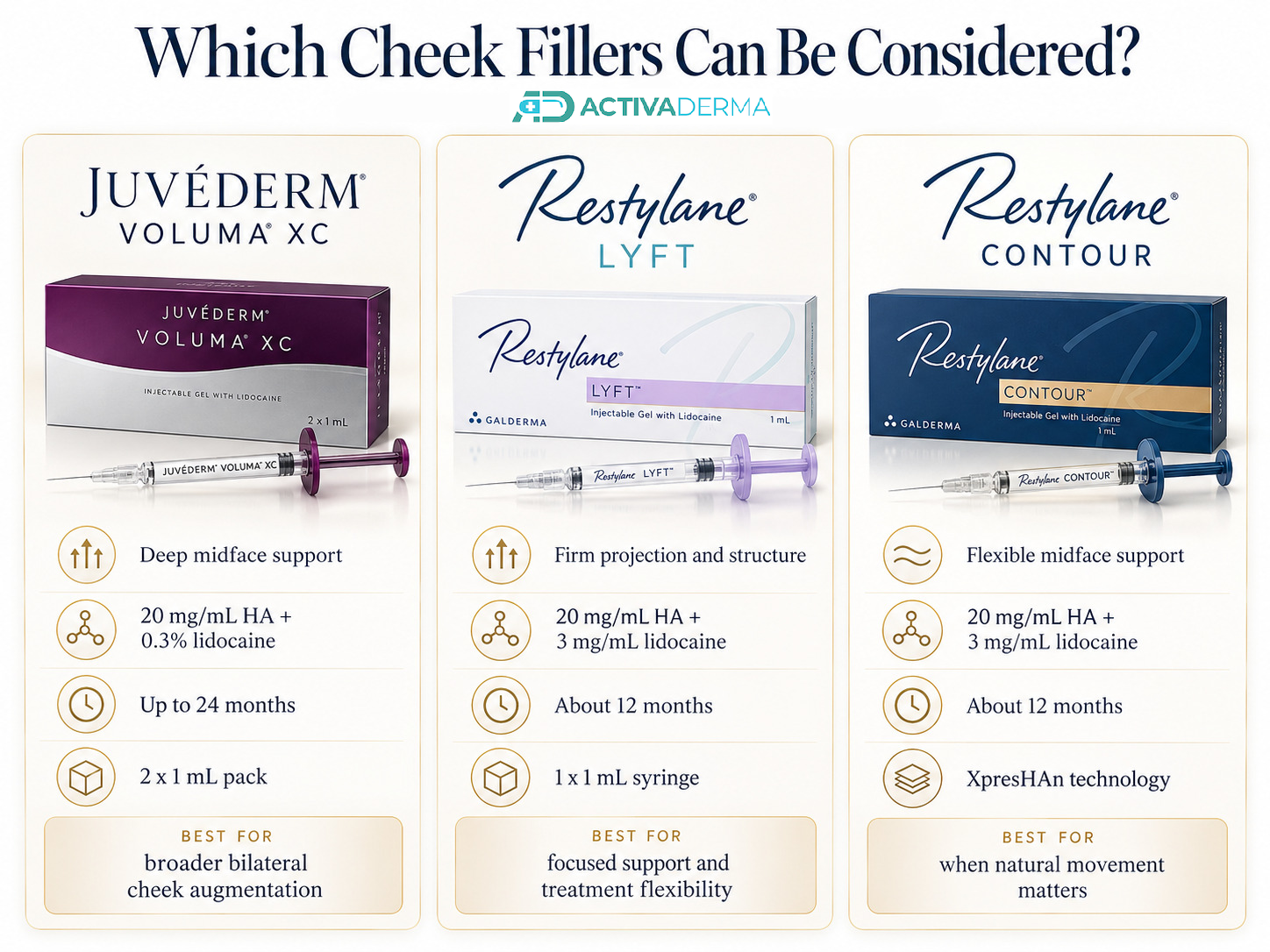
The right gel must suit the treatment plane, tissue thickness, desired projection, and regional label. These three HA fillers have U.S. cheek indications, but their feel and clinical positioning differ.
JUVÉDERM VOLUMA XC
VOLUMA XC is designed for deep midface support. It contains 20 mg/mL HA with 0.3% lidocaine and is FDA approved for deep cheek augmentation. In the FDA study, 67.1% of assessed patients still showed cheek improvement at Month 24.
Our JUVÉDERM Voluma with Lidocaine comes with two 1 mL syringes, which can suit broader bilateral cheek correction. If local fold depth remains, compare the three JUVÉDERM fillers for nasolabial folds that may be considered for direct treatment.
Restylane Lyft
Restylane Lyft fits treatment plans that need firm projection and more product versatility. It contains 20 mg/mL HA with 3 mg/mL lidocaine, while its U.S. label covers both cheek augmentation and moderate to severe facial folds, including nasolabial folds.
Its firm NASHA gel provides focused support in the cheek. Our Restylane Lyft with Lidocaine comes as a single 1 mL syringe, giving clinics more flexibility for conservative, asymmetric, or staged treatment plans.
For a closer comparison of the two firmer options, see how Restylane Lyft and VOLUMA differ in structure, approved areas, pack size, and duration.
Restylane Contour
Restylane Contour takes a more flexible approach to cheek support. The gel contains 20 mg/mL HA with 3 mg/mL lidocaine and uses XpresHAn technology to maintain natural movement through the midface.
In a 270-patient FDA study, Contour was noninferior to VOLUMA XC at Week 12, with follow-up continuing through Week 48. It suits cheek augmentation and midface contouring when flexibility matters, but it does not carry a direct nasolabial fold indication.
What Filler Properties Matter for Midface Support?
A cheek with lost projection usually needs a gel that can hold its shape at depth. G′ helps describe this quality: the higher it is, the more strongly the filler resists pressure and deformation. This can support projection over bone, but a high G′ alone does not make one product the best choice.
The cheek also moves whenever the patient smiles. Cohesivity helps the gel stay together, while flexibility and tissue integration help the result move naturally. Water uptake affects how much the filler may expand after treatment. Even two fillers with the same HA concentration can behave differently because of their cross-linking and particle design.
One laboratory comparison measured Restylane Lyft at a G′ of 799 Pa, which supports its firm, shape-holding profile. However, test methods vary, so G′ values from separate studies are not always directly comparable. Product selection should match the gel’s overall behavior, injection plane, and expected duration to the patient’s anatomy.
How Much Cheek Filler Is Needed to Improve Nasolabial Folds?
There is no “one syringe equals one lift” rule. In FDA cheek studies, the median total initial and touch-up volume was 6.6 mL with VOLUMA XC and 4.0 mL with Restylane Contour. Restylane Lyft averaged 6.227 mL across both sides.
These were study treatment totals, not routine dosing targets. Use the least volume needed to correct the diagnosed cheek deficit, then assess the fold separately.
Cheek Filler Results: How Much Can Nasolabial Folds Improve?
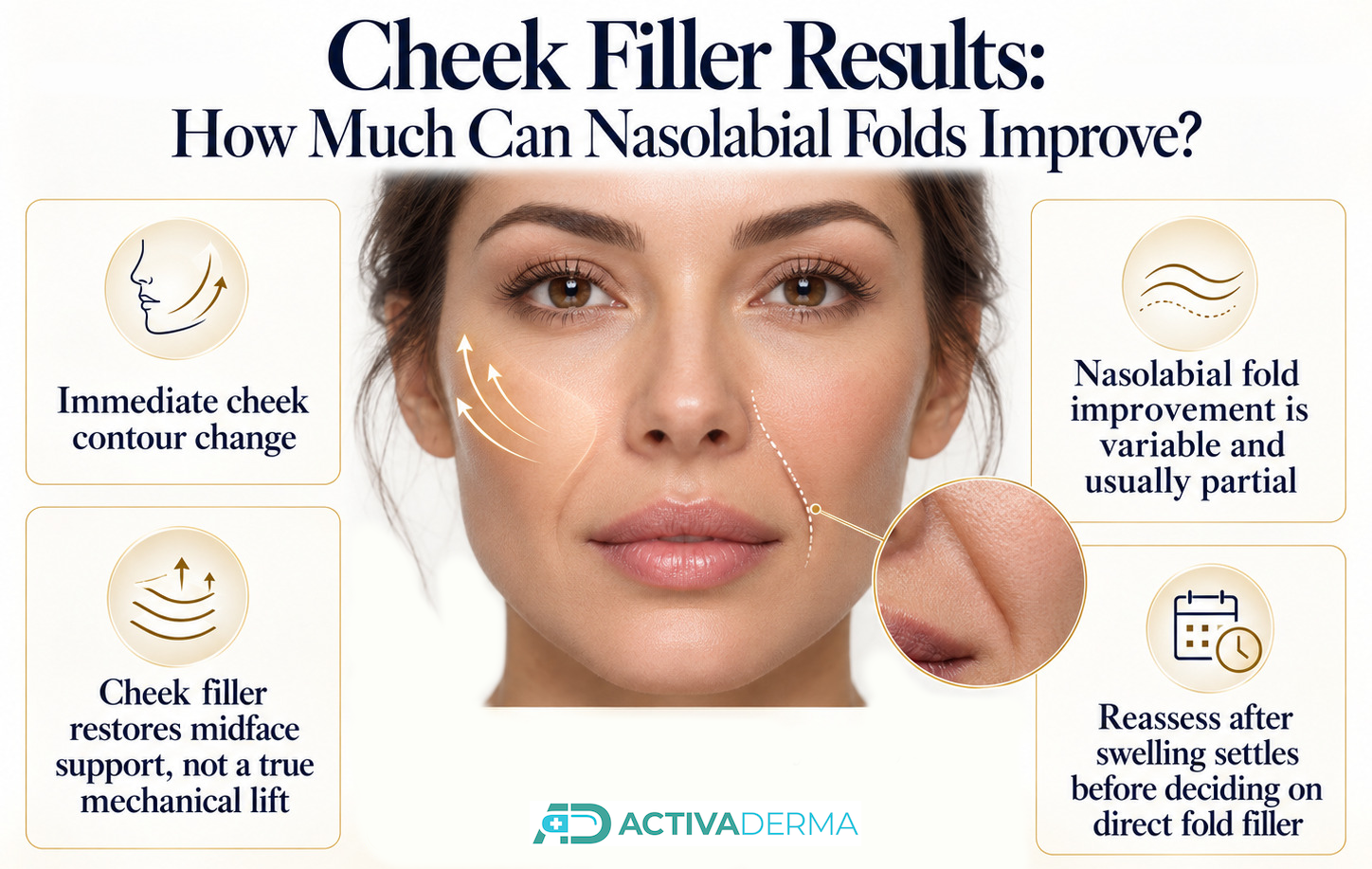
Cheek contour changes immediately. Fold improvement is less predictable and is usually partial. The 77-patient imaging study found no photographic change in the fold after 3 mL of cheek filler, while the smaller randomized study found similar fold-score improvement from cheek and direct placement.
Document the two outcomes separately. Standardized front and oblique photos at rest and during a smile, taken before treatment and after swelling settles, will show whether the cheek improved, the fold softened, or both.
How Long Do Cheek Filler Results Last?
Expect about 12 months with Restylane Lyft or Contour and up to 24 months with VOLUMA XC after optimal treatment. Product, volume, baseline anatomy, patient biology, previous filler, and maintenance all change the timeline.
Any secondary improvement in the nasolabial fold may fade sooner than the added cheek volume. The fold was not the main outcome measured in these cheek studies, and its appearance still depends on skin laxity, facial movement, and local fold depth. These are also key factors that affect how long dermal fillers last, especially around the mouth, which moves far more than the upper cheek.
Cheek Filler Safety and Nasolabial Fold Treatment Planning
HA filler is a medical implant, even when the appointment is short. The FDA lists bruising, redness, swelling, pain, tenderness, itching, and rash among common reactions. Many settle within days to weeks.
- Infection, delayed inflammation, nodules, and granulomas require clinical assessment.
- Unintended intravascular injection can cause tissue necrosis, vision loss, blindness, or stroke. Providers need detailed vascular knowledge and a current emergency plan.
- Aesthetic complications include asymmetry, visible product, prolonged edema, excessive cheek width, and a heavier midface.
- Stop and reassess if added cheek volume increases the contrast beside the fold instead of softening it.
Why More Cheek Filler Does Not Necessarily Mean More Lift
Extra gel creates extra expansion, not proportional traction. The 3D imaging study found that even 3 mL in the cheek did not move the skin between the injection site and the nasolabial crease. Once the cheek deficit is corrected, another syringe may add width or heaviness while the fold stays put. That is the point to change the plan, not increase the volume.
Cheek Filler vs Other Options for Nasolabial Folds
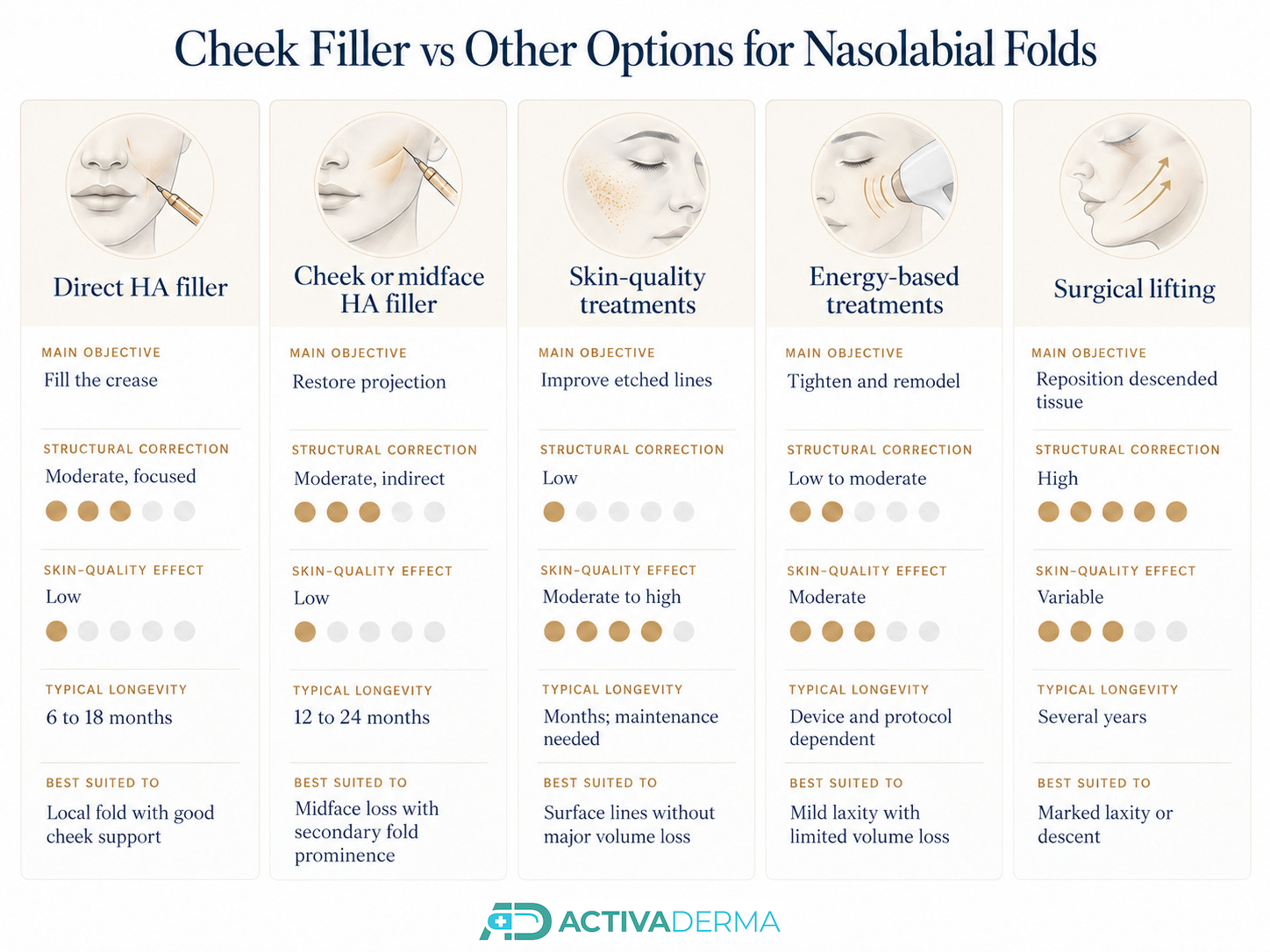
The most useful non surgical option depends on whether the concern is volume, a local crease, skin quality, or true tissue descent.
|
Option |
Main objective |
Structural correction |
Skin-quality effect |
Typical longevity |
Best suited to |
|
Direct HA filler |
Fill the crease |
Moderate, focused |
Low |
6 to 18 months |
Local fold with good cheek support |
|
Cheek or midface HA |
Restore projection |
Moderate, indirect |
Low |
12 to 24 months |
Midface loss with secondary fold prominence |
|
Skin-quality treatments |
Improve etched lines |
Low |
Moderate to high |
Months; maintenance needed |
Surface lines without major volume loss |
|
Energy-based treatments |
Tighten and remodel |
Low to moderate |
Moderate |
Device and protocol dependent |
Mild laxity with limited volume loss |
|
Biostimulatory injectables |
Build collagen gradually |
Moderate |
Moderate |
Often 1 to 2 years after a series |
Broader loss with gradual goals |
|
Surgical lifting |
Reposition descended tissue |
High |
Variable |
Several years |
Marked laxity or descent |
Cheek Filler to Lift Nasolabial Folds: Practice Considerations
Demand is real. More than 5.3 million HA filler procedures were performed in the U.S. in 2024, but popularity does not turn cheek filler into a universal fold treatment.
At Activa Derma, we offer trusted midface fillers in pack sizes that fit different treatment plans.
- JUVÉDERM Voluma with Lidocaine comes with two 1 mL syringes, making it a practical choice for bilateral cheek augmentation.
- Restylane Lyft with Lidocaine comes as one 1 mL syringe, which gives clinics more flexibility for smaller treatment plans or direct fold correction.
Once the anatomy and treatment goal are clear, you can explore our full range of dermal fillers to compare options for midface support, facial contouring, and local fold correction. Match the gel and treatment area to the patient. If cheek correction leaves a clear crease, reassess the fold before adding more volume.
Conclusion
Cheek filler to lift nasolabial folds works best when the cheek has genuinely lost volume and the patient wants that loss corrected. It may soften the fold by restoring contour and reducing shadow, but it does not reliably pull the lower face upward. Treat the diagnosed anatomy, reassess the residual crease, and add direct fold treatment only when needed.
FAQ
Will cheek fillers lift nasolabial folds?
Sometimes they soften the folds when midface volume loss is part of the problem. They do not create a reliable mechanical lift.
Is cheek filler better than filling nasolabial folds directly?
Only when the cheek is deficient. Direct filler is more predictable for a local crease, while cheek filler is better for restoring lost midface contour. Some patients need both.
Can cheek filler completely remove nasolabial folds?
Usually not, and complete removal is rarely a natural goal. A deep static crease, skin laxity, or local pyriform deficit often remains after cheek correction.
How much cheek filler is needed to soften nasolabial folds?
A mild deficit may begin around 0.5 to 1 mL per side, but there is no fixed dose. Treat the cheek deficit, not the fold from a distance, and reassess before adding more.
Can cheek filler make nasolabial folds worse?
Yes. Excess anterior or medial cheek volume can increase the height difference beside the fold, making its shadow look deeper. It can also add unwanted width or heaviness.
Can cheek and nasolabial fold filler be used together?
Yes. When both midface loss and local fold depth are present, cheek treatment can come first, followed by a two-week review and conservative direct correction of the residual fold.
What is the fastest way to get rid of nasolabial folds?
Direct HA filler gives the fastest visible softening for a true local crease. If laxity or tissue descent is severe, filler will not match the correction from an appropriate surgical procedure.