
Restylane Lyft vs Voluma: 11 Factors to Compare
A patient wants stronger cheeks or a better chin profile. Which syringe belongs in the treatment plan?
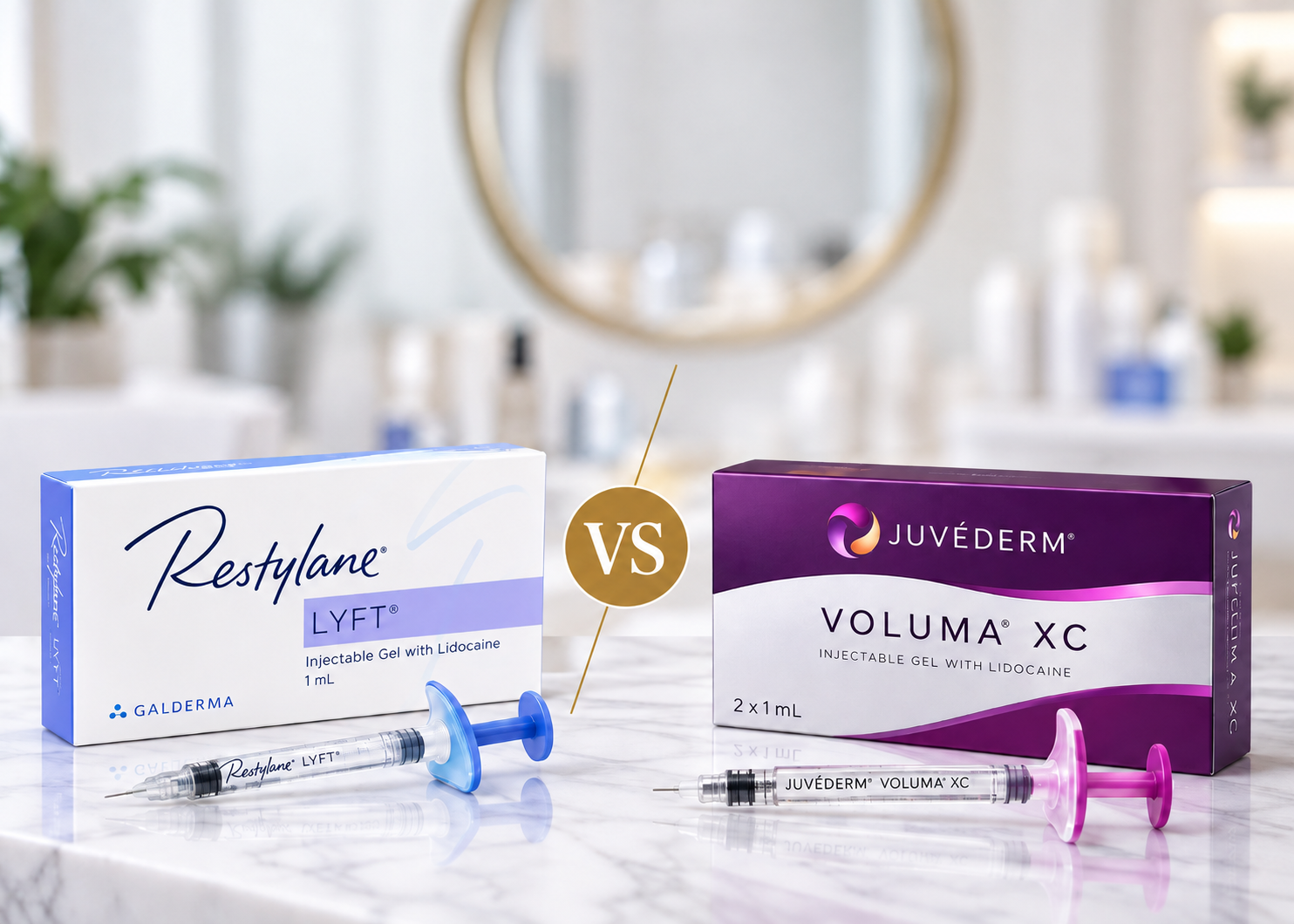
Both Restylane Lyft and Voluma gels behave differently, and both are crosslinked hyaluronic acid fillers that contain lidocaine.
Lyft uses NASHA technology, while Voluma uses Vycross technology. The right choice depends on the anatomy, treatment area, and desired result.
Restylane Lyft vs Voluma at a Glance
Both products contain 20 mg/mL of HA and 0.3% lidocaine. Their differences become clearer when the treatment goal is defined. Restylane Lyft favors firm, focused support and covers more U.S. treatment areas. Juvederm Voluma offers a smooth, cohesive gel, the longer cheek-duration claim, and an approved temple indication.
|
|
Restylane Lyft |
Juvederm Voluma |
|
Manufacturer |
Galderma |
Allergan Aesthetics, an AbbVie company |
|
Active material |
Crosslinked hyaluronic acid |
Crosslinked hyaluronic acid |
|
HA concentration |
20 mg/mL |
20 mg/mL |
|
Gel technology |
NASHA |
Vycross |
|
Lidocaine |
0.3% |
0.3% |
|
Current U.S. FDA-approved areas |
Cheeks and midface, chin, moderate to severe facial folds such as nasolabial folds, and dorsal hands |
Cheeks and midface, chin, and temples |
|
Structural positioning |
Firm gel for focused support and projection |
Smooth, cohesive gel for contour and volume restoration |
|
Cheek longevity data |
Benefits generally last 2 to 12 months |
Up to 2 years with optimal treatment |
|
Chin longevity data |
Up to 12 months |
Up to 1 year with optimal treatment |
|
Reversibility |
HA can be broken down with hyaluronidase |
HA can be broken down with hyaluronidase |
|
Main practice consideration |
Wider range of approved treatment areas |
Longer cheek evidence and a temple indication |
What Is Restylane Lyft?
Restylane Lyft is a firm HA dermal filler made for deep support. Its NASHA gel contains 20 mg/mL hyaluronic acid and 0.3% lidocaine. U.S. approvals cover the cheeks, mild to moderate chin retrusion, nasolabial folds, and age-related volume loss in the dorsal hands.
What Is Voluma?
Juvederm Voluma is a smooth, cohesive HA filler for deep facial volume and contour. It also contains 20 mg/mL hyaluronic acid with 0.3% lidocaine, but Vycross technology gives the gel a different structure. Its U.S. indications cover the cheeks, chin, and temples in adults over 21.
Restylane Lyft vs Voluma: Formulation and Gel Technology
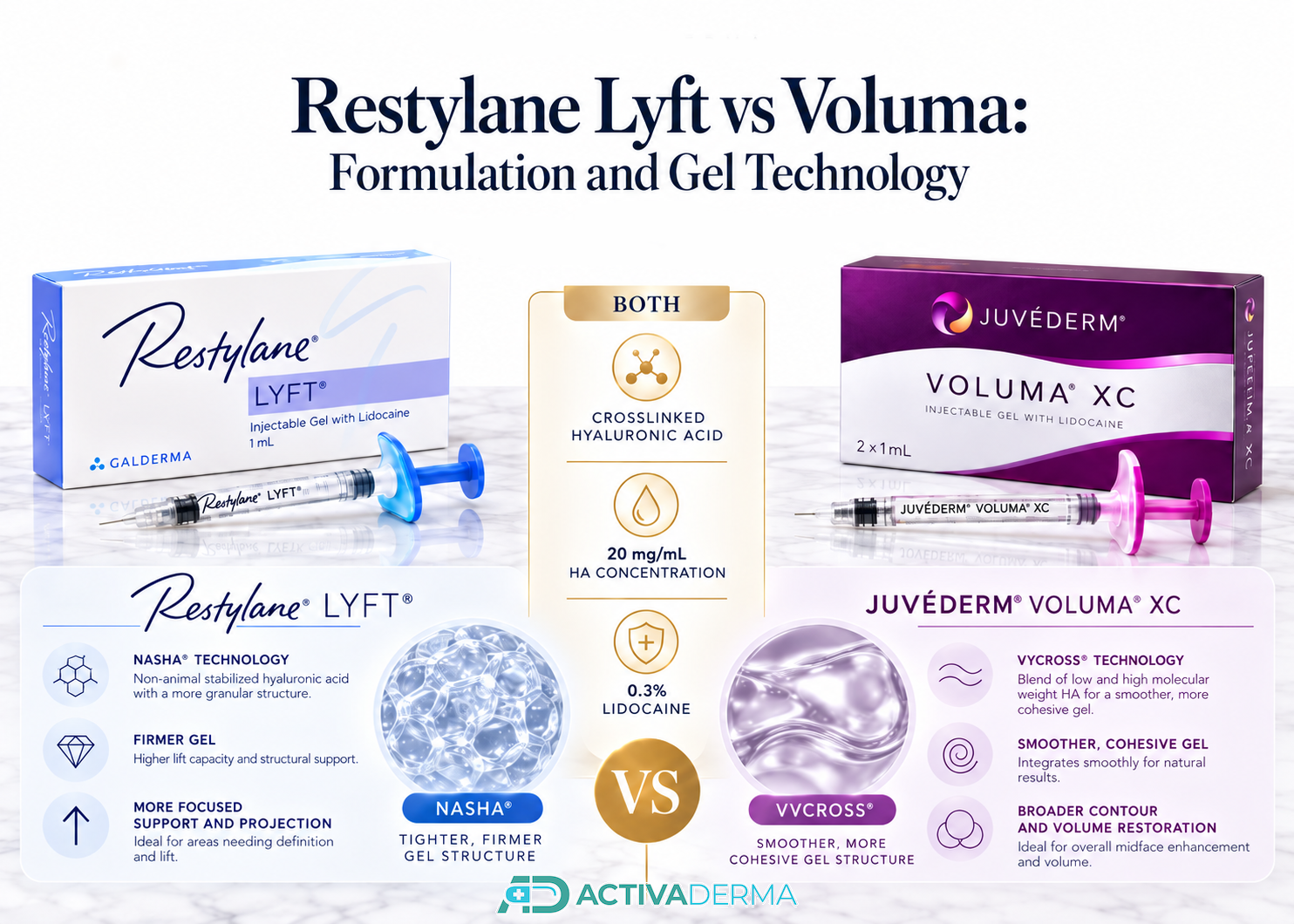
The concentration is the same, but the gel networks are not. Manufacturing, crosslinking, and HA chain size change how each product resists pressure, flows, and holds shape after injection.
Restylane Lyft: NASHA Technology
NASHA means Non-Animal Stabilized Hyaluronic Acid. The HA is made through bacterial fermentation and crosslinked with BDDE into a firm gel with limited chemical modification. In bench tests, Restylane Lyft is the firmer of the two. That resistance to deformation can help with precise placement and projection over bone.
Juvederm Voluma: Vycross Technology
Vycross combines roughly 90% low-molecular-weight HA with 10% high-molecular-weight HA, then crosslinks the chains with BDDE. The result is a smooth, cohesive 20 mg/mL gel built for deep contouring. It may feel smoother than Lyft, but it is not a thin gel. Juvederm Voluma has its own balance of firmness, spread, and tissue integration.
Why Gel Technology Matters
A firmer gel may hold projection well, while a cohesive gel can create a smooth transition across a broader area. Still, rheology does not choose the product by itself. Depth, tissue thickness, movement, volume loss, and the amount placed all affect palpability, spread, and contour. The best results still depend on anatomy and technique.
Restylane Lyft vs Voluma Rheology: What Should Practitioners Actually Compare?
Start with G prime, or G′, which describes resistance to deformation.
- Cohesivity describes how strongly the gel stays together, while viscosity relates to flow.
- Flexibility shows how well it tolerates repeated movement.
In two published analyses, Lyft measured about 545 to 855 Pa and Juvederm Voluma about 284 to 312 Pa for G′. The direction is consistent, but the exact values differ because rheology changes with the test method. It should guide, not replace, clinical judgment.
Restylane Lyft vs Voluma FDA-Approved Treatment Areas
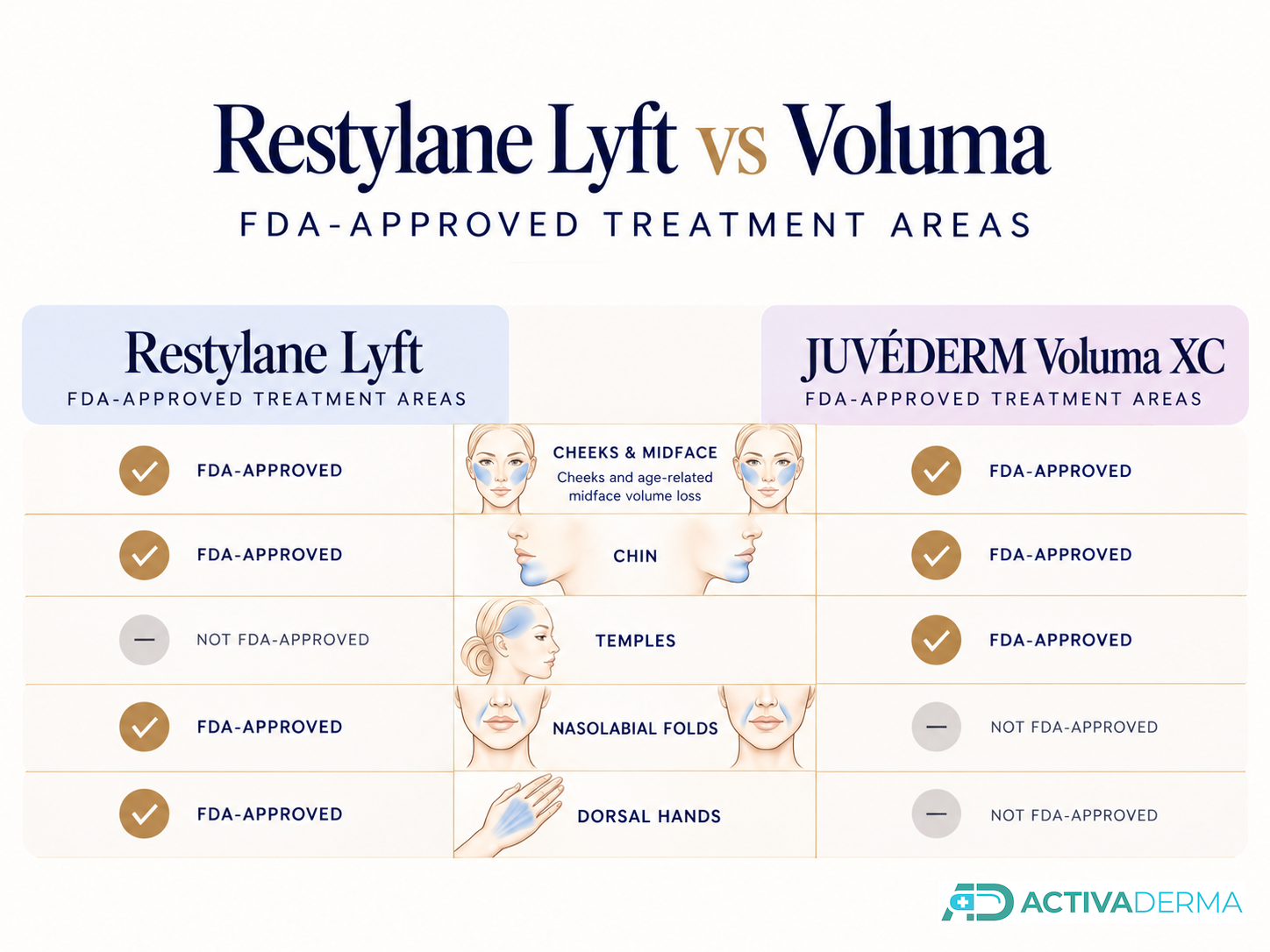
They have similar FDA-approved uses in the cheeks and chin, but the labels are not interchangeable. The current Restylane Lyft instructions and Voluma directions for use define the approved plane, area, and patient group.
|
Treatment area |
Restylane Lyft |
Juvederm Voluma |
|
Cheeks and age-related midface volume loss |
FDA approved, adults over 21 |
FDA approved, adults over 21 |
|
Chin |
FDA approved for mild to moderate retrusion, adults over 21 |
FDA approved to improve the chin profile, adults over 21 |
|
Temples |
Not FDA approved for this area |
FDA approved for moderate to severe hollowing, adults over 21 |
|
Nasolabial folds |
FDA approved for moderate to severe folds |
Not an approved Voluma indication |
|
Dorsal hands |
FDA approved for volume deficit, adults over 21 |
Not FDA approved for this area |
Restylane Lyft vs Voluma for Cheeks
Juvederm Voluma is the stronger choice when broad cheek restoration and the longest label-supported duration are the priorities. Its results can last up to 2 years with optimal treatment.
Prefer Restylane Lyft when the goal is firmer, focused cheek projection or sharper zygomatic definition.
Restylane Lyft vs Voluma for the Chin
Restylane Lyft gets a slight preference when a chin needs crisp projection. Its high-G′ gel is built for structure. Its 2025 FDA approval covers adults with mild to moderate chin retrusion, and 69.7% of study patients remained improved at 12 months.
Juvederm Voluma remains a strong option for smoother chin contour, with results lasting up to one year.
Restylane Lyft vs Voluma for Temples
Juvederm Voluma is the clear choice between these two for temples. It is the only one with a U.S. indication for moderate to severe temple hollowing, and its clinical program followed results through 13 months.
Restylane Lyft may be discussed off-label, but it does not have the same product-specific evidence or FDA approval for this area.
Restylane Lyft vs Voluma for Nasolabial Folds and Hands
Restylane Lyft is the better-supported option here. Its label covers moderate to severe facial folds, including nasolabial folds, and related volume loss in the dorsal hands. Benefits generally last about six months in both areas.
Juvederm Voluma is not approved for either use, so its cheek, chin, and temple evidence should not be carried into those treatment areas.
Restylane Lyft vs Voluma Results
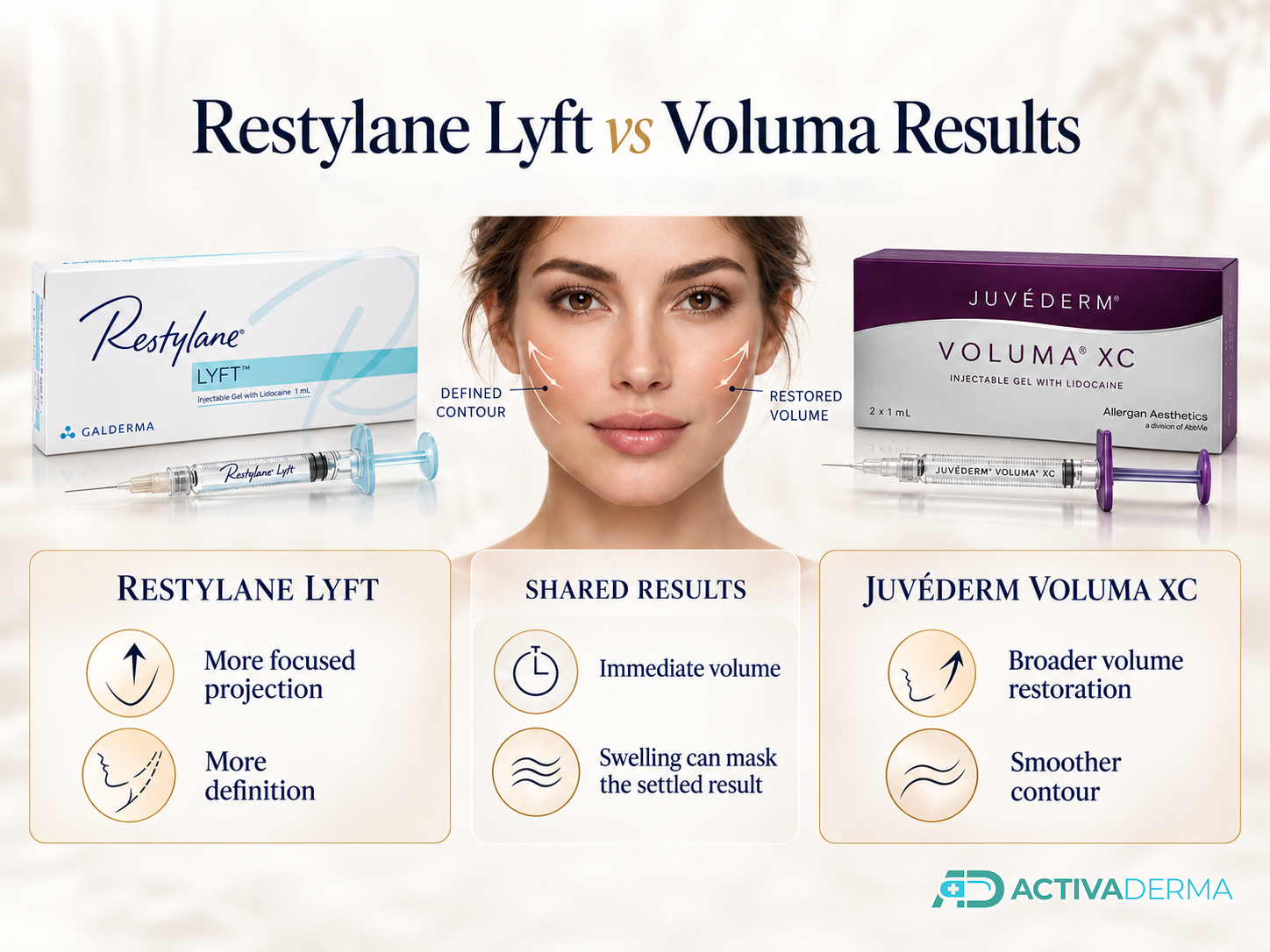
Both fillers add immediate volume, but swelling can hide the settled result.
- Lyft often creates more focused projection and definition.
- Juvederm Voluma often suits broader volume restoration and a smoother contour.
Either can support facial rejuvenation, but neither creates a surgical lift of the lower face.
Reassess after early swelling and tenderness resolve before adding more filler, especially in a single patient receiving treatment across several facial zones.
Which Lasts Longer: Restylane Lyft or Voluma?
Juvederm Voluma lasts longer in the cheeks based on manufacturer-supported data: up to 2 years versus up to 12 months for Lyft. In the chin, both have evidence through 12 months.
Actual longevity changes with the treatment area, dose, placement, baseline anatomy, age, patient biology, treatment goal, and maintenance plan.
Restylane Lyft vs Voluma Side Effects and Safety
Both have the usual risks of hyaluronic acid fillers. Most expected reactions begin at the injection site and settle as the tissue recovers.
- Expected reactions: Redness, swelling, bruising, tenderness, pain, firmness, itching, discoloration, and temporary lumps or bumps.
- Delayed problems: Inflammation, infection, nodules, or persistent swelling can appear later and need clinical review.
- Vascular events: Unintended injection into a vessel can cause tissue loss, vision changes, blindness, or stroke. Blanching, unusual pain, visual symptoms, or neurologic signs require immediate action.
Restylane Lyft vs Voluma: Which Patients May Suit Each?
The best results come from matching a specific product to the tissue problem, not from using one favorite filler throughout the face.
Consider Restylane Lyft When...
- Focused structural support or defined cheek projection is needed.
- Mild to moderate chin retrusion is the main concern.
- The treatment plan also includes approved correction of nasolabial folds or dorsal hands.
- The clinician knows NASHA well or the patient had a favorable result before.
- Broad cheek volume and a smooth midface contour matter most.
- The patient values cheek results supported for up to 2 years.
- The temples need an FDA-approved option.
- The practice knows Vycross technology or the patient has responded well before.
- The target is the lips, superficial fine lines, or under-eye hollows. Our lip filler guide explains why those areas call for different gel properties.
- Dedicated jawline definition is the goal.
- Thin, highly mobile tissue needs a softer or more flexible gel.
- Significant laxity or skeletal change calls for a different procedure rather than more volume.
Consider Juvederm Voluma When...
Consider Another Filler When...
Restylane Lyft vs Voluma for Practice Inventory
Price alone will not settle this choice because the difference is only $5.50 per syringe. We offer Restylane Lyft as one 1 mL syringe for $185, while Juvederm Voluma comes in a two-syringe pack for $359.
Lyft gives clinics more freedom when one syringe is enough. Voluma requires a larger upfront order, but its pack may fit broader cheek or midface treatments.
Always confirm local authorization and follow the instructions included with each EC-origin pack.
Restylane Lyft vs Voluma: Which Should You Choose?
Choose Restylane Lyft for focused structure and approved correction in the cheeks, chin, folds, and hands.
Choose Juvederm Voluma for smooth cheek or midface restoration, long cheek-duration evidence, or an approved temple treatment.
Each has unique benefits. We offer both Restylane Lyft and Juvederm Voluma. That gives your practice room to buy for the treatment plan instead of forcing every patient into one product.
FAQ
Is Restylane Lyft better than Voluma?
It is better for focused structure and for approved treatment of folds or hands. Juvederm Voluma is often better for broad cheek restoration, longer cheek duration, and temples. Anatomy and the desired result decide the winner.
Is Restylane Lyft good for cheeks?
Yes. It is FDA approved for cheek augmentation and age-related midface volume loss in adults over 21. Its firm NASHA gel is especially useful when projection and definition matter.
How long does Restylane Lyft last in the cheeks?
Its FDA-reviewed patient information says cheek benefits generally last from 2 to 12 months. Dose, placement, metabolism, baseline volume loss, and maintenance affect the lasting result.
Who is not a good candidate for Voluma?
Avoid it in patients with severe allergies, prior anaphylaxis, or allergy to lidocaine or its bacterial proteins. Postpone treatment over active infection or inflammation.
What's the difference between Restylane and Restylane Lyft?
Restylane is both a brand family and a specific HA filler. Restylane Lyft is a firmer NASHA product designed for deeper structural treatment, with approved uses that include cheeks, chin, folds, and dorsal hands.
Does Voluma lift the face?
It can restore midface volume and support the cheek contour, which may create a lifted look. It does not tighten loose skin or reproduce a surgical facelift.
Is Voluma worth the money?
Juvederm Voluma can be worth it when the patient needs cheek, chin, or temple volume and values its long cheek evidence. Judge value by the full correction plan and expected maintenance, not the cost of one syringe.
Which is better for cheeks, Juvederm or Restylane?
Compare specific products, not the two families. Juvederm Voluma often suits broad, smooth cheek volume with longer label-supported duration. Restylane Lyft often suits firmer projection and sharper cheek definition.