
8 Sunekos vs Profhilo Differences: Which Is Better?
Crepey under-eye skin, dull cheeks, and mild neck laxity may all be called skin-quality concerns, yet they need different kinds of support.
The Sunekos vs Profhilo decision starts with three details: whether the concern is local or diffuse, where it sits, and whether the patient wants softer lines, stronger hydration, or broader firmness.
Sunekos vs Profhilo at a Glance
The main difference is the ingredient strategy:
- Sunekos pairs hyaluronic acid with amino acids for targeted tissue-quality work.
- Profhilo uses stabilized high- and low-molecular-weight HA complexes for wider hydration and bioremodeling.
Important Notice: Neither family appears on the FDA's list of approved dermal fillers for U.S. cosmetic use.
|
|
Sunekos family |
Profhilo family |
|
Core formulation |
Non-cross-linked hyaluronic acid plus a patented blend of six amino acids |
Thermally stabilized complexes of high- and low-molecular-weight hyaluronic acid |
|
Primary positioning |
Targeted extracellular matrix and tissue-quality support |
Broad bioremodeling, hydration, and firmness |
|
Main practitioner goal |
Improve fine lines, crepey texture, and fragile skin |
Improve diffuse dehydration and mild laxity |
|
Commonly discussed areas |
Face, periocular skin, neck, decolletage, hands, and selected body areas |
Face, neck, decolletage, selected body areas, and deeper facial tissue |
|
Best suited to |
Localized or delicate skin concerns |
Broader areas needing more global improvement |
|
Volumizing filler? |
Not primarily; the family focuses on skin quality, with mild volume support in some formulations |
Not primarily; the family focuses on bioremodeling, with structural support in some formulations |
|
Typical initial course |
Commonly 3 to 4 sessions, usually 1 to 2 weeks apart |
Commonly 2 sessions, usually about 4 weeks apart |
|
U.S. regulatory status |
No FDA-approved cosmetic indication |
No FDA-approved cosmetic indication |
What Is Sunekos?
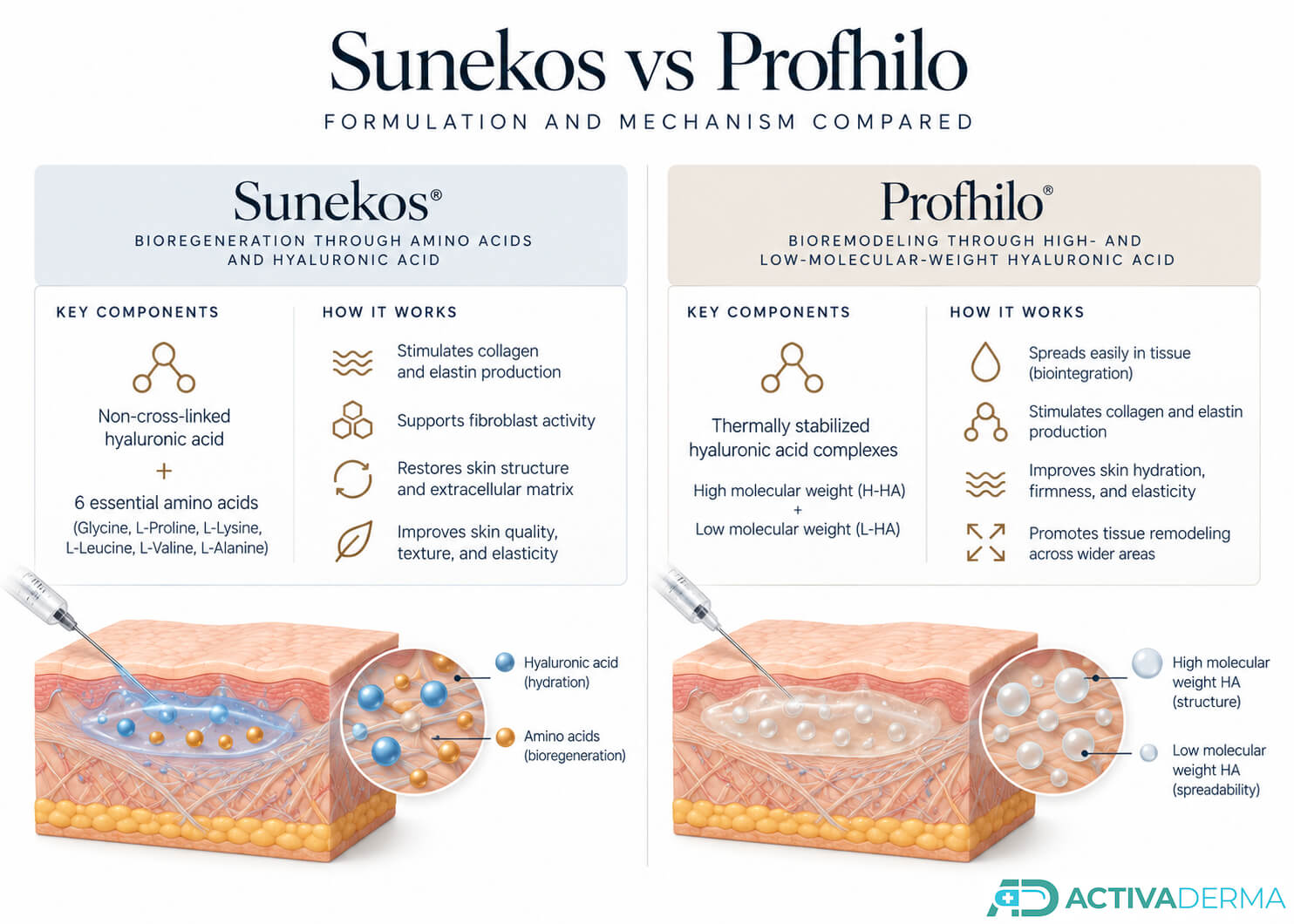
It is an injectable treatment family that combines non-cross-linked hyaluronic acid with six amino acids: glycine, proline, lysine, leucine, valine, and alanine.
Hyaluronic acid binds water, while the HY6AA blend supplies components used within the extracellular matrix. The goal is improved skin texture, hydration, and elasticity without the projection of a contouring filler.
As a skin booster, Sunekos goes beyond one formula or treatment area. Each formulation differs, but the family shares a tissue-quality focus and is intended to support fibroblast activity. It’s for patients seeking fresher, smoother skin rather than a new facial shape.
What Is Profhilo?
Profhilo is also an injectable treatment family, but built around stable hybrid cooperative complexes of hyaluronic acid. It uses high- and low-molecular-weight hyaluronic acid stabilized with heat through NAHYCO technology, without BDDE or another chemical cross-linker. The result spreads more broadly through tissue than a firm filler gel.
The appeal of Profhilo lies in this distribution. It primarily focuses on hydration, skin elasticity, and bioremodeling rather than filling one wrinkle or sculpting a cheek. Concentration, depth, and structural effect differ within the family, so providers should consult the selected formulation's current local instructions.
Sunekos vs Profhilo: Formulation and Mechanism Compared
Both use hyaluronic acid, yet their supporting components and tissue behavior point toward different goals.
Sunekos: HA Plus Amino Acids
Sunekos combines hyaluronic acid with HY6AA, a mix of six amino acids designed to support hydration and fibroblast activity involved in collagen and elastin production.
A 2026 systematic review of 11 studies found significant improvements in wrinkle severity, overall aesthetic scores, dermal thickness, and cell viability. However, the authors noted that larger prospective studies are still needed.
For clinicians, Sunekos is most relevant when fine lines or crepey skin matter more than facial contour.
Profhilo: Hybrid HA Complexes
Profhilo provides a high concentration of high- and low-molecular-weight HA in thermally stabilized complexes.
A peer-reviewed description of NAHYCO technology explains that heat, not a chemical cross-linker, stabilizes both fractions.
Its low viscosity supports broad distribution, deep hydration, improved elasticity, and gradual remodeling across an area rather than precise line filling.
Why the Difference Matters
Formulation changes the expected result.
- Sunekos works well for a focused concern, such as crepey periocular tissue.
- Profhilo offers wider spread for diffuse dehydration or mild skin laxity.
This affects the suitable area, visit count, and likely results. The right choice follows anatomy and the desired outcome, not brand recognition.
Sunekos vs Profhilo: Which Is Better for Different Patient Concerns?
The right choice depends on the type and location of the skin concern.
Sunekos may suit focused areas with fine lines, crepey skin, or thin tissue. Profhilo may suit wider areas affected by dehydration, dullness, reduced elasticity, or mild skin laxity.
These are practical differences in how the treatments have been studied and used, not proof that one is superior. Direct comparison evidence remains limited, so patient anatomy and the desired result still guide the treatment plan.
Both aim to improve skin quality without obvious filler volume. However, neither is designed to correct deep folds, major volume loss, or advanced sagging skin.
Sunekos vs Profhilo for the Under-Eye Area
Under-eye treatment starts with identifying the actual problem, not choosing a brand.
Sunekos may be considered when thin, crepey skin and fine lines are the main concerns, especially when the goal is to improve skin quality without adding volume.
One open-label study followed 22 women aged 30 to 65 through three sessions spaced 15 days apart. However, it tested one Sunekos formulation without a control group or Profhilo comparison, so it cannot show that Sunekos works better.
Profhilo is generally used for wider hydration across the face rather than focused tear-trough correction. More importantly, neither treatment should be chosen before ruling out swelling, pigmentation, fat prolapse, or true hollowing. These concerns may all look like “tired eyes,” but they need different treatment plans.
Sunekos vs Profhilo by Treatment Area
The choice changes as the treatment area becomes larger. Sunekos fits precise work around the eyes, on fine neck creases, or in other small areas with thin or fragile skin. Its more focused approach also gives clinicians greater control when one patch of skin needs attention.
Profhilo earns its place when dehydration or mild skin laxity covers a wider area, such as the cheeks, lower face, neck, decolletage, or body. Its hyaluronic acid complexes spread more broadly, which supports overall skin hydration rather than one small line.
On the neck, for example, Sunekos may better suit individual creases, while Profhilo may be the stronger choice for general dryness and laxity.
Sunekos vs Profhilo Treatment Courses
The visit count is one of the clearest practical differences, although no schedule applies to every formulation or treatment area.
Typical Sunekos Treatment Course
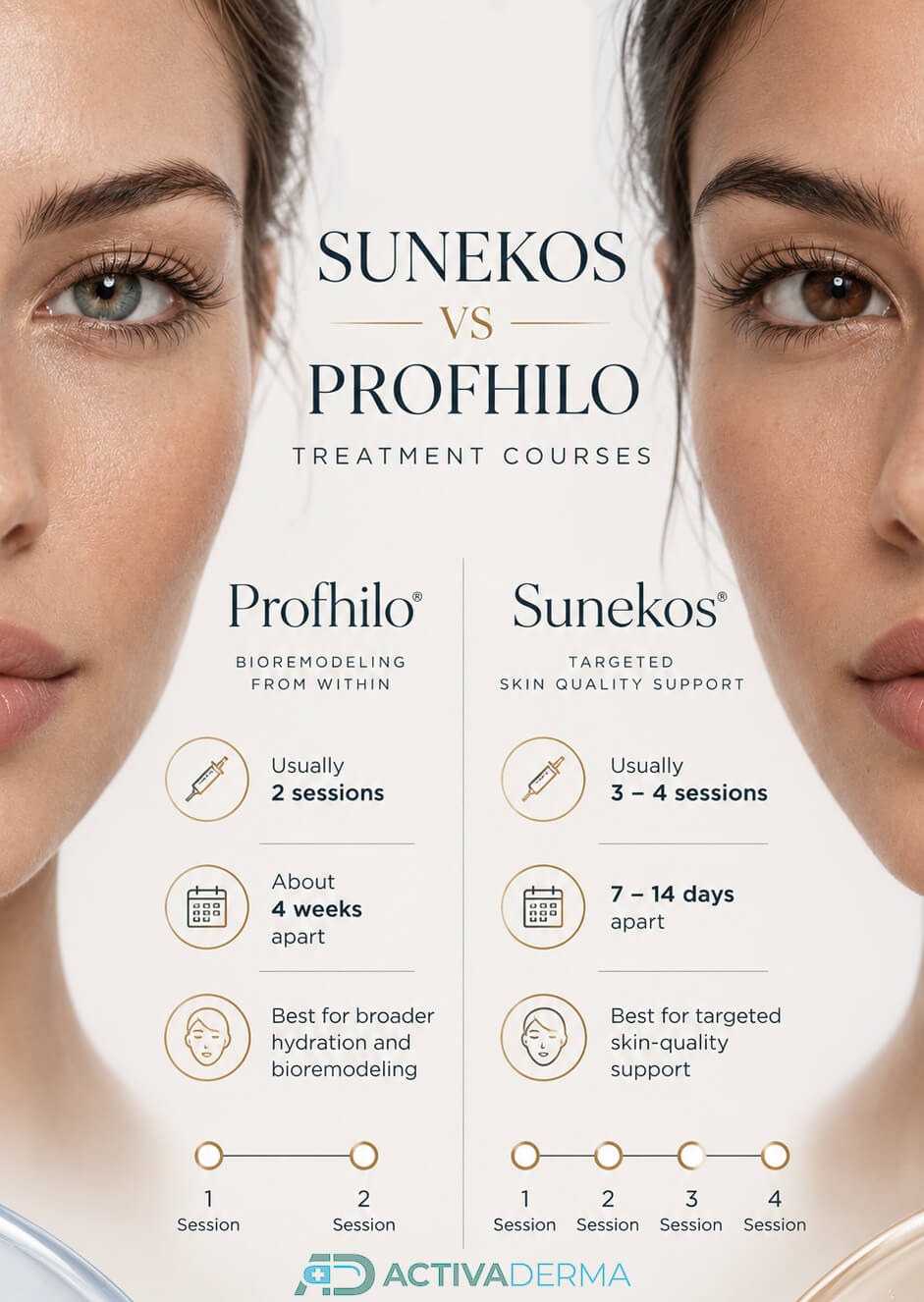
Protocols commonly use 3 to 4 sessions spaced 7 to 14 days apart. One official algorithm uses four sessions at 7- to 10-day intervals, while its periocular course uses three sessions two weeks apart.
Formulation, area, and baseline quality can change the schedule. One Sunekos benefit is progress checked across several visits, though patients must accept extra appointments.
Typical Profhilo Treatment Course
Most studied facial Profhilo treatments use two sessions about 30 days apart. In a 64-woman open-label study, participants received 2 mL at baseline and another 2 mL four weeks later. Profhilo requires fewer initial visits in this pattern, which may help adherence.
Other formulations use different volumes, points, and maintenance plans, so current local instructions remain controlling.
Sunekos vs Profhilo Results: What Should Practitioners Expect?
Both families aim to improve overall skin quality rather than change facial shape. Natural-looking results build across the initial course.
- Hydration: Both bind water through hyaluronic acid. Sunekos adds tissue support, while Profhilo provides wider-spread skin hydration.
- Fine lines and texture: Sunekos targets fine lines and crepey areas. Profhilo may soften texture over a broader zone.
- Elasticity and firmness: Both aim to stimulate collagen and elastin production.
- Volume and contour: Neither family replaces structural filler. Some formulations offer mild support, but they will not rebuild a cheek or pull loose skin tight.
How Long Do Sunekos and Profhilo Results Last?
Expect months, not years.
An open-label Sunekos study followed improvements through six months, while an open-label Profhilo study followed outcomes for 16 weeks.
About 4 to 6 months after a completed treatment course is a practical planning range, not a guarantee.
Longevity depends on formulation, area, baseline condition, age, sun exposure, biology, and maintenance. Photograph and grade the same concern at baseline and follow-up instead of repeating treatment by calendar alone.
Sunekos vs Profhilo Side Effects and Downtime
- Redness, swelling, tenderness, bruising, and temporary bumps are common and usually brief.
- Periocular swelling is more visible than a small hand or neck reaction, and thin tissue shows bruising more easily.
- Infection, nodules, hypersensitivity reactions, and vascular injury are important complications that require prompt clinical assessment.
Sunekos vs Profhilo: Which Patients Should You Choose for Each?
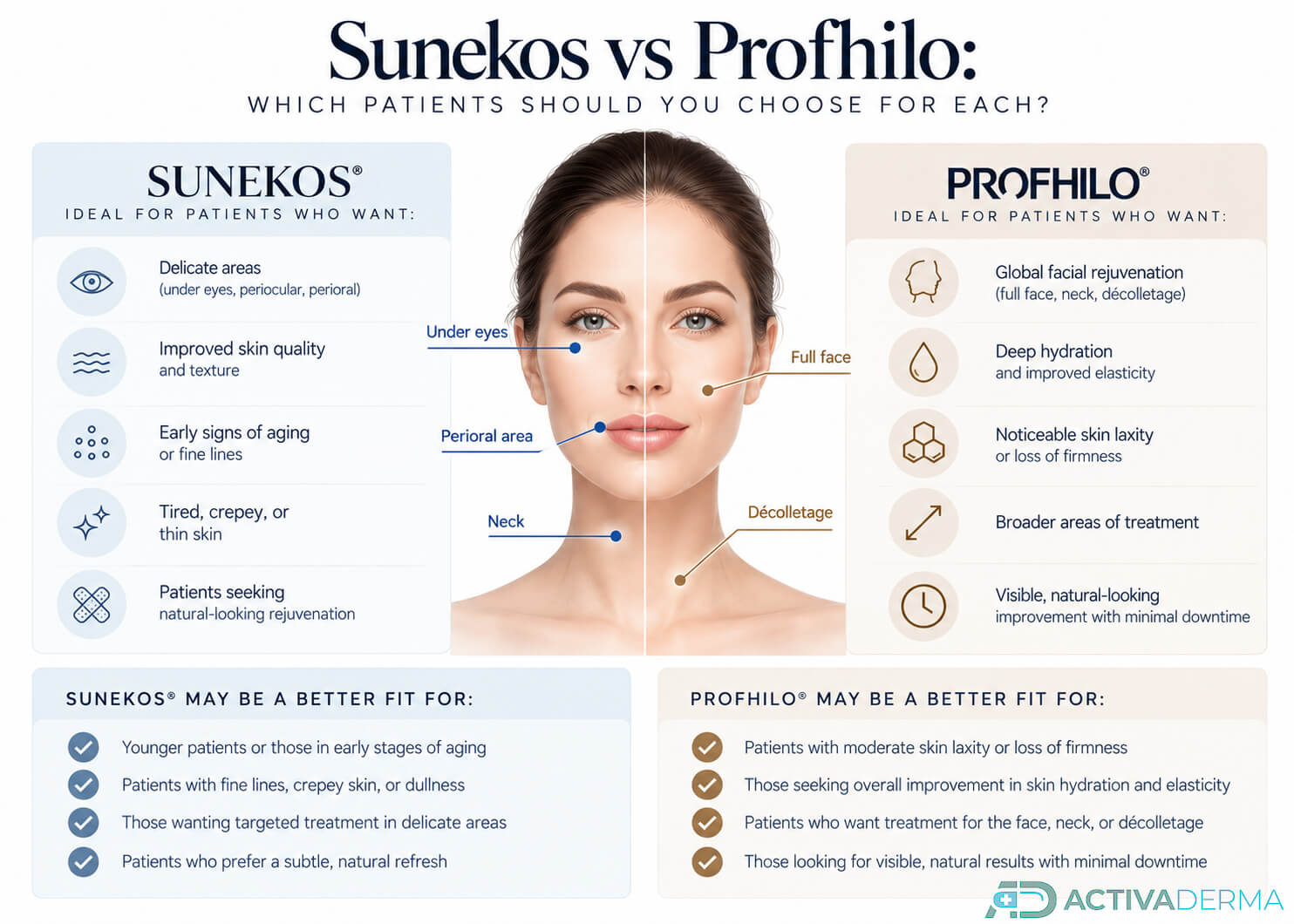
Start with one measurable concern. “I want better skin” needs an area, finding, and expected effect.
Consider Sunekos When...
Patients want localized fine lines, crepey texture, or thin, fragile tissue without traditional volumization. It’s more for patients who accept more frequent visits and want better texture rather than a new facial outline. It may also fit under-eye work after edema and structural hollowing are ruled out.
Consider Profhilo When...
Dehydration or mild laxity covers a wider area, and the patient wants global improvement or intense hydration. Profhilo helps improve overall skin health and firmness without filler-like projection. It may be the better choice when fewer initial visits matter, though results still develop gradually.
Can Sunekos and Profhilo Be Used Together?
Yes. Sunekos and Profhilo can be included in the same treatment plan when they address different skin concerns. Profhilo may improve broad skin hydration and mild laxity, while Sunekos can target fine lines or a small area of crepey skin.
Keep them as separate injectable treatments and never mix them in the same syringe. After the first skin booster treatment, reassess the results before deciding when and where to use the second.
Sunekos vs Profhilo: Cost and Practice Considerations
Acquisition cost is only the start.
At Activa Derma, we offer four Sunekos options priced from $139 to $189 and three Profhilo options priced from $175 to $359. This gives clinics room to match the skin booster with the treatment area, patient concern, and budget.
Look beyond the price of one unit when calculating treatment costs. Sunekos often requires three or four initial visits, while Profhilo commonly starts with two. Chair time, consumables, maintenance, and follow-up appointments all affect profitability.
The better choice should also complement your current filler and toxin services instead of repeating a treatment you already offer.
Sunekos vs Profhilo: Which Is Better?
Sunekos is often better for targeted fine lines and fragile tissue. Profhilo is often better for broad dehydration, mild laxity, and fewer initial visits. Match the hyaluronic acid treatment with the anatomy, area, and desired results.
Build a clearer skin rejuvenation menu by comparing our Sunekos range and Profhilo range, then give every formulation one well-defined clinical purpose.
FAQ
What is the main difference between Sunekos and Profhilo?
Sunekos adds six amino acids to HA for targeted tissue-quality support. Profhilo uses stabilized high- and low-molecular-weight HA for broader hydration and bioremodeling.
Is Sunekos better than Profhilo?
Only for the right concern. Sunekos favors localized fine lines and crepey tissue; Profhilo favors diffuse dehydration and mild laxity.
How long do Sunekos results last?
Improvement commonly lasts about six months after a completed course. Age, area, sun exposure, biology, and maintenance can shorten or extend it.
Does Profhilo change your face shape?
Usually not. Profhilo primarily focuses on hydration, elasticity, and tissue quality rather than building a new cheek or jaw contour.
What is the best skin booster for mature skin?
The amino-acid family may suit thin, crepey mature tissue; the hybrid-HA family may suit broad dehydration and mild laxity. Major volume loss needs another approach.
Does Profhilo tighten skin?
It can improve firmness in mild laxity, but it cannot create a surgical lift. Advanced laxity needs another plan.
What are the downsides of Profhilo?
Bumps, swelling, bruising, and cost. Profhilo skin results are subtle, so the treatment cannot replace filler or surgery for major lift or contour.
What are the benefits of using Sunekos?
It pairs hydration with amino-acid-supported tissue work, targets delicate areas, and improves quality without obvious volume. Treatment results are gradual, with minimal downtime.